Sign in. It’s quick, free and it’s up to you.
An account is an optional way to support the work we do. Find out more.
Sign in. It’s quick, free and it’s up to you.
An account is an optional way to support the work we do. Find out more.
(Seo alt ónár bhfoireann nua Gaeltachta. Is féidir an bunleagan as Gaeilge a léamh anseo.)
IT WILL TAKE more than 100 years for young people in the Gaeltacht to buy a house if the current rate of house building in areas where Irish is the daily language continues.
That’s according to a submission made by Conradh na Gaeilge to the consultation process on ‘Our Rural Future’.
Irish language organisations such as Conradh have contended that while young people throughout the country are facing huge challenges to owning or renting their own home, the situation in Gaeltacht communities is even more acute.
To address this, the advocacy organisation for the Irish language and Gaeltacht community is proposing that the Gaeltacht be included in the Living Cities scheme – a scheme under which participants receive a tax credit up to €200,000 over five years to encourage them to buy or build houses in the Gaeltacht.
This would be facilitated by extending the Living Cities scheme, which offers the same €200k tax break for people to move into city centres, to all the Gaeltacht areas and off shore islands.
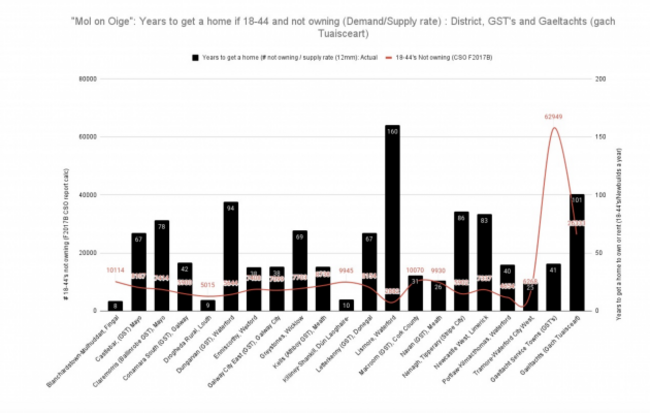
The Conradh na Gaeilge submission suggests it will take 101 years for young people – people aged 18-44 – to find a home in the Gaeltacht and less than half that, 41 years, to find a home in a Gaeltacht service town.
Gaeltacht service towns are towns such as An Daingean, Galway and Letterkenny – generally towns in or adjacent to the Gaeltacht.
The figures are based on an analysis of the actual supply and delivery of houses measured against the number not owning a house. It doesn’t relate to income or affordability and relates to the overall building and delivery of homes, including social and affordable homes.
According to the 2022 census figures, there are 62,949 people aged 18-44 who do not own or rent a home in Gaeltacht service towns, and 26,333 in the Gaeltacht proper.
This report sets out the analysis of housing needs in the Gaeltacht for the next ten years.
“To achieve the EU average housing target; assuming 50 houses for every 100 people by 2034, this means that 13,000 houses are needed in the Gaeltacht by 2034: 1,300 houses per year over 10 years,” the submission states.
“If we continue to maintain a 30% growth in jobs over the next 10 years, a further 18,500 houses would be needed for 37,000 new jobs; 1,850 houses per year. 13,000 + 18,500 = demand for 31,500 houses over the next 10 years; an average of 3,150 per year.”
These figures are based on an analysis of the 2022 Census and the targets set out in the Government’s own National Planning Framework. The submission also acknowledges that this information is contained in a report commissioned by Gaeltacht development agency, Údarás na Gaeltachta, from a Waterford based company, Irish Sustainable Homes, which has been involved in major housing developments in Ireland and overseas.
According to the analysis cited by Conradh na Gaeilge in its submission and in the report by Irish Sustainable Homes to Údarás na Gaeltachta, there are only a handful of areas in the electoral divisions in the country where housing supply is anywhere near adequate.
These are Mulhuddart and Blanchardstown in Fingal in Dublin where over 10,000 people aged 18-44 living in the area have been waiting for 8 years, Drogheda (Rural) where the 5,015 young people will be waiting nine years for a house.
In Killiney/Shankill in Dublin, 9,945 young people will have to wait 10 years and in Tramore/West Waterford city, the 9,930 people aged 18-44 will have to wait twenty-six years for their home.
Conradh’s submission includes a number of proposals to address the housing shortage in Gaeltacht areas, a problem that the organisation links to a challenge to the viability of the Gaeltacht. This submission follows a recent report issued by Tuismitheoirí na Gaeltachta which indicated that there had been a slight decrease in the number of families in the Gaeltacht raising their children through Irish.
As well as recommending that a tax credit of up to €200,000 over five years be made available to young people to attract young people who have left Gaeltacht areas back, it is also recommended that there be collaboration with the Department of Housing and the Department of Finance to provide a tax credit for young people currently living in the Gaeltacht.
The submission states that these young people should have spoken Irish at standard B2 according to the Common European Framework of Reference. This is equivalent to the level of the Leaving Cert.
It argues that there has been a significant under-supply in Gaeltacht areas over the last decade and projects that a failure to meet the demand that exists currently over the next demand will stifle the growth of Gaeltacht communities. The submission estimates that had the demand over the past ten years been met, there would be an additional 37,000 children (aged 0-9 years) in Gaeltacht communities now. This figure is based on two children per home.
The Gaeltacht service towns are towns such as An Daingean in Corca Dhuibhne, Galway near Connemara and Letterkenny in Donegal. The legislation intends that services through Irish would be available to the Gaeltacht community. There are a number of towns such as Macroom in Co. Cork that have been designated as Gaeltacht service towns but their status has not yet been confirmed.
Among other measures proposed in the submission, Conradh na Gaeilge is calling for the publication of a National Planning Statement for Housing in the Gaeltacht, which has been promised since early 2021. Many, including Conradh na Gaeilge, were disappointed when the Housing Plan published this month indicated that it would now not be published until the first half of 2027.
The deadline for submissions to the consultation process on ‘Our Rural Future’ was this Friday and the process began in March. The aim of the process is to prepare the next edition of the policy, Our Rural Future, which is being prepared by the Minister for Rural, Community and Gaeltacht Development, Dara Calleary.
The Journal’s Gaeltacht initiative is supported by the Local Democracy Reporting Scheme

To embed this post, copy the code below on your site












have your say