Sign in. It’s quick, free and it’s up to you.
An account is an optional way to support the work we do. Find out more.
Sign in. It’s quick, free and it’s up to you.
An account is an optional way to support the work we do. Find out more.
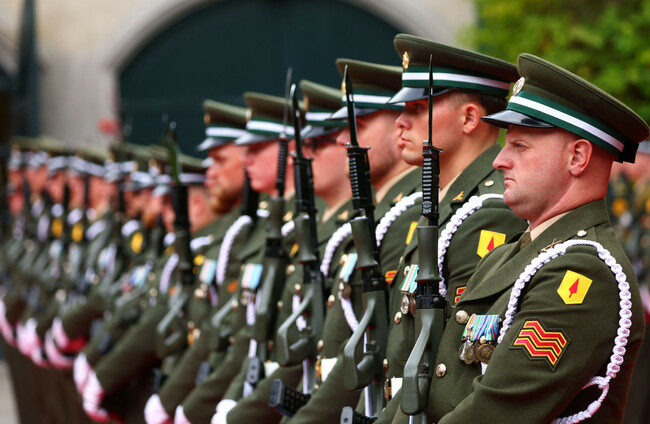
IRELAND IS MISSING out on the economic benefits of Europe’s massive increase in defence spending because it does not have a significant defence industry, Minister of State for European Affairs and Defence Thomas Byrne has said.
Byrne said the government is now changing legislation and introducing a security clearance system in an effort to allow more Irish companies to compete for European defence work.
His comments come after the government was warned earlier this year that Ireland could indirectly contribute billions towards increased European defence spending through its EU contributions while receiving relatively little economic benefit in return.
A briefing presented to government bodies warned that Ireland risked “losing on one hand and losing on the other” as increased defence spending coincided with pressure on agricultural funding in negotiations over the EU’s next long-term budget.
The presentation estimated that Ireland could contribute €7.3 billion towards defence-related spending over the 2028-2034 budgetary period.
Asked by The Journal in Strasbourg whether that remained a risk, Byrne declined to endorse the figure.
“I’m not going to go into figures like that because some of these figures can be bandied about,” he said.
However, Byrne acknowledged the broader concern.
He said Irish businesses have traditionally benefited when European countries increase spending on infrastructure and other major projects.
“That’s not the case with defence spending, because we don’t have a defence industry of any significance,” Byrne said.
He said there are Irish companies operating in the sector and that the government is trying to increase their involvement so that “there’s an economic benefit back” to Ireland.
Byrne said the government is changing legislation to allow Enterprise Ireland to advise companies in the defence sphere, while a new security clearance system will allow Irish companies to participate in European consortiums competing for defence contracts.
“This is not necessarily about missiles,” he said, pointing to areas such as drone technology and other high-tech industries.
Byrne said Ireland currently does not feature heavily when European countries spend on defence.
“That’s definitely a concern,” Byrne added.
Byrne also strongly rejected suggestions that Ireland’s European partners are putting pressure on the government to abandon its policy of military neutrality.
“There is literally zero pressure on neutrality. They don’t care, and they accept it,” he said.
Byrne stressed that the increased defence spending targets agreed by Nato members do not apply to Ireland.
“The new targets of three-and-a-half per cent plus one-and-a-half per cent, they’re NATO targets, and we’re not part of NATO, so we’re not bound by them, and nobody’s ever suggested that we should be bound by them.”
Ireland has nevertheless substantially increased its own defence budget in recent years, with the government aiming to bring annual defence spending to €1.5 billion by 2028.
Byrne said European countries do, however, sometimes question what contribution Ireland is making to their wider security.
He recalled a Latvian parliamentarian asking him: “What are you doing to protect our cables?”
Byrne said the question was not confrontational but reflected the security concerns of countries on Europe’s eastern flank.
He said Baltic countries have a “real visceral fear” of Russia, pointing to incursions and disruption in the region and the direct family experience many politicians there have of Soviet repression.
“They do feel that they need solidarity,” Byrne said.

To embed this post, copy the code below on your site














have your say