We need your help now

Support from readers like you keeps The Journal open.

You are visiting us because we have something you value. Independent, unbiased news that tells the truth. Advertising revenue goes some way to support our mission, but this year it has not been enough.

If you've seen value in our reporting, please contribute what you can, so we can continue to produce accurate and meaningful journalism. For everyone who needs it.

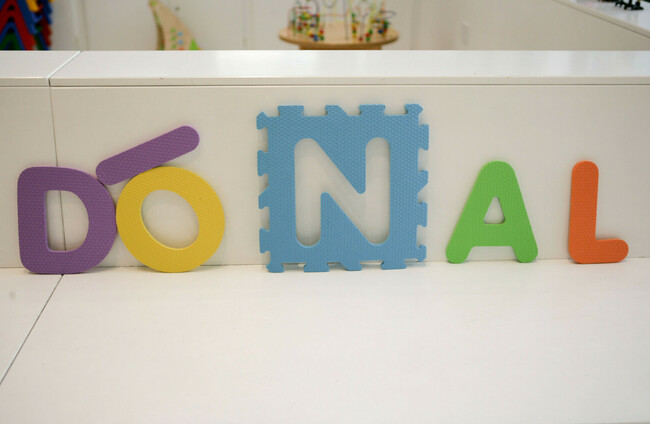
The days of lack of facilitation of the síneadh fada may be numbered, due to a Belgian court ruling on GDPR, and imminent legislation. Alamy Stock Photo

Irish speakers have long pushed for the use of the fada to be guaranteed - it may happen soon

A long running grievance that Irish bodies, such as the HSE, banks and Aer Lingus, do not facilitate the use of the síneadh fada looks like it’s coming to a head.

(Alt é seo ónár bhfoireann Gaeltachta.  Is féidir leat an bunleagan as Gaeilge a léamh anseo.)

IT’S A LONG story but now, at last, it seems that there’s hope for a satisfactory ending.  The ‘sineadh fada’ or length accent diacritic mark which is used to elongate or enhance the sound of vowels in the Irish language has long been the cause of consternation for some companies operating online forms and databases while the failure to include them, thus leading to misspelled names,  has vexed Irish speakers. 

The síneadh fada/diacritic mark is no trivial matter in linguistic terms.  This small mark can be the difference, for instance, between a slice of delicious cake, cáca, or what you have to pick up after your dog does his business, caca. 

In legal terms, while legislation is in place to protect the síneadh fada, the relevant order has yet to be signed into law.

Sinn Féin TD Aengus Ó Snodaigh has brought a Bill before the Dáil to provide legal protection for the síneadh fada as it used in the names of people and there is also a possibility — arising from a precedent set by a case in Belgium —  that the matter could be resolved when that precedent is implemented in cases which are currently being brought by Irish language activists.

Resented and challenged

The inability of different public bodies within the State, as well as several other well known companies to cope with the ‘síneadh fada’ within their systems has long been resented  and challenged by Irish speakers, given the status of Irish as the official language according the Constitution.

Now, however, a number of cases being considered by the Data Protection Commission may, due to a ruling in a Belgian court on the issue of diacritical marks, lead to a legal obligation to correctly record names while legislation is also being considered by the Dáil which would have the same effect. 

The most high profile hallenge to the State’s footdragging on the síneadh fada came almost ten years ago when Gaeltacht filmmaker Ciarán Ó Cofaigh was in hospital and discovered that this own name was being misspelled on his medical charts.   He felt it was an infringement of his rights and sought rectification under Article 16 of the General Data Protection Regulation(GDPR). 

“They are a central, functional element of a person’s proper name,” he said at the time. “My name without a fada isn’t my name.”

While ill, Ó Cofaigh initiated a case against the Health Service Executive on the grounds that the sínte fada in his name were not reflected in his record on its computer system. 

Under  Article 16 of GDPR, a person can request that an authority which holds data relating to them correct that data where it is inaccurate.

Ó Cofaigh made a complaint to the Data Protection Commission (DPC) in Ireland, but the ruling made by the DPC was that there had been no interference with his fundamental rights.

Cost cited as factor

When contacted by The Journal, the DPC gave an explanation of the ruling in the case by providing a link to a case study document.  The ruling referred to the cost that would fall on the HSE to update the organisation’s computer system to accommodate sínte fada.

“The DPC has a number of ongoing cases for this type of complaint. We can not comment on the specifics of these complaints,” a spokesperson for the body said.

Reference was also made in the ruling to cases across Europe, and while organisations that hold personal data under their control are required to be ‘reasonably careful’ in handling it, it was ruled that the right of rectification under Article 16 of the GDPR is not an absolute right.

Speaking to The Journal this week, Ó Cofaigh said he had received no satisfaction on the matter at the time or since. He explained that he had been in hospital when he initiated his case and that he was still suffering from the same illness, meaning he did not have deep enough pockets to pursue the case continuously.

“They made a decision but the decision was weak in my opinion,” he said. “They were really trying to get rid of it — they didn’t want to be dealing with it.”

He holds the same position still, seven years on.

Nothing has changed and I am still of the opinion that my data should be corrected when it is inaccurate under Article 16 of the GDPR, the right of rectification.

“That has not been provided for, they did not agree with me, and there are plenty of politicians who say I am right but there was no support to be had from them.

“I have health issues with cancer — I am at stage four of prostate cancer — and, honestly, there was only so much I was able to do.

“I tried to pursue the legal route but, of course, deep pockets are needed for that, and some of the organisations that said they would support me, when push came to shove, instead of giving full support, were giving a little bit of support.”

The use of the síneadh fada causes issues for some companies offering online booking systems.

lt is not possible to book a flight with Aer Lingus using a name with sínte fada, though it is worth noting that other airlines — such as British Airways — can accommodate this. There are also difficulties with accounts and names containing sínte fada at various banks.

Apology from Aer Lingus 

In response to an inquiry from The Journal, a spokesperson on behalf of Aer Lingus said that the airline’s current reservation system, Astral, does not allow customers to use sínte fada as it was developed in the late 1960s on a platform that cannot accommodate such characters.

“We recognise the limitations of the system in terms of accepting special characters and we apologise to customers for any inconvenience that results from this,” said the spokesperson, explaining that this does not affect a customer’s ability to travel with Aer Lingus.

As future systems are being developed, we are weighing reasonable steps to put in place to address this issue.

While the DPC ruled that there was no interference in fundamental rights in the case brought by Ó Cofaigh, there are signs that a similar ruling might not be possible in court cases which are coming down the tracks.

A court in Belgium has ruled that a bank customer had the right to have their name, which included diacritic marks, spelled correctly by the bank’s computer systems.

That 2019 ruling stated that the bank was not entitled to refrain from adapting its computer system to accept diacritical marks — such as the síneadh fada or the umlaut — even if significant cost and many hours of work would be involved in doing so. This court court adjudication stands in contrast to the determination by the DPC in the case brought by Ó Cofaigh in Ireland. 

Sineadh Fada Bill before the Dáil

It is Sinn Féin TD Aengus Ó Snodaigh who is bringing the Bill before the Dáil, and the Official Languages (Amendment) Bill 2026 has now reached the second stage of the legislative process.

This is a Bill that would amend the Official Languages Act 2003, the Data Protection Act 2018 and the Communications Regulation Act 2011 if enacted.

The Data Protection Act is the primary legislation that Ó Snodaigh wishes to amend. Under Section 92, subsection 17: “for the purposes of this section, personal data are inaccurate if (a) they are incorrect or misleading as to any matter of fact, or (b) they are incomplete in a material manner.”

The amendment proposed by Ó Snodaigh would add the following to that subsection: “or (c) if they include an inaccurate rendering of the name or address of a data subject including but not limited to where a name or address in the Irish language omits a síneadh fada on a vowel or has been Anglicised, whether in part or in full, unless requested by the data subject.”

The text is in English because, as with many Acts passed by the Oireachtas, no Irish language version of the Data Protection Act 2018 is available.

Recently in the Dáil, Ó Snodaigh asked the Gaeltacht Minister, Dara Calleary when he would be signing a regulation that would place an obligation on public bodies “regarding the recording and correct use of people’s names with sínte fada.”

In his response, Calleary said he hoped “to make an announcement shortly that the consultation on the draft language standards has commenced.”

Consultation process ‘later this year’

He said that consultations with the relevant Government departments would follow and, in short, that a consultation process would be getting underway later this year.

The Minister’s response suggests that a resolution to this problem is unlikely during 2026 — and even when the regulation is eventually signed, it will have no bearing on private companies such as Aer Lingus.

Given that GDPR is a European Union regulation, there is a strong argument that the Belgian case will be used as a precedent in the cases that are pending in Ireland on this issue, and time will tell whether they will end up before the courts before a resolution comes from the Houses of the Oireachtas.

It seems like that an end may be in sight for the this particular scéal fada. 

The Journal’s Gaeltacht initiative is supported by the Local Democracy Reporting Scheme

Readers like you are keeping these stories free for everyone...
A mix of advertising and supporting contributions helps keep paywalls away from valuable information like this article. Over 5,000 readers like you have already stepped up and support us with a monthly payment or a once-off donation.

Close
Comments
This is YOUR comments community. Stay civil, stay constructive, stay on topic. Please familiarise yourself with our comments policy here before taking part.
Leave a Comment
    Submit a report
    Please help us understand how this comment violates our community guidelines.
    Thank you for the feedback
    Your feedback has been sent to our team for review.

    Leave a commentcancel

     
    JournalTv
    News in 60 seconds