We need your help now

Support from readers like you keeps The Journal open.

You are visiting us because we have something you value. Independent, unbiased news that tells the truth. Advertising revenue goes some way to support our mission, but this year it has not been enough.

If you've seen value in our reporting, please contribute what you can, so we can continue to produce accurate and meaningful journalism. For everyone who needs it.

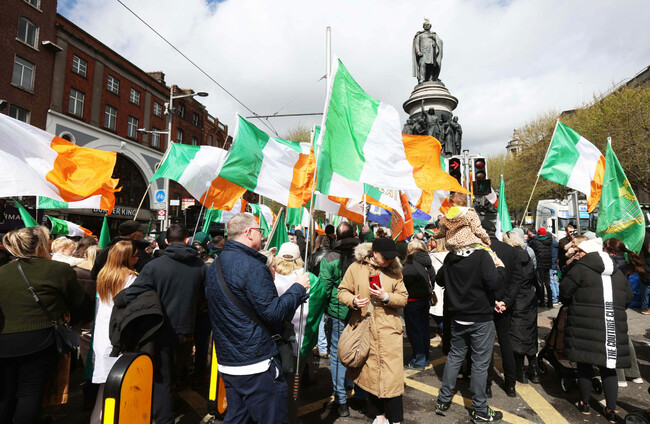
The fuel price protests attracted a slew of online commentary last week RollingNews.ie

The more I read about Ireland on the internet, the less I knew who was real and who was a dog

Our FactCheck editor details the internet trends seen by a thirty-something-year-old man.

THE INTERNET’S OLDEST proverb was written as a joke by Peter Steiner in a New Yorker cartoon in 1993: “On the internet, nobody knows you’re a dog.”

Online humour tends to age more quickly than milk in the sun, but the cartoon has survived three decades because it captures the dark soul of the social media age, where a person’s identity is assumed and their participation matters more than authenticity.

It was hard not to think of the joke while I was scrolling through social media posts this week from profiles that presented themselves as Irish but which often seemed not to be.

Last week, I wrote about how the fuel price protests were a magnet on social media for international users who had developed a sudden affinity with the agrarian struggle in Ireland, and used it to distort the narrative about what was happening on the ground.

There were, it has to be said, plenty of legitimate users from Ireland and further afield posting in support of the protesters and venting spleen at the government.

But the volume of anonymous, tricolour-branded profiles I encountered was too suspicious to ignore, so I went on a mini investigation to see how many dogs I could find masquerading as Irish accounts that were operating from somewhere else entirely.

The process turned out to be a lot easier on paper than in practice.

The first step was to check the replies beneath posts on X about the week’s divisive political issues – like the fuel protests and the Dáil motion of no confidence in the government – and check for strange posting styles.

It wasn’t particularly difficult to find these types of accounts.

I found users saying things like “here in Ireland” or “I’m from Ireland” (do Irish people really have to prove their Irishness online?), repeating the same talking points over and over (again, who does this?), or overusing Americanised spellings and inserting spaces between commas and before question marks.

Anyone exhibiting this behaviour with a tricolour in their username, AI-generated or blank images for profile pictures, and handles relating to Irish history (e.g. Gráinne Mhaol) or which sounded a bit too stereotypically Irish (e.g. Seán O’Reilly) immediately came under suspicion.

I then checked X’s transparency information – which tells you where in the world an account is posting from or if it’s using a VPN or proxy to log in via a third country – to see if I could find out whether they were actually based outside Ireland.

I found many of these types of accounts over the past week – but the exercise turned mind-melting quickly when X’s transparency information stated that most of them were posting from Ireland.

I found some examples: an account called National Review giving out about NGOs turned out to be posting from west Asia; another prolific account called Cú Chulainn claimed to be based in Dublin but was actually posting from Brazil.

Over on Facebook, I even unearthed a US-based account called ‘Real Irish News’ with a profile picture of the GPO on Dublin’s O’Connell Street, which shared the false claim that Taoiseach Micheál Martin was at his daughter’s wedding last weekend.

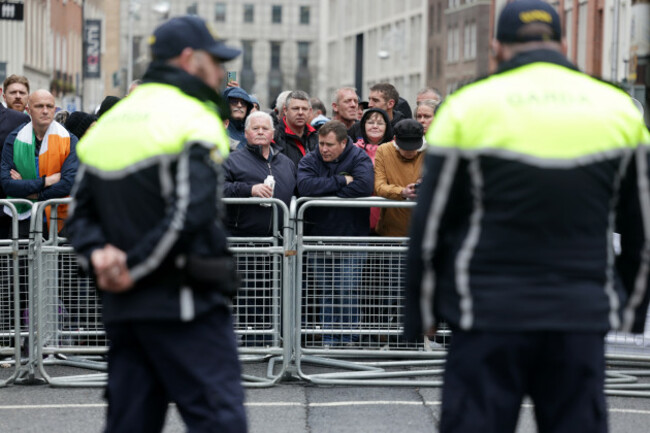
image Gardaí watching protesters outside Leinster House ahead of the Dáil's no-confidence vote on Tuesday RollingNews.ie RollingNews.ie

In the majority of cases, though, the whole thing was a mirage.

Normally when I’m doing this kind of work, I feel like I’m able to trust my nose – and this time it smelled like these were not Irish users. But did the stench come from something else entirely? 

Over and over I found myself looking at anonymous accounts with twee usernames recycling specious arguments that were clearly designed to rile people, written in a register and style that seemed unnatural for an Irish social media user.

Still, X was telling me those accounts were posting from Ireland. From a verification point of view, my suspicions and inner certainty proved nothing.

An Irish person can genuinely write in American English or adopt an unconventional punctuation style; they may have whatever reason to include a tricolour flag in their username and take the moniker of a historical figure like Brian Ború.

Even when accounts said they were based here, but were flagged by X as logging on via a VPN or another proxy, it was impossible to say they were posting from abroad; I didn’t have any proof of that beyond my internal bullshit detector.

The result left me in a complete state of uncertainty, because I had nothing to ground my suspicions on aside from my own confirmation bias, which I knew is a dangerous place for any journalist or fact-checker to be operating in.

Any or all of the accounts that drew my suspicions could well be genuine people posting from Ireland, but social media has become so unreliable that it’s become harder to trust that anyone is who they say they are.

It’s an experience that’s now a core part of using the modern internet, where the information ecosphere has degraded so precipitously.

Everything has become increasingly steeped in a constant cycle of interpretation, second-guessing and doubt, rather than the straightforward flow of information and genuine interaction that used to make up the online world.

The advent of LLMs means that people are increasingly questioning whether banal articles, websites, newsletters or social media posts were written by a human or generated by artificial intelligence. 

And awareness of that has also evolved to the point that the paranoid game of attribution has turned inwards.

My mini investigation was meant to be straightforward, but it left me questioning how much I could trust my own instincts, as well as whose posts I was looking at.

When you think something feels off, you might become suspicious, but then question yourself for thinking that your instincts could be shaped by lowered expectations and that you don’t want to accept that humans can sometimes write as weirdly as AI chatbots.

Because that’s what happened to me.

None of this is helped by the fact that the tools we’re given to navigate this space are clearly inadequate.

Despite Facebook and X offering location tags and account transparency features, these can be easily gamed.

That leads to a kind of ambient uncertainty that seeps into everything, including our brains and attempts to teach media literacy.

Those trying to make sense of political discourse online, whether as journalists, fact-checkers or ordinary users, find it much harder to know what is representative, what is coordinated, and what is simply noise.

And when such levels of doubt set in, it becomes increasingly difficult to shake the belief that everyone on the other side of a screen might be a dog.

Readers like you are keeping these stories free for everyone...
A mix of advertising and supporting contributions helps keep paywalls away from valuable information like this article. Over 5,000 readers like you have already stepped up and support us with a monthly payment or a once-off donation.

Close
JournalTv
News in 60 seconds