Sign in. It’s quick, free and it’s up to you.
An account is an optional way to support the work we do. Find out more.
Sign in. It’s quick, free and it’s up to you.
An account is an optional way to support the work we do. Find out more.
IRELAND’S PRESIDENCY OF the EU comes at a time of “uncertainty and unpredictability” around the world, so says Taoiseach Micheál Martin on the official website of the six-month event.
The greeting also informs us that it’s a time of “increased threat and conflict”, a point made all the more real now it’s been confirmed that Ukrainian President Volodymyr Zelenskyy will meet the Taoiseach at Dublin Castle today.
War and peace aside, Martin’s welcome goes on to outline Ireland’s priorities for the next six months.
These priorities include five pillars, three of which could probably have applied to any EU presidency of the last 50 years. They are, “simplifying regulation for businesses and citizens”, “deepening our single market” and “championing fair and open trade”.
The remainders relate to reducing energy prices and a focus on the two biggest transitions of our time, decarbonisation and the advancement of AI.
In short, some of the goals for Ireland’s presidency could be seen as being ambitious and novel, while others are simply keeping the show on the road.
While the latter view may sound somewhat uninspired, the reality is that unforeseen events can often upend even the most precise planning. It means that dealing with the unexpected is very much part of any EU presidency.
Cyprus, for example, wasn’t expecting to be doing its six-month stint as the US and Israel launched a war in Iran that has dominated the EU’s priorities since.
Ireland, however, does have a history of holding the presidency at some particularly pivotal moments.
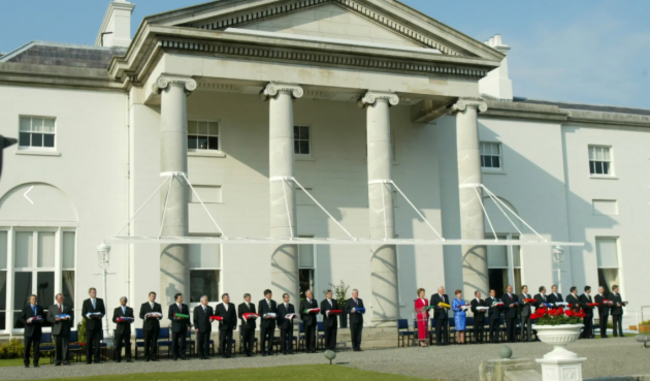
Perhaps the most obvious is back in 2004 when Ireland presided over the largest enlargement of the EU in its history, when the bloc increased in size from 15 to 28 member states.
On that occasion, Ireland staged a ‘Day of Welcomes’ in May 2004 with celebrations across the country and plenty of music in Dublin.
There were ceremonies in Áras an Uachtaráin and Farmleigh House as Celtic Tiger Ireland flexed its muscles and then taoiseach Bertie Ahern was said to have “enchanted leaders across Europe” in a diplomatic success for the country.
That 2004 success, however, had a strong connection to another successful EU presidency by Ireland. Of the 13 member states that joined in 2004 and the years after, 11 had been members of the Soviet Union.
The westernisation of those nations had its roots back to the fall of the Berlin Wall in November 1989, with the opening six months in 1990 also coinciding with another Irish EU presidency.
Ireland could not have planned for such a seismic event as the collapse of East Germany but it was nonetheless thrown into the deep end and the decisions taken in those six months had global consequences.
Paul Gillespie, former foreign policy editor of The Irish Times and now of UCD’s School of Politics and International Relations, says that Charles Haughey’s diplomatic stewardship of Ireland’s during that period was especially successful.
“It really mattered, particularly with (former German chancellor) Helmut Kohl. I mean Kohl said that we Germans will never forget that you supported us, and how much you did. Kohl came back I remember in 1996 just before another Irish presidency, and he spent the German National Day in Ireland. He spent a couple of weeks here, if I remember correctly, and he said the same again at a State dinner, so it’s just an example of how these things matter.”
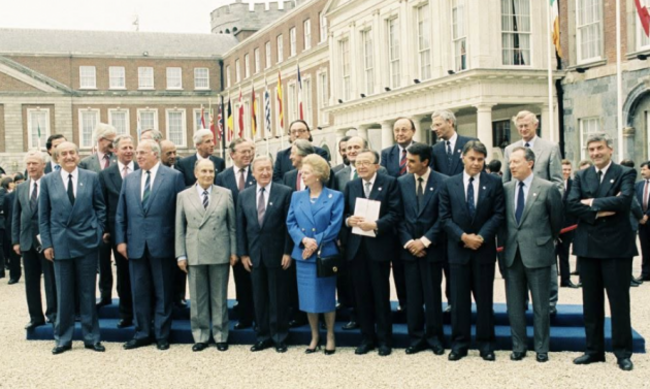
Dublin hosted a number of crucial European summits during this period, one was in April 1990 when it was agreed by the European Community (as it was then called) that German reunification would be a positive development for the bloc.
Another Dublin summit in June 1990 copper-fastened the EC’s moves towards greater integration and that particular event is often regarded as Haughey’s pinnacle in terms of his power and influence here and abroad.
In his 2021 biography of Haughey, DCU Professor Gary Murphy shared a copy of a note sent by Margaret Thatcther to Haughey after the summit, which read:
Some of the discussion was fairly tough going. But once again, you showed a very sure touch as chairman and I thought your final press conference was masterly.
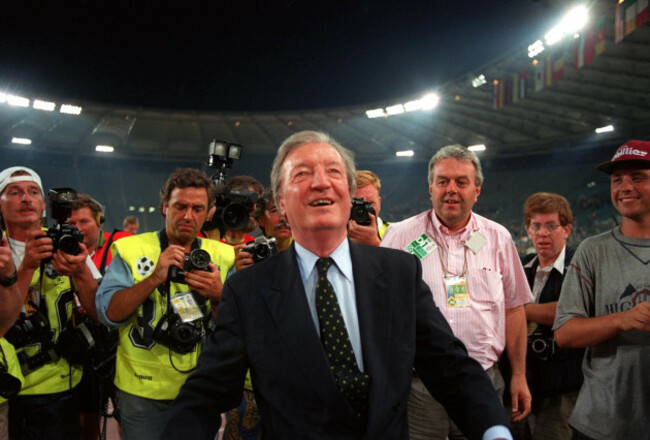
In a partial echo of today, the Italia ’90 was on at the time and the first day of that EU summit took place on the day Ireland defeated Romania in the storied penalty shootout. Five days later, Haughey famously waved the Irish flag on the pitch at Stadio Olimpico in Rome as Ireland fell to defeat to Italy.
As Murphy tells it in the book, this meant refusing the request of the president, Patrick Hillery, who also wanted to attend.
Crowning achievement
Ahead of this latest EU presidency, much has been made of Micheál Martin crisscrossing the continent as part of his duty to meet each EU leaders ahead of the upcoming six months.
Indeed, as the Taoiseach has faced periods of internal party strife and suggestions that his leadership days are numbered, it has frequently been suggested that his experience would be vital to the success of the presidency. One could even build a case that it has protected him from any heaves at home.
Which brings us to today and the opportunities presented by events such as Zelenskyy’s visit.
The meeting is a reminder that war is approaching the EU’s borders and that any Ukraine-Russia peace deal that doesn’t place European interests at its heart could be disastrous.
Whether anything happens in that regard over the next six months is impossible to predict but, should there be a deal, Ireland would be at the centre of the EU’s response.
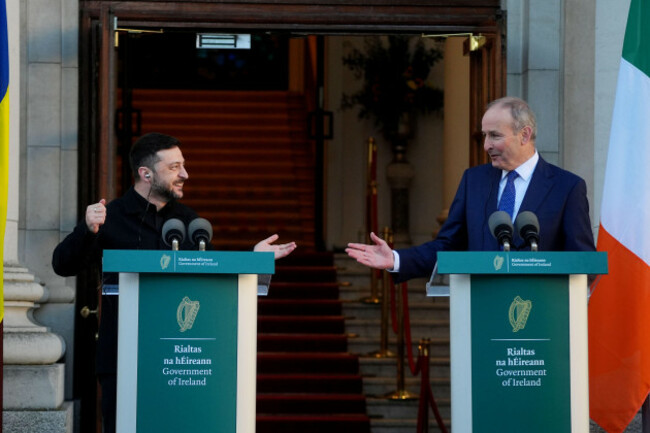
Martin spoke only this week at the Shared Island Forum in describing the EU as “the most successful peace-building endeavour in human history”, and he has been vocal in his support of Ukraine’s bid for EU membership.
So given the fact that Fianna Fáil predecessors Ahern and Haughey both took advantage of some fortunate timing to make their mark in Europe, could Martin do the same if the cards fall that way?
Gillespie says he’s well-placed to do so, adding that he was present at the Shared Island Forum this week when the Taoiseach spoke about being in the Balkans and making a connection between the ethnic complexities there and Ireland’s peace process.
“That was one thing he mentioned, which is an obvious example of how we could make a mark,” Gillespie explains.
“Because the enlargement agenda is now very important geopolitically and they would very much want Montenegro on the agenda, and obviously Ukraine as well. There are minority/majority issues in Ukraine, and stuff about languages and rights but the Irish experience is relevant there too and I think he’d be to the fore with that. ”
To begin with the Taoiseach must get through today, which on its own would be among the most high-profile of any premiership.
As per the released schedules, there is a meeting with European Council President António Costa in Government Buildings at midday and the opening ceremony for the Irish presidency in Dublin Castle at 2pm.
Zelenskyy is expected to be present for that opening ceremony and the three will hold a meeting thereafter. It’s the start of a series of big chances for the Taoiseach and there’s no time to hold his breath.

To embed this post, copy the code below on your site



have your say