Sign in. It’s quick, free and it’s up to you.
An account is an optional way to support the work we do. Find out more.
Sign in. It’s quick, free and it’s up to you.
An account is an optional way to support the work we do. Find out more.

IT’S JUST 10 days until Micheál Martin takes his seat in the Oval Office next to Donald Trump in the glare of the world’s media – and if anything this trip is set to be even more fraught than last year’s.
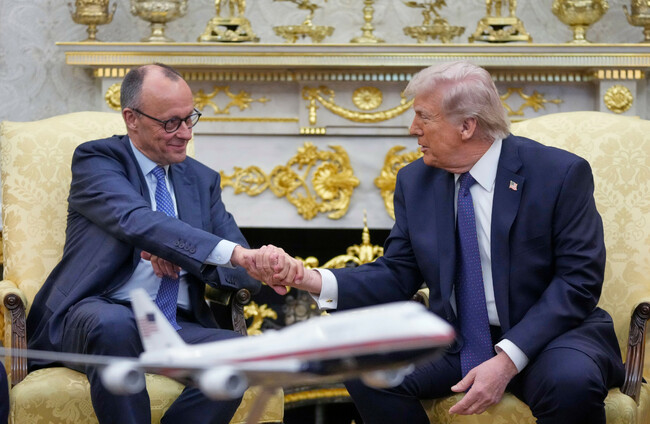
Just ask German Chancellor Friedrich Merz, who sat by this week as Trump railed against “terrible” Spain, threatening to “cut all ties” with the country whose prime minister has called the US-Israeli attacks on Iran as an “unjustified and dangerous” intervention outside of international law.
Spain drew Trump’s ire by refusing to allow the US to use joint bases on its territory for operations on Iran.
In the Oval Office, Merz played along, saying that he was trying to convince Spain to spend more on defence in line with Nato targets.
The EU’s official position on the current situation in the Middle East, agreed by its 27 foreign ministers last weekend, was a call for restraint, protection of civilians and “full respect of international law”.
The bloc condemned Iran’s attacks as a violation of sovereignty of other countries in the region. A number of people have been killed in Iranian strikes on Israel and Gulf countries.
The Journal asked a spokesperson for EU foreign affairs chief Kaja Kallas today whether the US attack on Iran was in line with international law.
“The position of the EU is quite clear: we are calling for full respect of international law,” Kallas’s spokesman said. “This is a position agreed by the 27 member states. This is our diplomatic position on the matter.”
Evidently, “quite clear” is a tough bar to reach when 27 countries’ very different attitudes are being sifted through to identify the lowest common denominator.
Even at national level clarity has been difficult to obtain this week. Minister for Foreign Affairs Helen McEntee said on Monday that she “can’t say” whether the US and Israeli strikes were illegal.
Even as Merz’s foreign minister was signing up to a statement calling for full respect of (not for, for some reason) international law on Sunday, the German chancellor was setting off to Washington publicly remarking that “international rules have relatively little effect” and “now is not the time to lecture our partners and allies”. Merz suggested the strikes aimed at toppling Iran’s regime were justified.
There are many uncertainties now for the EU – including how the war in Iran might affect Ukraine.
Yes, an ally of Putin now has other things on its plate. But if the conflict goes on it could affect both the price and availability of the US weapons Europe is buying for Ukraine. Oil prices are up – and that’s really good news for Russia, which is a massive exporter.
Rising energy prices obviously aren’t good news for European households and businesses. As recently as a couple of weeks ago, it seemed the world was facing into a gas glut which would have a positive effect – but not now.
While Iran has not officially shut off the Strait of Hormuz, through which a fifth of the world’s crude supplies and a substantial amount of gas run, shipping through the critical waterway has all but dried up.
Qatar, which supplies 20% of the world’s liquefied national gas (LNG), has shut down its production. Qatar’s energy minister predicted today in the Financial Times that all Gulf energy exporters will close production within days, driving oil to $150 a barrel.
The EU has made progress on diversifying its energy supply since Russia’s invasion of Ukraine in 2022, but remains massively dependent on imported fossil fuels.
The EU has set a 2027 deadline to wean itself off Russian gas. A protracted conflict in the Middle East, with the high energy prices that will result, would bring political pressure to ease off on that goal.
The head of the International Energy Agency today described murmurs from some quarters that the Europe should once again look to Russia for energy supplies as “economically and … politically wrong”.
This is all happening at a time when the Irish government wants to boost Ireland’s energy security with a floating LNG storage unit in the Shannon estuary. Inevitably, critics now argue events in the Middle East have shown that developing an expensive LNG terminal would only serve to further expose Ireland to global price shocks and geopolitical risks.
Jerry Mac Evilly of Friends of the Earth said “skyrocketing” gas prices and supply disruption showed that Minister for Energy Darragh O’Brien needs to carry out a new energy security review – already requested by the Oireachtas climate committee – before he proceeds with his controversial LNG plan. The US is the biggest exporter of LNG to Europe.
The hope in Brussels is that the war in the Middle East will last only a few weeks, on the basis that neither the US (for political reasons) nor Iran (for capability reasons) can afford to fight on for longer.
Today, the US and Israel pledged to increase their attacks, in which an estimated 1,000 people have already been killed, including over 150 at a girls’ school that was likely bombed by the US.
The EU’s call for restraint and respect for international law does not so far appear to have been heard.

To embed this post, copy the code below on your site











have your say