Sign in. It’s quick, free and it’s up to you.
An account is an optional way to support the work we do. Find out more.
Sign in. It’s quick, free and it’s up to you.
An account is an optional way to support the work we do. Find out more.
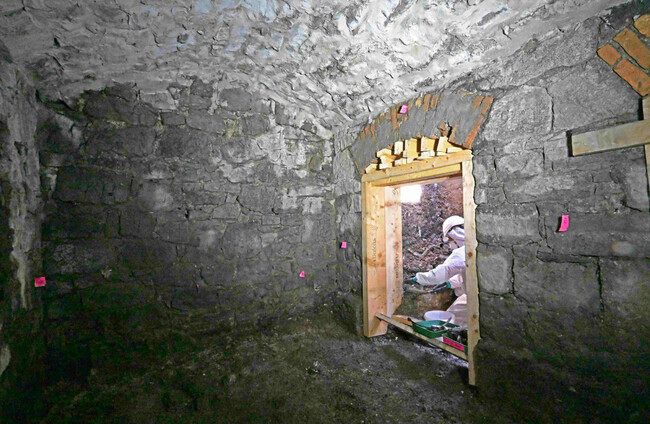

IN 2014, LOCAL historian Catherine Corless uncovered the names of 796 infants who had died at the Tuam mother and baby home. She could not find burial grounds for them.
Her research indicated that they were buried on the site of the former St Mary’s Home in the Galway town. After repeated pushes, the story was taken up by national and international media and the State established a Commission of Investigation into the matter in 2015.
The Commission published its report in 2021. It was agreed that works would be carried out, but these were initially delayed by the need to establish the Industrial Burials Act 2022.
In July 2025, excavation works began on the site.
Now, investigators are starting to forensically examine the remains of children found at the site in the hope of finally identifying them.
As of Wednesday, the remains of 99 infants have been uncovered by the excavation team.
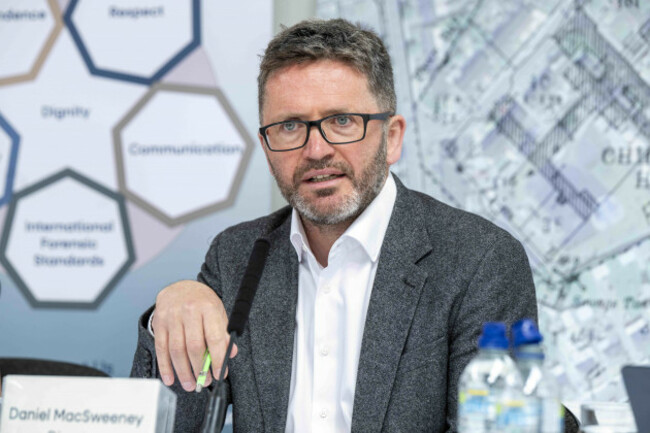
On Monday, Corless was brought to see the new forensic facility and mortuary by the director of the Office of the Director of Authorised Intervention Tuam (ODAIT), the statutory body responsible for the excavation and investigation into the inappropriate burials carried out at the site.
Media were brought to the same facility on Wednesday, and families and survivors will visit on Thursday.
ODAIT is continuing its work on the ground, but with its new facility will commence the next stage of its overarching work next week.
ODAIT’s director Daniel MacSweeney said the opening of the HSE facility that has undergone €4.1 million worth of works to adapt it to the agency’s needs “represents the start of a new phase of the Tuam intervention”.
“We can now start to forensically analyse the human remains, the skeletal remains that we’ve recovered, and then that will enable us to move from the statistics of how many sets of remains we’ve recovered, to really start to tell their story, to start to personalise them,” he told The Journal.
It is hoped forensic works will be able to discover the age of the children when they died, as well as their genders, and potentially any conditions or diseases they suffered from – as well as providing for Forensic Science Ireland (FSI) to attain DNA profiles that can be compared with samples given by living relatives of children who died at the home.
“Even if we know that we won’t be able to get a full identification for all of the sets of remains that we have, we hope to at least be able to tell a story, or a partial story, about them all.”
That area was previously identified on historic maps in the council’s planning files as a burial ground, but MacSweeney said they were still surprised by the number of remains recovered in the area.
“We had no idea if that meant two burials, 10 burials, 100 burials,” he said. “So we were surprised by this intense concentration of burials in this small place.”
As each is individually buried in coffins, they’re classed as separate archaeological contexts that need to be recovered as such.
MacSweeney and other members of the team repeatedly refused to speculate, or comment on what they deemed to be speculation: questions about other mother and baby home sites were shot down, as were queries about potential future discoveries, or time frames.
At present, legislation allows for the excavation team to work within a marked boundary, as well as into the back gardens of homes on the perimeter of the site if findings indicate there are remains present.
Asked if there is potentially burial spots beneath properties, MacSweeney said, “I don’t know. We’ll see.”
So far, they have not uncovered anything that has given them reason to believe there are remains buried outside the boundary. There have been times when they have had to go over the boundary to work safely within it, but he said ODAIT has had “wonderful cooperation” from people in Tuam in this regard.
He has no estimated time for completion of the site’s excavation, stressing that ODAIT is assessing the situation as it proceeds.
“It looks like we’ll get to the memorial garden towards the end.”
The memorial garden is home to the sewage tank.
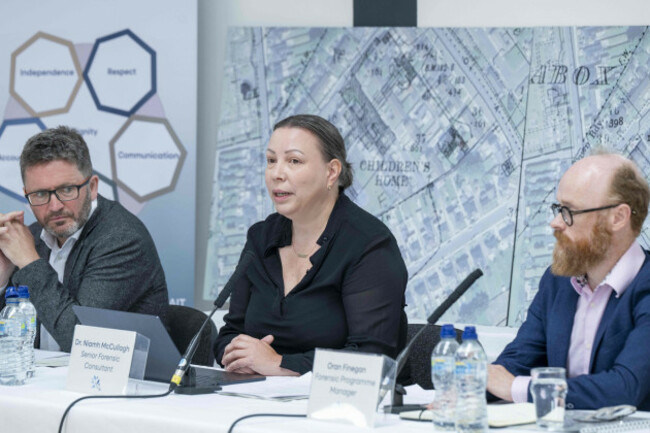
Dr Niamh McCullagh, ODAIT’s consultant forensic archaeologist, said that as they work through the site, “we don’t know what we’re going to find”, although they can make educated assumptions.
The facility will help with analysis of remains, no matter what these findings are.
She told The Journal that when they reach the multi-chambered structure in the sewage tank, “we will finally be able to deal with commingled remains, so we need space to be able to set out all of those remains to try and individualise people within those groups of remains.”
At present, the remains are being processed, with soils and sediments removed and dried to stabilise them in preparation for analysis.
McCullagh said that, given the age and poor burial conditions, cause of death will be very difficult to assess if it is something that hasn’t survived on the bones.
Diseases and infections can impact bone, and this is an area that could be examined, as well as dental work to establish diet. McCullagh said in a different excavation she was involved in, they were able to establish that a deceased infant was breastfed, and breastfed by a woman whose diet was predominantly fish.
“There are things that we can tell, but we can’t predict what that will be at this point. But we know that we’ll apply the methods.”
Like MacSweeney, McCullagh spoke about the objective of providing the infants with an individual identity, although she acknowledged for many of the infants this would not be the case.
As they progress away from the perimeter, where they are at the back of people’s gardens, McCullagh said they are exploring expanding the team of 21 to expedite matters.
The reaction amongst locals has been “quite mixed”, although there is a community liaison officer who speaks to people about their misgivings and concerns about the process.
“People have been very accepting. I think they’re grateful that it will be done, and that then things can move to the next stage in their lives, because they’ve been inundated with visitors to the site for the last 10 years.”

To embed this post, copy the code below on your site









have your say