Sign in. It’s quick, free and it’s up to you.
An account is an optional way to support the work we do. Find out more.
Sign in. It’s quick, free and it’s up to you.
An account is an optional way to support the work we do. Find out more.
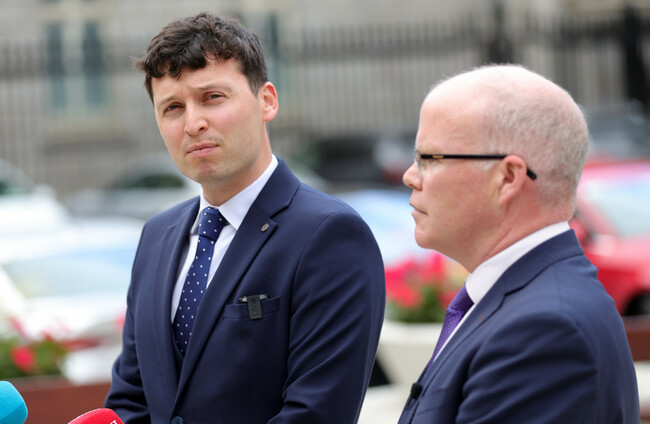
AN AONTÚ PRESS release advocating for Ireland to withdraw from the EU Migration Pact this week included a number of attention-grabbing suggestions.
The EU Migration and Asylum Pact is a mammoth overhaul of the way countries manage immigration and asylum processing, designed to standardise immigration laws and policy across the EU.
In the 23 September press release, Aontú outlined a Bill in the Dáil seeking to withdraw Ireland from the EU Migration Pact.
The bill was introduced by Aontú’s leader Peadar Tóibín, as well as the party’s Mayo TD Paul Lawless.
“We in Aontú are bringing this bill today,” the release quotes Lawless, “to allow us to opt-out of the pact.
“Poland has been given an exemption from the pact on the grounds that they already have a million Ukrainians, we should be exempt too, given that we have over a million foreign-born residents in our country and have the worst housing crisis in generations.”
The EU Pact on Migration and Asylum was adopted by the European Parliament on 10 April, with a majority of MEPs voting in favour of adopting it (322 for it versus 266 against). Eight Irish MEPs voted in favour of it, four opposed it, and one abstained.
Provisions of the pact were subsequently passed by vote in the Dáil. Ireland did not opt-in to two of the legislative measures of the pact as they are Schengen measures which do not apply to Ireland as it is not part of Schengen. A further two already had legislative basis in Ireland.
As such, it’s not clear what effect the Bill to withdraw from the EU Migration Pact would have — it is also not clear that Ireland can legally withdraw from the pact, given that it is a list of EU legislative acts, rather than one single treaty.
What is clearer is that Poland also was not given an exemption from the entire pact. However, it does have an exemption from one part contained within it.
In a response to The Journal, an Aontú spokesperson said that the quote from Lawless — “Poland has been given an exemption from the pact” — only referred to one part of the agreement, the “solidarity mechanism”, which they described as the “most contentious part of the EU Migration Pact”.
Although the term “solidarity mechanism” does not appear in the press release, it is worth looking at what it is – and how it impacts Poland.
The Pact’s “solidarity mechanism” is designed to relieve countries at the geographical periphery of the EU of some of the burdens of being the first point of entry for many people seeking asylum.
Those countries include the likes of Cyprus, Greece and Italy, which are common arrival points for people coming across the Mediterranean.
The mechanism will mean that Ireland will have the option to either take in asylum seekers from countries on the edge of the EU, or make financial contributions to support those member states instead.
Research published by the Oireachtas says that, under this mechanism, Ireland’s annual contribution is “currently set at 648 relocations per annum OR a financial contribution of €12.96 million per annum”.
Poland has indeed been granted an exemption to this one part of the pact — for one year. The EU commission will reassess whether they must abide by it in coming years.
This exemption is due, in large part, to a finding by the EU Commission that Poland faced a “significant migratory situation” from 2020 to 2025. Austria, Bulgaria, Croatia, Czechia and Estonia were also identified in the same pool “due to the cumulative migratory pressure of the previous years”.
“Since the beginning of the war, Poland and Czechia have recorded among the highest number of temporary protection registrations in the Union relative to their GDP and population,” the report reads.
In other words: even if Poland receives lower-than-average immigrants in 2026, it will neither have to take in relocated migrants nor pay a contribution, because there is still “a significant strain on the migration, asylum and border management systems” from previous years.
About 953,000 refugees from the war in Ukraine are estimated to still be in Poland. The latest corresponding figure for Ireland is estimated to be 84,739. Of that number, just over a quarter were children or teenagers.
Let’s revisit the rest of Lawless’s claim: “Poland has been given an exemption from the pact on the grounds that they already have a million Ukrainians, we should be exempt too given that we have over a million foreign born residents in our country.”
The 2022 census, cited by an Aontú spokesperson in response to The Journal’s queries, put the number of residents born outside the Republic of Ireland at 1,017,437.
The spokesperson noted that this was higher than most EU countries.
Lawless’s statement in the press release continues: “23% of Ireland’s population is foreign-born. This is not sustainable. The rapid population growth we are experiencing is putting huge pressure on our housing, health and justice systems.”
The comparison with Ukrainian refugees in Poland is somewhat confusing. The vast majority of foreign-born people in Ireland are not people with refugee status (estimated at 137,869 in 2025) or asylum seekers (estimated at 33,728).
There are also people with residency permits living in Ireland (327,396 in 2024).
Many other residents are from other EU countries (about 313,000 in the 2022 census) or are even Irish citizens born abroad to Irish parents (famous examples: Eamon de Valera, Saoirse Ronan, Michael Fassbender, Dana Rosemary Scallon and Sharon Horgan). This number of Irish people born abroad but living in Ireland is hard to get clear data on.
So, why were their numbers compared with war refugees?
“The point I was making in my press release and Dáil speech was not that we are exactly the same as Poland,” Deputy Lawless said in response to The Journal’s queries on the comparison.
“But rather that like Poland we are a unique member State with unique pressures and that in my opinion, because of this, we should be given an exemption in the same way Poland was.”
Lawless also said that his statements in the press release did not suggest that the Pact would increase the number of foreign-born people in Ireland, nor that the Pact would have any effects on foreign-born people who are not applying for asylum.
Official stats show that the number of applications for International Protection in Ireland had fallen by 39% between June and September 2026.
The Journal’s FactCheck is a signatory to the International Fact-Checking Network’s Code of Principles. You can read it here. For information on how FactCheck works, what the verdicts mean, and how you can take part, check out our Reader’s Guide here. You can read about the team of editors and reporters who work on the factchecks here.

To embed this post, copy the code below on your site

















have your say