Sign in. It’s quick, free and it’s up to you.
An account is an optional way to support the work we do. Find out more.
Sign in. It’s quick, free and it’s up to you.
An account is an optional way to support the work we do. Find out more.

NEW RENT RULES are set to come into force for new tenancies from tomorrow.
The Residential Tenancies (Miscellaneous Provisions) Bill 2026, which was signed into law this week, will overhaul how the rental market operates.
The government has said the change will provide more security for renters and help to boost supply, while opposition parties have railed against the plans, saying it will lead to rents being hiked and more people in emergency accommodation.
Here’s a look at what’s changing, how it will impact renters and landlords, and what politicians are saying about it.
Firstly, it’s important to say that the new rent rules will not apply to existing tenancies. Anyone who is currently renting and in a tenancy will not be impacted.
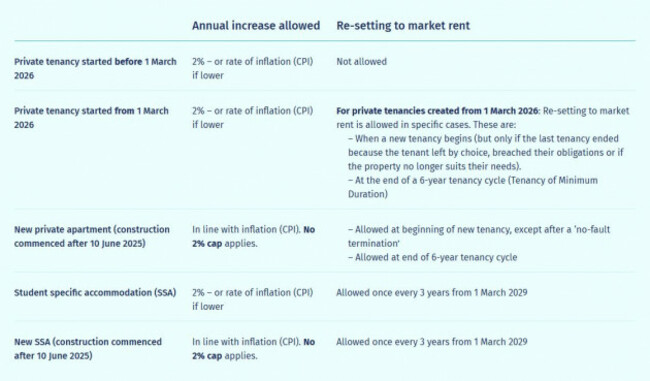
The new rules will only apply to tenancies created on or after 1 March.
Under the changes, all tenancies created from that date will last for a minimum of six years.
Landlords will also be able to reset rents to ‘market rent’ for new tenancies. Basically, market rent means the average rent that similar properties in a specific area are being rented for.
If a property’s rent is reset at the start of a new tenancy, the landlord can still review the rent of the tenancy each year. However, the next rent increase will be capped at either 2% or the rate of inflation, whichever is lower at the time.
The Department of Housing has confirmed that the long-promised Rent Price Register will also go live tomorrow.
This will contain a breakdown of costs across the private rental sector, along with other details for rented properties.
The Rent Price Register will be updated automatically and daily to ensure ‘market rent’ remains up to date.
Landlords will be required to use the new tool when setting or reviewing rent for a tenancy. They will be expected to self-assess whether rents that they set truly reflect market rates.
When a landlord wants to reset the rent for their property to the market rate – either for a new tenancy or after a tenant has completed a six-year tenancy – they have to enter the details of their property into the Rent Price Register.
This includes the type of dwelling, the floor space in square metres, the Eircode, the number of bedrooms and the property’s Building Energy Rating (BER).
Once this is done, the register will then present ten properties that match these criteria and how much each costs to rent.
The landlord then chooses three of these properties and submits them as evidence to support their argument that the rent they are setting for the property is ‘market rent’ and not above it.
Again, for existing tenancies created before 1 March 2026, the re-setting to market rent is not allowed.
Landlords will still be able to evict tenants under the new rules – but there are also rules in place for them.
To begin with, landlords have been divided into smaller and larger landlords.
A smaller landlord is defined as having three or fewer properties, while a larger landlord has four or more.
For larger landlords, they can only end a tenancy if:
Larger landlords will not be permitted to evict tenants so that they or a family member can move into the property, or to sell or renovate it.
For smaller landlords, the rules for evicting tenants differ slightly. During the six-year minimum tenancy, they can only evict a tenant if:
After the six-year minimum tenancy, smaller landlords can evict a tenant if:
Ultimately, the government is hoping that the changes will attract more landlords and investment in the private sector, leading to more supply, while giving renters greater security of tenure at the same time.
Speaking on Morning Ireland yesterday, Housing Minister James Browne said he “certainly expects rents to fall” as a result of the changes, though he did not say when exactly he expected this to happen.
“Increasing supply is the only way we’re going to make rents more affordable,” he said, adding that the housing crisis is being driven by a “supply crisis”.
“If we continue with one of the most restrictive rent control measures, which was on a rolling, temporary basis, we know we were not going to get the supply, but rents were going to continue to rise. What I’ve introduced are balanced measures to control rent while also driving supply.”
Put to him that there was no guarantee that the new laws will increase supply and subsequently lead to more affordable rents, he said: “The guarantee is if we don’t do something, rents will rise and supply will not rise.”
It’s safe to say that opposition parties are extremely opposed to the changes.
Sinn Féin leader Mary Lou McDonald has said allowing rents to be reset at market rate is “a hammer blow for ripped-off renters and a gift for big landlords and vulture funds”.
She claimed that 25% of tenancies in Ireland are new leases, and that six-year tenancies would offer no greater protection to people who move frequently for education or work, such as students, apprentices, trainees, nurses and teachers.
Labour’s Conor Sheehan said the changes will give landlords a “fresh opportunity to hike rents sharply” and that the consequences for landlords will be “dire”.
Social Democrats TD Cian O’Callaghan said that rather than just adding to housing supply, corporate landlord firms will “snap up more and more homes”.

To embed this post, copy the code below on your site















have your say