Sign in. It’s quick, free and it’s up to you.
An account is an optional way to support the work we do. Find out more.
Sign in. It’s quick, free and it’s up to you.
An account is an optional way to support the work we do. Find out more.
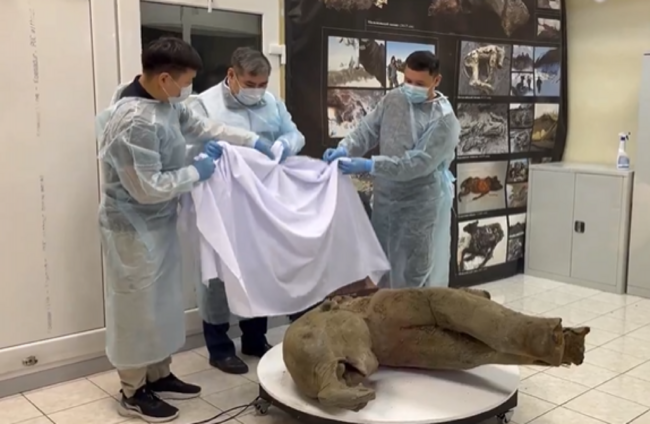
RUSSIAN SCIENTISTS HAVE shown off the remarkably well preserved remains of a baby mammoth found in the far eastern, permafrost-covered region of Yakutia.
The 50,000-year-old female mammoth has been nicknamed “Yana” after the river in whose basin it was discovered this summer.
Experts say “Yana” is the best preserved mammoth carcass in the world and is one of only seven whole remains ever found.
Studies will now be carried out to work out her exact age at death, estimated at “one year old or a bit more”.
The carcass was shown at the Federal University of the North East in the regional capital of Yakutsk, the institution said in a statement.
“We were all surprised by the exceptional preservation of the mammoth,” rector Anatoly Nikolayev said.
Researcher Maxim Cheprasov said it was a “unique discovery”.
🦣 Russian scientists on Monday showed off the remarkably well-preserved remains of a baby mammoth found in Siberia over the summer.
— The Moscow Times (@MoscowTimes) December 23, 2024
Read more:https://t.co/4rYj5i1far pic.twitter.com/uKcUB6LILQ
The remains weigh 180 kilograms and are 120 centimetres tall and 200 centimetres long.
The carcass was dug up near the Batagaika research station where the remains of other prehistoric animals – a horse, a bison and a lemming – have also been found.
Before this discovery, only six mammoth carcasses had been found in the world – five in Russia and one in Canada, the university said.
Yakutia is a remote region bordering the Arctic Ocean. Its permafrost acts like a giant freezer which preserves the remains of prehistoric animals.

To embed this post, copy the code below on your site













have your say