Sign in. It’s quick, free and it’s up to you.
An account is an optional way to support the work we do. Find out more.
Sign in. It’s quick, free and it’s up to you.
An account is an optional way to support the work we do. Find out more.
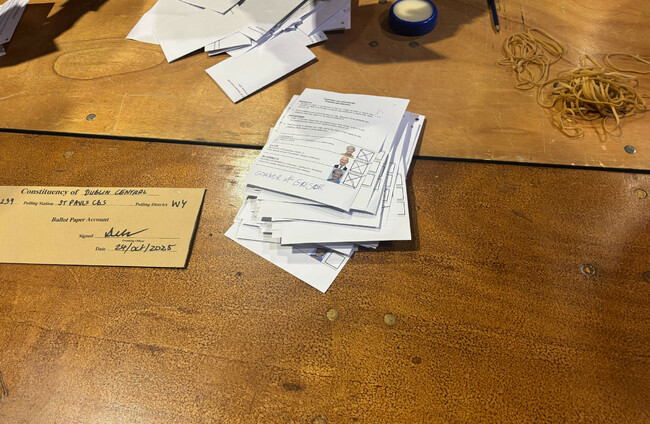
IN THE WAKE of a presidential election, some online commentators have spread false claims about the number of votes that had been purposely spoiled, and what that represented.
Prior to election day, a movement encouraging people to spoil their votes had been running on social media, often pushed by accounts who said that the presidential election was “rigged”, or wasn’t democratic.
One such account was the verified Damo & Ivor account on Facebook, which regularly posts false claims and conspiracy theories, some of which have previously been factchecked by The Journal.
“317,000 spoiled votes, beating candidates in a number of different constituencies,” a 25 October post on that account read. “Unite against corrupt government and media.”
This incorrect figure exaggerated the number of spoiled votes by more than 100,000.
There were in fact 213,738 invalid ballot papers.
The 317,000 figure is likely a distortion of a post put forward by Aontú, which read: “317,000 people spoiled their votes or voted for a withdrawn candidate.”
This figure is roughly correct if you add together invalid papers with the first preference votes for Jim Gavin, who had announced that he was no longer contesting the election, but too late to officially withdraw from the ballot.
There are a number of reasons people may have voted for Gavin, including a straightforward desire to see him become president — technically, Gavin could have won the election and accepted the presidency.
Other than that, some people may have wanted Gavin to get 12.5% of the vote, meaning Fianna Fáil to be able to get a refund of their campaign expenses — in the end he got 7.2 percent of first preference votes.
Another reason some people might want to vote for Gavin is in the hopes he would win, decline the role, and therefore trigger a fresh election (a strategy Aontú leader Peadar Tóibín specifically discouraged).
And some people who voted for Gavin explicitly said that they did so as a joke, as an alternative to spoiling their votes, or as a way to voice their dissatisfaction with the other candidates.
Similarly, the people who spoiled their votes did so for myriad reasons.
Readers who wrote to The Journal said that they did so because they felt none of the candidates on the ballot represented them, or as a protest against the government, or to voice dissatisfaction with the direction the country was going in.
Others expressed a desire for political and constitutional reform that would make it easier for more candidates to stand the next time. Some also spoke about their broader frustration with the rising cost of living and how they feel working citizens are treated.
In the run-up to the election, The Journal debunked AI-generated videos claiming that Catherine Connolly announced she was withdrawing from the election, or that the majority of votes had been spoiled.
We also debunked false claims that the election was “rigged”; that candidates who wish to run for president need government backing; that Simon Harris blocked ‘the will of the people’ by not letting Fine Gael representatives nominate Conor McGregor for president; and that Irish presidents can unilaterally call referendums.
The Journal had also investigated Catherine Connolly’s visit to Syria in 2018, the Disability Green Paper that is haunting Heather Humphreys’ presidential run, as well as the “military industrial-complex”, often mentioned in presidential debates.
The Journal’s FactCheck is a signatory to the International Fact-Checking Network’s Code of Principles. You can read it here. For information on how FactCheck works, what the verdicts mean, and how you can take part, check out our Reader’s Guide here. You can read about the team of editors and reporters who work on the factchecks here.

To embed this post, copy the code below on your site















have your say