Sign in. It’s quick, free and it’s up to you.
An account is an optional way to support the work we do. Find out more.
Sign in. It’s quick, free and it’s up to you.
An account is an optional way to support the work we do. Find out more.
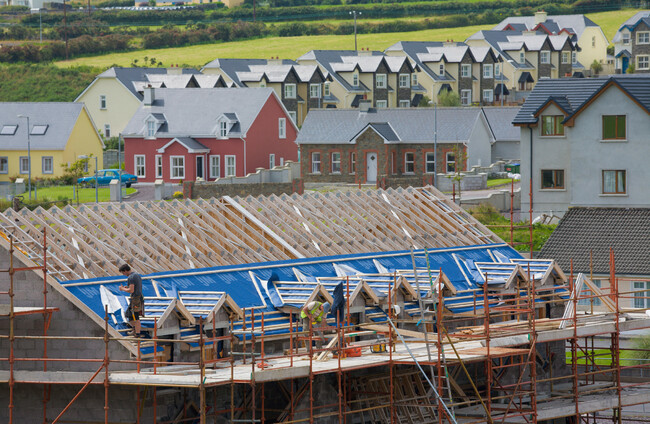
FEWER NEW HOMES were completed in the three months to June, when compared to the same period last year.
There were 8,823 new dwelling completions in April, May, and June, a fall of 3.6% on the same three months of 2025, when this figure stood at 9,152.
Apartment completions meanwhile in Q2 were 2,658, down 12.2% from last year, while there were 4,738 scheme dwelling completions, up 2%.
A scheme dwelling is part of a multi-unit development with two or more houses.
The number of single dwellings finished in Q2 was 1,427, down 3.7%.
Meanwhile, more than half of completions (54%) were scheme dwellings, 30% were apartments, and 16% were single dwellings.
The Central Statistics Office (CSO) today published its new dwelling completions report for Quarter 2 2026.
Trevor Grant, chair of Irish Mortgage Advisors, remarked that while new housing completions in the first quarter were up almost a third on the same months in 2025, the latest figures for the second quarter “suggest that progress was short-lived”.
He said this will be a “particular blow for the many young people who are hoping to buy a home but consistently find that houses are out of their reach”.
However, he added that “we’re now into the traditional builders’ holiday period, house building is likely to be sluggish in the coming weeks”.
Grant meanwhile said housing completions and house prices are “directly interlinked” and that “without a significant boost to housing supply, steep house price inflation will persist”.
He called on the government to “think outside the box and deliver measures in Budget 2027 which will not only continue to stimulate housing supply, but also reduce the costs of delivering housing”.
More than a third (36%) of completions were in Dublin, with less than a fifth in the Mid-East region (Louth, Meath, Kildare, and Wicklow).
There was a relative decrease in completions in two regions, with a 16.4% fall in the Dublin region and a 13.9% fall in the Mid-West (Clare, Limerick, and Tipperary) region.
The regions meanwhile with the largest relative increase in completions were the Border (Cavan, Donegal, Leitrim, Monaghan, and Sligo) at 14.6%, while the South-East (Carlow, Kilkenny, Waterford, and Wexford) saw the second largest relative growth at 12%.
Just over three-quarters of apartment completions were in Dublin and in Dublin City, 91.4% of completions were apartments.
The most scheme completions were in the Mid-East (Kildare, Louth, Meath, and Wicklow) region at 1,301.
The South-West region (Cork and Kerry) had the most single dwelling completions in Q2, at 239 completions.
Elsewhere, the CSO also released its flash estimate for the consumer price index.
The consumer price index (CPI) is the official measure of inflation for Ireland.
These flash estimates are subject to revision when the final figures are published by Eurostat on 13 August 2026.
The CPI is estimated to have risen by 3.1% in the 12 months to July, with no change since last month.
This compares with inflation of 3.2% in the 12 months to June 2026.
Energy prices are estimated to have decreased by 1.7% in the month and have gone up by 6.5% over the 12 months to July, while food prices are estimated to have gone up by 0.3% in the last month and increased by 0.8% in the last 12 months.

To embed this post, copy the code below on your site













have your say