Sign in. It’s quick, free and it’s up to you.
An account is an optional way to support the work we do. Find out more.
Sign in. It’s quick, free and it’s up to you.
An account is an optional way to support the work we do. Find out more.
LAST UPDATE | 5 Dec 2024
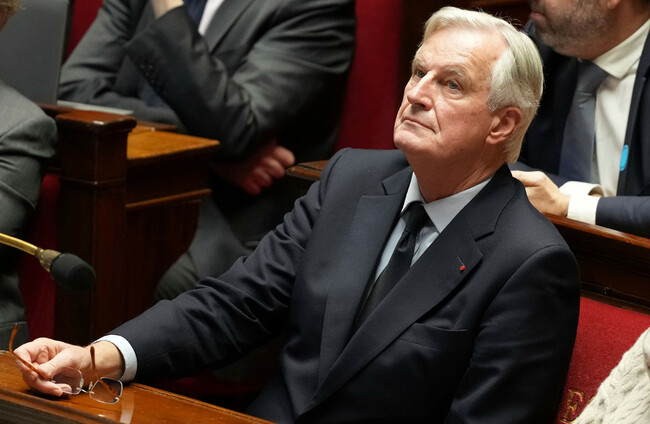
FRENCH PRIME MINISTER Michel Barnier has handed in his resignation to president Emmanuel Macron, following his loss in a vote of no confidence in parliament last night, with the president urgently seeking ways to halt growing political and financial chaos.
According to a statement today, Barnier will stay on in a caretaker role until a new government can be appointed.
“The prime minister today submitted the resignation of his government” to President Emmanuel Macron, who has “taken note” of the resignation, the president’s Elysee Palace said.
Barnier and his ministers remain “in charge of daily business until the appointment of a new government”, it added.
Poised to be contemporary France’s shortest-serving premier, Barnier arrived at the Elysee Palace just after 9am Ireland time this morning for the resignation formality.
The outgoing premier and government constitutionally obliged to step down after the vote – the first prime minister to be ousted by parliament in over six decades.
Barnier’s government lasted just three months in office. It was defeated after a no-confidence motion proposed by the left received crucial backing by the far-right headed by Marine Le Pen.
Macron is expected to make an announcement tonight outlining a successor to Barnier, with the turmoil coming just days ahead of a visit by incoming US president Donald Trump on Saturday.
Barnier’s record-quick ejection comes after snap parliamentary elections this summer, which resulted in a hung parliament with no party having an overall majority and the far right holding the key to the government’s survival.
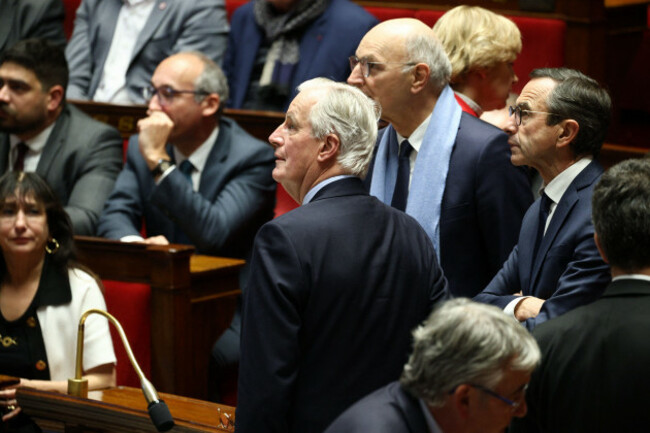
Macron now has the unenviable task of picking a viable successor with over two years of his presidential term left, with some — though not all — opponents calling on him to resign.
The president will then address the nation at 7pm Irish time.
Macron has rejected calls from the left to resign. During a visit to Saudi Arabia he told reporters that such a decision was “political fiction” and “doesn’t make sense”.
“It’s frankly not up to scratch to say these things,” Macron said.
“It so happens that if I am before you, it is because I was elected twice by the French people. I am extremely proud of this and I will honor this trust with all the energy that is mine until the last second to be useful to the country.”
The no-confidence motion, brought by the hard left in the National Assembly, came amid a standoff over next year’s austerity budget, after the prime minister on Monday forced through a social security financing bill without a vote.
With the support of the far right, a majority of 331 MPs in the 577-member chamber voted to oust the government.
It was the first successful no-confidence vote since a defeat for Georges Pompidou’s government in 1962, when Charles de Gaulle was president.
Macron flew back into Paris just ahead of the vote after wrapping up a three-day state visit to Saudi Arabia.
After landing in Paris, he headed directly to the Elysee Palace.
“We are now calling on Macron to go,” Mathilde Panot, head of the parliamentary faction of the hard-left France Unbowed (LFI) party, told reporters, urging “early presidential elections” to solve the deepening political crisis.
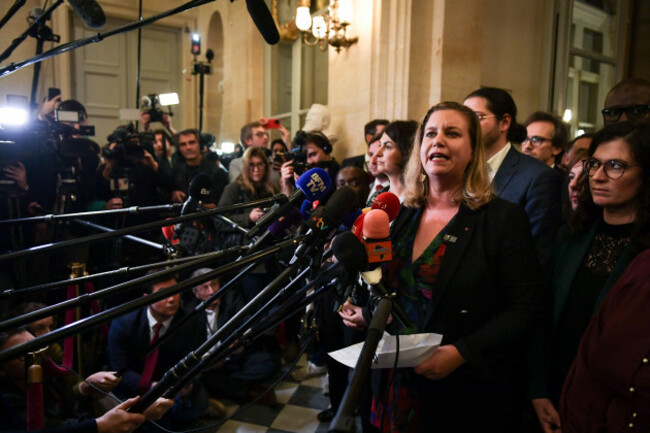
But taking care not to crow over the government’s fall, Le Pen said in a television interview that her party — once a new premier is appointed — “would let them work” and help create a “budget that is acceptable for everyone”.
Laurent Wauquiez, the head of right-wing deputies in parliament, said the far right and left bore the responsibility for a no-confidence vote that will “plunge the country into instability”.
Candidates for the post of premier are few, but loyalist Defence Minister Sebastien Lecornu and Macron’s centrist ally Francois Bayrou are possible contenders.
On the left, Macron could turn to former Socialist premier and interior minister Bernard Cazeneuve, a contender in September.
Barnier was the fifth prime minister to serve under Macron since he came to power in 2017, with every premier serving a successively shorter period.
Given the turbulence, the new nominee now risks serving an even shorter term than Barnier, whose tenure was the shortest of any administration since the Fifth Republic began in 1958.
“His failure,” was left-wing daily Liberation’s front-page headline, with a picture of Macron, whose term runs until 2027.
In an editorial, Le Monde said Le Pen’s move risked upsetting her own supporters, such as retirees and business leaders, by toppling the government.
“In the space of a few minutes, she shattered the strategy of normalisation she had consistently pursued,” the daily said.

To embed this post, copy the code below on your site













have your say