Sign in. It’s quick, free and it’s up to you.
An account is an optional way to support the work we do. Find out more.
Sign in. It’s quick, free and it’s up to you.
An account is an optional way to support the work we do. Find out more.
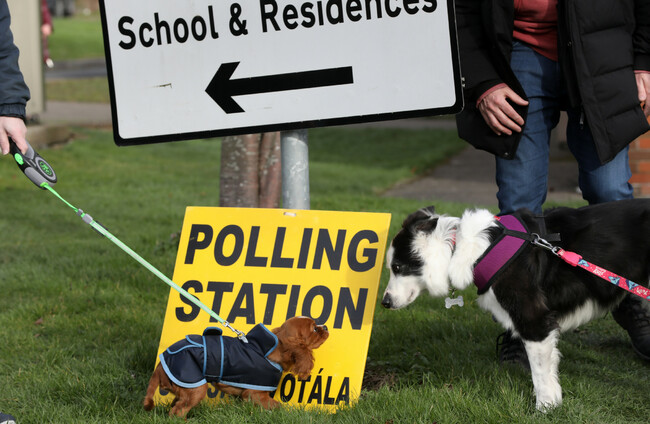
VOTERS WILL GO to the polls in just 21 days, on Friday 29 November, to choose who will lead the country for the next five years.
Political candidates will be campaigning hard over the course of the campaign to win your vote, but first things first – are you on the register?
If not, or if you need to change your address for any reason, you’ll need to act fast.
The deadline for registering to vote or update your details is Tuesday 12 November.
The window to register for postal and special voting is even shorter – this Sunday 10 November, in reality though this means you will need to get the forms posted today.
If you have not previously registered, you can do so on the Check the Register website. All you will need is your PPS number and your Eircode.
If you have previously registered, but are now living at a different address, you can update your details here. This must also be done by 12 November.
If you are moving from Dublin to any county outside of Dublin, or moving to Dublin from any county outside of Dublin, you can only update your details or change your address using the ERF1 Form, available here.
Once registered, a polling card will be sent to your home address before the general election.
Okay, so with that out of the way, here’s everything else you should know.
A lot of the parties began launching various policy documents in the weeks before the election was formally called.
We have a good idea of what most are proposing on housing and childcare already, with all of the big parties pledged to cut the monthly cost of childcare to €200.
Sinn Féin has also published a detailed health policy document. We can expect similar from Fine Gael and Fianna Fáil over the next couple of weeks.
Manifestos are set to start dropping early next week.
Fianna Fáil and the Green Party have both confirmed they will be the first to launch theirs, with the rest expected the following week. Fine Gael’s plans remain unknown, with a press officer telling The Journal they are “only operating in 24 hour cycles”.
In terms of slogans for this election, we have to give a notable shout out to Fianna Fáil and Independent Ireland for basically choosing the same one.
Here’s the core messages being put forward by the parties:
Fianna Fáil: ‘Moving Forward Together’
Fine Gael: ‘Putting money back in people’s pockets’
Sinn Féin: ‘It’s Time for Change’
The Green Party: ‘Greens Deliver’
Labour: ‘Building Better Together’
Social Democrats: ‘For the Future’
People Before Profit-Solidarity: ‘End 100 years of FF/FG – Another Ireland is possible’
Aontú: ‘It’s time for common sense’
Independent Ireland: ‘Forward Together’
How many seats are up for grabs?
As per the Constitution, there must be an average of one TD to represent every 20,000 to 30,000 people in the country.
This means that this general election will see 14 more TDs elected to the Dáil than before, following a review by the Electoral Commission last year.
This will make it the largest Dáil in the history of the State, with a total of 174 seats to be filled across 43 constituencies. Each constituency must have three, four or five TDs.
Some changes were made to the constituencies as part of a boundaries review last year. You can see how your area was impacted here.
You can check who is running in your area on The Journal‘s Candidate Database here.
Debates, debates, debates
At The Journal, we’ll be covering all of the main events across the election and diving deeper into the issues that our readers care about with sit down interviews with the various party leaders planned across the course of the next three weeks.
We kicked this off today, sitting down with Fianna Fáil leader Micheál Martin. You can read that interview here.
Our political podcast The Candidate will also be bringing you behind the scenes and behind the headlines of the election campaign every week. Episodes are available wherever you get your podcasts.
Elsewhere, one of the biggest components of any election campaign is always the live TV leaders’ debates.
This year, Virgin Media has pulled the plug on its live debates, leaving RTÉ to carry the mantle.
Although not officially announced by RTÉ, we understand Upfront with Katie Hannon will host a 10-way leaders debate on Monday 18 November.
Taking part will be: Fianna Fáil, Fine Gael, Sinn Féin, the Greens, Labour, Social Democrats, Aontú, Independent Ireland, People Before Profit and Independents4Change TD Joan Collins.
Prime Time will then hold a debate between the leaders of the three largest parties (Micheál Martin, Simon Harris and Mary Lou McDonald) on Tuesday 26 November.
Polling stations will open across the country at 7am on the morning of 29 November and you will be able to cast your vote until 10pm that night.
The following day, the counting begins.
Last time around, in 2020, it took three days for all of the ballots to be counted across the country.
If we expect similar again that means we should know who the winners and losers are by Monday 2 December at the earliest. Although, depending on if any recounts are required it could be longer.
The 34th Dáil is then scheduled to sit for the first time on Wednesday 18 December.
Compared to previous years, there is an unusually long gap between this and polling day, but it does give the parties plenty of time to get government formation talks done and dusted before Christmas.
In 2020, the arrival of the Covid pandemic in March meant it took five months for government formation talks to conclude.
Everyone will be hoping for speedier work this time around.

To embed this post, copy the code below on your site


















have your say