Sign in. It’s quick, free and it’s up to you.
An account is an optional way to support the work we do. Find out more.
Sign in. It’s quick, free and it’s up to you.
An account is an optional way to support the work we do. Find out more.

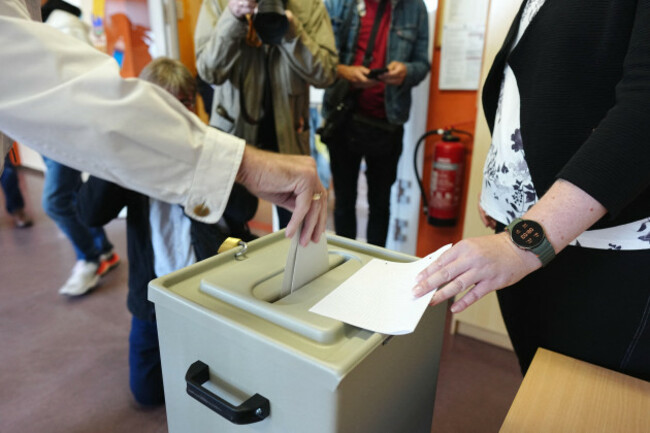
GERMAN VOTERS ARE going to the polls today for a crucial regional election in the eastern state of Saxony-Anhalt, where the far-right Alternative für Deutschland (AfD) is expected to win big.
The party, which has been polling at over 40% for months in Saxony-Anhalt, even has its sights on winning its first-ever state government, although this is far from assured.
Polls opened at 8am (7am Irish time) and some 1.7 million voters have until 6pm (5pm Irish time) to cast their ballots, with first projections expected shortly after.
The small state is currently ruled by the centre-right CDU of Chancellor Friedrich Merz in coalition with two smaller parties. Its state premier Sven Schulze is hoping to build another multi-party coalition to cling to power.
All other major parties have so far maintained a “firewall” of non-cooperation with the AfD, whose Saxony-Anhalt branch is categorised as a right-wing extremist group by Germany’s domestic intelligence agency.
The AfD’s top candidate Ulrich Siegmund, a 35-year-old who is lauded at campaign events and has a large social media following, has confidently predicted gaining an absolute majority.
“It was the others who erected the firewalls,” he told Bild newspaper. “If no one wants to work with us, then we’ll just have to do it alone.”
Such a scenario would shake Germany, a country that has long been at pains to atone for its history in World War II and the Holocaust and which has so far kept extremist parties in check.
A strong AfD win would also heap pressure on Merz, who has vowed to reboot a stagnant economy and restrict irregular immigration, but has seen his party beaten by the AfD in national surveys too.
“If the AfD wins in Saxony-Anhalt, Merz’s critics will become even more vocal, and calls for better leadership will become impossible to ignore,” said political scientist Wolfgang Schroeder of Kassel University.
However, Schroeder also said he does not expect Merz to be ousted, given the current absence of a strong rival candidate: “As far as I can see, there is no alternative chancellor.”
Siegmund has vowed to lead a political revolution from the small state of 2.1 million people that propels the anti-establishment party to national victory in 2029.
The AfD’s key campaign promises include a “remigration and deportation offensive”, a ban on LGBTQ pride rainbow flags at public schools, and an end to new wind farms.
The term ‘remigration’ refers to the forcible deportation of non-white people from Europe.
The party has also tapped into a sense of nostalgia for communist East Germany and lingering resentment about an enduring wealth gap with the West decades after the 1989 fall of the Berlin Wall.
The prospect of an AfD state government – while eagerly awaited by many voters– has sparked alarm among mainstream parties and minority groups.
Thousands of the AfD’s opponents joined a “festival of democracy” rally in Magdeburg on the eve of the vote.
The German Economic Institute warned the AfD’s immigration policy would be “ruinous” for the state, whose population is already ageing, shrinking and highly reliant on foreign-born workers.
Others have voiced fears an AfD-run state security apparatus could leak sensitive information to Russia.
The Kremlin “makes no secret of the fact that the AfD is the most important instrument for destabilising Germany for (Russian President Vladimir) Putin,” Thuringia state interior minister Georg Maier told the Handelsblatt daily.
The latest poll, released Thursday by public broadcaster ZDF, gave the AfD a commanding lead of 41%.
The CDU got 23%, the centre-left SPD 8.5% and the Greens 6%, while two smaller parties failed to cross the five-percent hurdle to reenter parliament.
A similar result may allow a scenario where the CDU and others form a minority government with ad hoc support from the far-left Die Linke party, which polled at 11.5%.
In the final stretch of campaigning, a social media video stoked fears about mail vote fraud, with claims of manipulation at an elderly care home that were denied by state authorities.
Germany’s parliamentary speaker Julia Kloeckner dismissed AfD speculation of voter manipulation, speaking to news weekly Der Spiegel.
“Questioning elections without concrete evidence appears to have one goal,” she said, “to sow distrust in our rules and to accept the results only if the outcome suits”.

To embed this post, copy the code below on your site














have your say