Sign in. It’s quick, free and it’s up to you.
An account is an optional way to support the work we do. Find out more.
Sign in. It’s quick, free and it’s up to you.
An account is an optional way to support the work we do. Find out more.


A MISTRIAL HAS been declared in the Lindsay Clancy case in the US. The 36-year-old was on trial for the murder of her three children, Cora, five, Dawson, three and eight-month-old Callan, by strangulation in her Massachusetts home in January 2023.
The defence’s case was that Clancy admitted killing her children, but pleaded not guilty by reason of lack of criminal responsibility, due to her suffering from postpartum psychosis at the time.
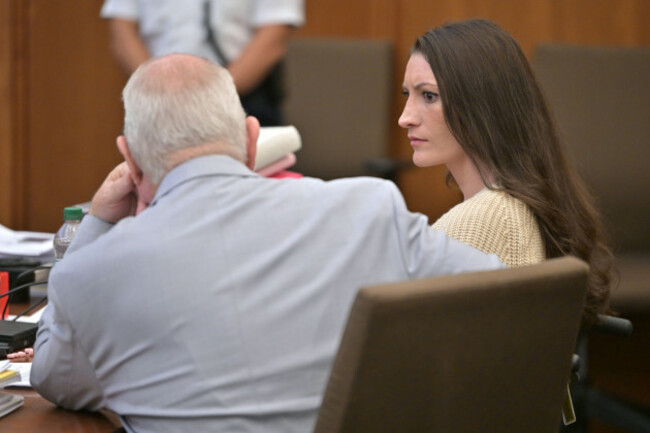
The dramatic mistrial verdict comes after the jury of nine women and three men could not break their 11-1 deadlock. The courtroom descended into chaos on Friday, as the defence claimed one juror allegedly held out on the majority’s preference for an acquittal. The judge gave Clancy’s attorney an hour to appeal.
The ruling stood, however, and Clancy now faces a likely retrial. It’s an outcome no one wanted and one which will no doubt be deeply retraumatising for her, the family and everyone involved.
The distressing case which has gripped onlookers on both sides of the Atlantic for the past five weeks became not only a trial about the tragic deaths of three young children and the devastating family tragedy at its core, but also a de facto trial on maternal mental health and how society views mothers who struggle.
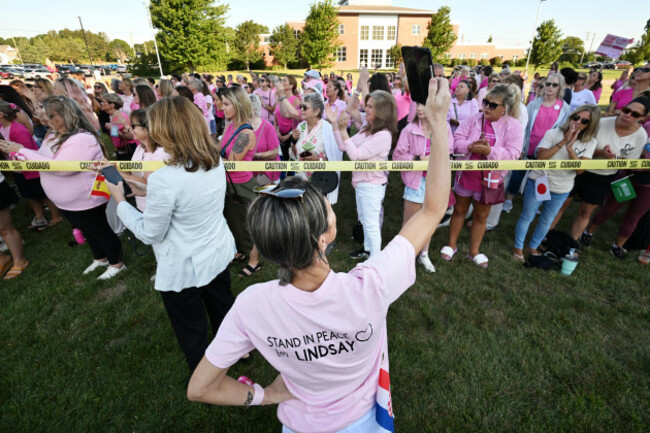
Unlike past similar cases of matricide, Lindsay Clancy received strong public support throughout the trial. Whether this reflects a growing understanding that we can no longer criminalise mental health and instead see the nuance behind the headlines, or an indication of the public’s appetite for true crime, women turned up outside the courthouse wearing pink for Lindsay for weeks on end.
Clancy received boxes full of letters of support from all over the world, as well as the constant stream of armchair sleuths on the internet proffering alternative theories about what might have happened.
Many found it almost impossible to make sense of the actions of the former nurse, who was by all accounts ‘a loving mother’ to her three children. During the trial, several witnesses, including family members, former in-laws and nannies, testified that Lindsay was a ‘good mother,’ with even her ex-husband and father of their three children, Patrick Clancy, agreeing she was a “very dedicated” mother who did everything for her children.
Over the weeks, the court heard how the Clancy home was full of their children’s drawings, their favourite toys, and how, like most mums, Lindsay had taken lots of pictures of her children and hung collages on the walls.
But Lindsay Clancy was struggling.
During the trial, the court heard how Lindsay, who is now wheelchair bound after jumping from a window following her actions, was preparing to return to work after her third child was born in May 2022. However, her postpartum mental health worsened.
From September 2022 to January 2023, she was prescribed numerous medications from several different doctors, leading the defence to argue that she was overmedicated.
Things took a turn in December 2022, when her anxiety peaked. She was not sleeping; she was overmedicated, and she reported having intrusive thoughts.
What makes this case even harder to understand, and what surely had a bearing on the messy verdict, is that Lindsay Clancy did exactly what people are urged to do when they no longer feel like themselves; she asked for help.
In the months before she strangled her three children, she told caregivers she was experiencing intrusive thoughts, wrote in self-help journals, sought inpatient treatment and was turned away, called a suicide helpline, used the words “I’m not okay,” and saw multiple psychiatrists.
Fundamentally, Lindsay Clancy was a loving mother who did what she was supposed to do when you’re not feeling like yourself, yet, as her defence argued in this case, she was let down everywhere she turned for help and support. Her defence was very clear that she was failed – many observers agreed – and the mistrial verdict is yet another reminder of the failure of a woman in crisis. We have got to do better.
In Ireland, according to the HSE, postnatal and perinatal depression happens in 10% to 15% of women. However, many mums will tell you the real number is probably much higher, because unlike Lindsay Clancy, many don’t ask for help.
I know this because I went through feelings of postnatal depression in early 2017 after the birth of my first child. I was scared. I felt isolated. I didn’t know what was happening to me or why. Because of the stigma and shame that surrounded postnatal depression, I was too afraid to ask for help. I won’t go down in the official record books as a perinatal depression case for that year, but I am one of the many silent statistics.
Many women do take that brave step to come forward in the hopes of finding help and support. Often, they find that GPs are “unprepared for addressing their perinatal mental health difficulties,” a 2025 Mental Health Reform Paper outlined. It reported, “community and medical appointments during and six weeks after pregnancy are not adequately addressing mental health needs as they arise.”
Adding, “at a three-month postpartum health visit, 49% of people were not asked about low mood or depression by their doctor, and almost 36% were not asked by their public health nurse.”
It’s a familiar scenario to many new mums, who can attest to being asked ‘but have you tried journalling, or yoga or going for walks?’ when they tell a medical professional how they are feeling.
While all those things might be helpful in getting some headspace, what mothers who are struggling need is a tangible support system. What they have at present is a chronically underfunded and under-resourced perinatal mental health system that is often difficult to access and has no dedicated mother and baby unit. The specialist psychiatric inpatient unit where mothers experiencing severe mental illness can receive intensive treatment while remaining with their babies has been badly needed for decades.
Specialist Perinatal Mental Health Services (SPMHS) are now available in all 19 maternity hospitals nationwide, but only six of these are consultant-led multidisciplinary teams. The others are bespoke sites staffed by perinatal mental health midwives. The government has also committed to opening that much-needed mother and baby unit, but while all these things sound great on paper, are mothers on the ground seeing an impact? Are they getting help when they ask for it? Can they easily access services?
Aolish Gormley, who herself suffered from postnatal depression and is the woman behind the Year of Care campaign, which is calling for a full year of meaningful postnatal care, has heard many instances where the reality does not meet up to the promises.
“I recently heard from a woman who had experienced postnatal depression after her second child and is now pregnant again. Knowing her history, she proactively asked to be referred to the perinatal mental-health team. She received a letter back saying the service was not currently accepting applications.”
It’s not an isolated occurrence. On my second pregnancy, I verbalised my worries about going through postnatal depression after my previous experience. Despite being told that I’d be linked in with the hospital’s perinatal mental health team, I was not, and no one asked about my mental health after the birth or at any of my appointments.
As it stands, suicide is the leading direct cause of maternal death in Ireland. The 2025 Mental Health Reform paper noted that eight of the 24 deaths of new mothers between 2019 and 2021 were at their own hands (33%), compared to 12.3% of maternal deaths over the period from 2009 to 2021.
In the UK, it’s recently been reported that thousands of women suffer from undiagnosed PTSD after childbirth and do not receive the correct specialist care. While we don’t have official statistics from Ireland relating to PTSD, given the state of our perinatal health services, it’s not hard to imagine that those stark figures are being replicated here.
This trial and the messy verdict should serve as a line in the sand in how we both view and support postpartum women in crisis. We keep telling mums to ask for help when they need it, but what happens when they do?
If we want to help other women like Lindsay Clancy before it’s too late, this question can no longer go unanswered.
Niamh O’Reilly is a freelance writer and journalist.
If you have been affected by any of the issues mentioned in this article, you can reach out for support through the following helplines. These organisations also put people in touch with long-term supports:
To embed this post, copy the code below on your site














have your say