Sign in. It’s quick, free and it’s up to you.
An account is an optional way to support the work we do. Find out more.
Sign in. It’s quick, free and it’s up to you.
An account is an optional way to support the work we do. Find out more.
LAST UPDATE | 18 Mar
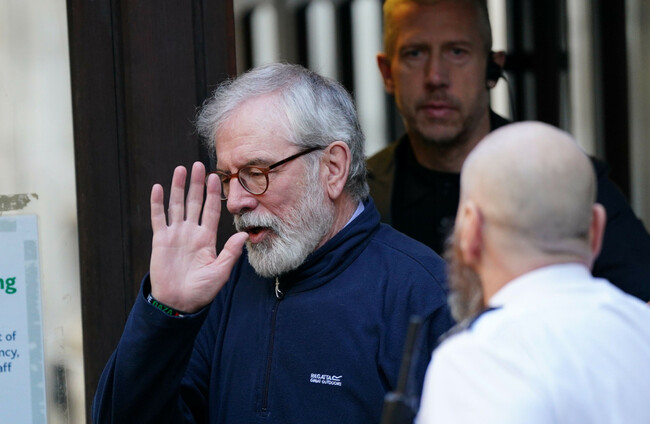
EVIDENCE PROVING GERRY Adams was behind three IRA bombings in England is “extremely limited” and “bordering on non-existent”, the UK’s High Court heard.
Edward Craven KC, for Adams, said the job of the court should not be to rule on a historical truth but to address a dispute between two parties.
John Clark, a victim of the 1973 Old Bailey bombing in London; Jonathan Ganesh, a 1996 London Docklands bombing victim; and Barry Laycock, a victim of the 1996 Arndale shopping centre bombing in Manchester, all allege that Adams was a leading member of the Provisional IRA on those dates, including of its Army Council, and are seeking £1 in damages.
The former Sinn Féin president denies the allegations and is defending the claim, telling the court that he had “no involvement whatsoever” in the bombings and was never a member of the Provisional IRA.
Adams today told the High Court the IRA were “undefeated” and “defied all attempts to criminalise them”.
Max Hill KC, for the three bombing victims, referenced a statement from the 1980s made be a solicitor who had represented Adams, which said that “the provos will do” whatever Adams says.
Adams said the statement was “not accurate” and denies ever being a member of the Provisional IRA.
He added: “These are men and women who fought the British, arguably from 1970 or 1971, right up until the historic statement in 2005.
“They were undefeated, they defied all attempts to criminalise them, to coerce them, they made the right call when they eventually made the call and they had the maturity and intelligence to choose the right way forwards.”
After Adams finished giving evidence today, Craven said to the judge: “You have actually had very little evidence of how, why and by whom these bombings were authorised.
“That is the central question in this trial. When you actually focus on that, the evidence is extremely limited and we say bordering on non-existent.
“There is not a single page in the 6,000-page bundle that implicates Mr Adams in any of the bombings.”
About the evidence given by the 13 witnesses, some of which related to intelligence gathered years ago, he said: “All you have is high-level assertions, unsupported by detail, uncorroborated by documents.
“We say that comes absolutely nowhere close to proving allegations of this magnitude.”
He added: “The desire to establish for the historical record that Mr Adams was a member of the IRA is the purpose that has driven this claim.”
Adams has claimed that while he was a member of Sinn Féin, and was the organisation’s president from 1983 to 2018, he “was never a member of the IRA or its Army Council, and I never held any role or rank within the IRA”.
Last week, the court heard from former intelligence operatives working for the British authorities who said they believed Adams was a “de facto leader” of the IRA and he ran his own “fiefdom” in Belfast.
Hill KC, for the three bombing victims, said while cross-examining Adams today that a former volunteer Brendan Hughes, who had at one point been friends with Adams, understood Adams to be a “major, major player in the war”.
Hughes said the words during a recorded interview that was played in court to Adams.
Hughes and Adams were at Long Kesh prison together in the early 1970s and they were together the day before Hughes died in 2008, the court heard.
Today, after playing the clip in which Hughes calls Adams a major player, Max Hill KC, for the three bombing victims, said: “You were, weren’t you Adams? And you deny it.”
Adams said: “I was president of Sinn Féin for 35 years, deeply involved in the struggle.
“I defended the use of armed struggle when I thought it was appropriate.
“I’m not boasting but I don’t deny that I was a person of interest, of influence, and I used that influence as best I could to move from war to peace and that is, thankfully, what we are enjoying to this day.”
Hill also quoted a passage from the book Say Nothing, in which Hughes gave an interview saying that Adams’s IRA membership was common knowledge.
He said: “The British know it. The people on the street know it. The dogs know it on the street. And he’s standing there denying it’.”
Hill also described Hughes as a “proud IRA volunteer until his death”.
Adams replied: “I don’t know what his status was.
“It’s interesting that the direction from the claimants’ counsel was that I was helping, involved, in those armed actions and those decisions to bring the war to Britain, while those who were against what we were doing saw us as traitors.”
The court also heard that Adams had “great admiration” for a former IRA “gunrunner”.
Hill asked Adams about former Sinn Féin politician Martin Ferris, who he described as a “former member of the IRA and convicted IRA gunrunner”.
Adams said he knows him and that he has “great admiration for him”.
Hill named other prominent Sinn Féin figures who he said were part of the IRA, such as Pat Doherty and Gerry Kelly.
The barrister said: “It is not contradictory to say that senior politicians were also involved in the activities of the IRA.”
Adams said Sinn Féin is “replete with histories of IRA people who then went on to embrace politics”.
He added: “It is not a new thing at all.”
Hill said: “You were not unique, you were like everybody else”.
Adams replied: “That’s not true.”
Adams also said today that the British government “dodged its responsibility” in the Northern Irish peace process.
Hill said: “The Home Secretary has concluded that Mr Adams is at the nerve centre of the PIRA. My question is, is that accurate?”
Adams said: “That is not true. The British Government had to come to terms that there was a possibility of peace and a political process. They dodged their responsibility by demonising those of us who were trying to reach out and to find ways of getting out of the chaos towards a democratic conclusion.”
Hill asked whether there was a “conspiracy” against Adams and if they “deliberately” described him as a terrorist “knowing it was false”.
Adams said: “They may have believed it for all I know but it was an easy option for them.”
He added later: “The bombings in this case, the killing of three people and the wounding of others, I regret very much, but the folks giving this information have a vested interest.”
Hill also said that 1,178 people were killed by the Provisional IRA and that Adams has “over a long period of time, chosen to stand by the IRA”, to which Adams replied: “I do not stand by everything that they did, but these were my neighbours.”
Anne Studd KC, for the bomb victims, previously told the trial that being a member of Sinn Féin and a member of the Provisional IRA was “a distinction without a difference” for some individuals, including Adams.
Studd also told the court that Adams had “a foot in each camp” of the military and political sides of the Irish Republican movement.
The barrister continued that Adams was “directly responsible for and complicit in those decisions made by that organisation to detonate bombs on the British mainland in 1973 and 1996”.
The trial before Mr Justice Swift, is due to conclude later in March.

To embed this post, copy the code below on your site








have your say