Sign in. It’s quick, free and it’s up to you.
An account is an optional way to support the work we do. Find out more.
Sign in. It’s quick, free and it’s up to you.
An account is an optional way to support the work we do. Find out more.
 GE2024Climate Change
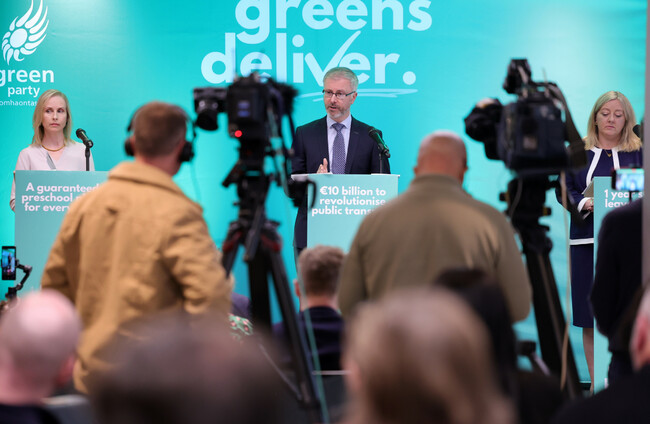
THE GREEN PARTY has outlined its priorities for the general election, pledging to “supercharge” transport projects, introduce a tax on business class flights and roll out better supports for new parents.
The party launched its general election manifesto in Dublin this morning, a 90 page document entitled: ‘towards 2030 a decade of change volume II’.
One journalist at the press conference was quick to focus on the inclusion of ‘volume II’ in the title, making the point that it is a well-known cliche that sequels are generally worse than the original.
Deputy party leader Róisín Garvey didn’t miss a beat, shooting back that Paul Mescal’s Gladiator will be better than the original.
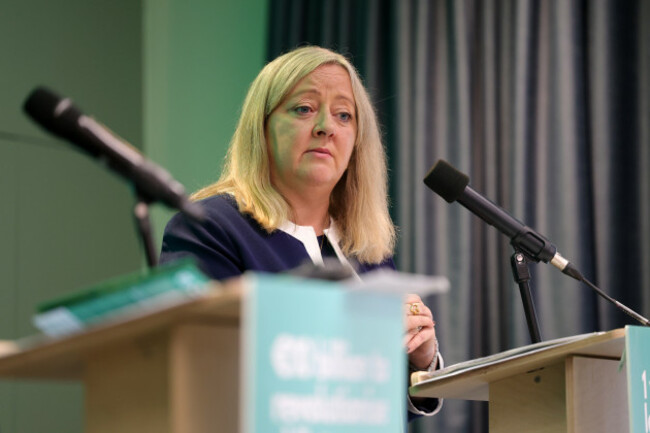
Party leader Roderic O’Gorman told reporters that it was the Green Party who have been “the drivers of change” over their last five years in government, pointing to progress in reducing emissions, improving public transport and reducing childcare costs.
“We say to voters today, don’t put that progress at risk,” O’Gorman said.
“In this election, we’re saying we want to go much further, and for the sake of our planet and for our children’s future, we must go much further.”
The Green’s manifesto covers a range of policy pledges, including investing approximately half of the Apple tax money to “supercharge” delivery of major transport projects in the State.
For parents, the party has pledged to increase maternity leave from 26 weeks to 28 weeks and increase paternity leave from two weeks to four weeks.
The party has also pledged to reduce the voting age to 16 and introduce gender quotas at the Cabinet table mandating that 40% of Cabinet ministers must be women.
It has also pledged to extend the right to request remote working to all workers.
The document also includes a commitment to legislate for assisted dying, a pledge absent from Fianna Fáil’s manifesto, which was launched yesterday.
On the Apple Tax, the party has pledged to use €7bn of the Apple tax money, along with an additional €3bn from other sources, to improve public transport and cut emissions.
This would include investment in major projects including Metrolink, Dart+, the Luas extension, and rail projects in Cork, Limerick, Galway and Waterford.
The manifesto also focuses on continuing the roll-out of ‘Local Link’ bus routes in rural Ireland and more late-night and 24-hour buses in urban areas.
The party has also set its sights on air travel, proposing a tax on private jets and business class travel.
It also includes a pledge to equip 200,000 low-income homes with free solar panels and includes further details on its plans for a State-led childcare model.
On housing, the Greens are proposing to extend the existing Help to Buy scheme to include people who wish to buy the home they are renting.
The current system only applies to new build homes.
When asked by The Journal if the party will now support the reintroduction of a temporary no-fault eviction ban now that they are no longer tied to Fianna Fáil and Fine Gael, O’Gorman said his focus is on “providing solutions for people who are at risk of homelessness”.
He argued that this is best done through the tenant in situ scheme, which enables a local authority to buy a home if it is being sold and the tenant is at risk of homelessness.
The manifesto also pledges to improve the reliability of bus and rail services and plans for a new “Climate Ticket” that will offer extra savings to regular commuters.
It’s understood that the climate ticket is suggested as a replacement for the existing Tax Saver ticket for commuters that was introduced pre-pandemic. The Green party has proposed this new ticket system to better reflect modern-day work patterns, where many workers work from home for part of the week and therefore no longer get value from the Tax Saver ticket.
Elsewhere, the Labour Party will launch its finance policy in the afternoon.
Labour has said it wants to prioritise investment in public services instead of “irresponsible” tax cuts, arguing that goverment must be ready for possible economic shocks and challenges in the coming years.
It is set to propose that income tax credits and bands, as well as social welfare payments, be indexed to an average of inflation and wage growth. Further increases to social welfare payments would also be agreed annually as part of the Budget.
It will also pledge to broaden the tax base with increased tax on wealth, rather than income, by designing a wealth tax similar to the Spanish model.
In Spain, a wealth tax is paid annually on the net value of a person’s total assets.

To embed this post, copy the code below on your site













have your say