Sign in. It’s quick, free and it’s up to you.
An account is an optional way to support the work we do. Find out more.
Sign in. It’s quick, free and it’s up to you.
An account is an optional way to support the work we do. Find out more.
LAST UPDATE | 24 Apr 2025
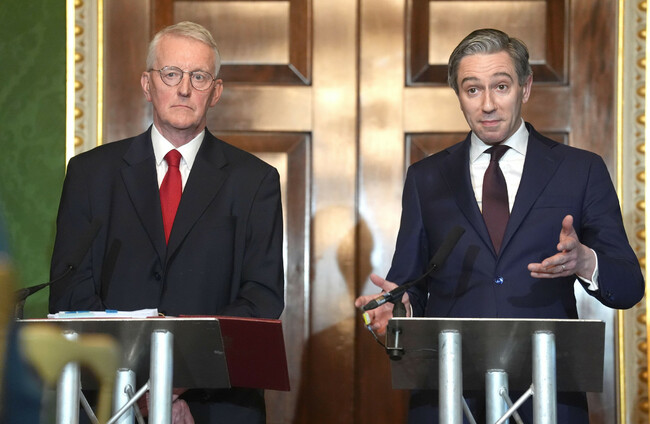
TÁNAISTE SIMON HARRIS has said that the Irish and British governments will know whether they can reach an agreement on Northern Ireland legacy issues “within weeks”.
The Foreign Affairs Minister said both governments are working in “very good faith” to bring about an agreed position.
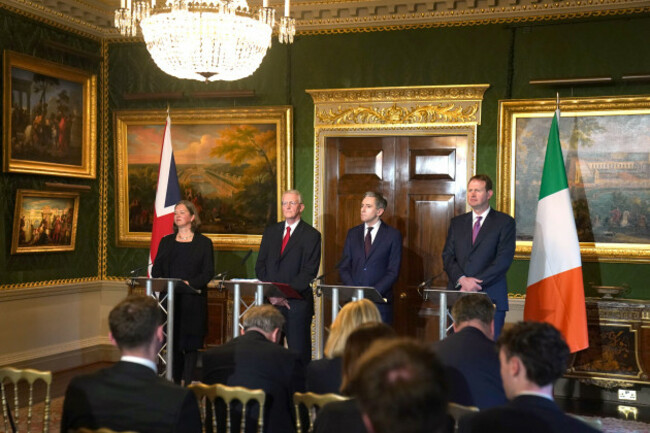
He made the comments following a meeting of the British-Irish Intergovernmental Conference (BIIGC) at Hillsborough Castle in Co Down.
Harris met with Northern Ireland Secretary Hilary Benn at the meeting, which focused mostly on legacy issues. Justice Minister Jim O’Callaghan and Northern Ireland’s Parliamentary Under-Secretary of State Fleur Anderson also attended the conference.
It was the first time the conference, which was established under the Good Friday Agreement, has been held in Northern Ireland since 2006.
Speaking to reporters, Harris said the discussions were applying two key tests when it comes to legacy: whether the mechanism complies with the European Convention on Human Rights, and whether it has the support of victims and their families.
“We are in the middle of a negotiation and a discussion, so I don’t want to go through each issue, other than to say I think a lot of progress has been made on a lot of issues,” Harris said, adding that there is ”a moment in time where we have to call this for many reasons”.
“People are getting older. People are going to their grave still not knowing the truth in relation to the loss of their loved one,” he said.
I think we will know within weeks whether it is possible to have a joint position between the two governments or not.
“I really hope it is, and we’re both working in very good faith to try and bring that about. But it is now a question in my mind of within weeks.”
He said it was important for both sides to come to an agreement on what legacy mechanisms look like.
Describing their meeting as “constructive”, he said there were detailed discussions on the reform of the controversial Legacy Act and the Independent Commission for Reconciliation and Information Recovery (ICRIR).
“I passionately believe, I know you do too, that this peace agreement, the Good Friday Agreement works best when the two governments pull in the same direction, and if at all possible, that’s where we want to get to, where we could actually have a joint position in terms of a mechanism on the legacy of the past,” he added.
Benn agreed that their discussions had been “productive”, adding that the governments have “moved closer together” on an agreed position on legacy issues.
“Over the the work that’s been taking place in recent months, we’ve moved closer together,” the Northern Ireland Secretary said.
“I think that’s a very fair reflection as what has been happening and we’re putting in all of this effort, the intensive discussion that our officials have been engaged in, the regular conversations that the Tánaiste and I have had is because we want to be able to find an agreement.”
Benn said that some of the issues “are quite tricky”, but said that both sides are “putting the work in “because we believe we’ll be in a stronger position if we can find an agreement, and in the end, help to build confidence in arrangements that, in the end, are going to deliver the families”.
“This is what it’s all about. It is the families that we have to have in mind, and in particular, the many families I have met who are still searching for answers, in some cases after very many years, about what exactly happened to their loved ones.
We all have an obligation to find a mechanism that will finally give them the answers they have sought for so long.
The meeting follows the UK-Ireland summit in March when the two governments pledged to work closely to deliver security, investment and growth.
At the time, Prime Minister Keir Starmer said the relationship between the UK and Ireland had “reset” following a “turbulent” post-Brexit period.
With reporting by Press Association

To embed this post, copy the code below on your site














have your say