Sign in. It’s quick, free and it’s up to you.
An account is an optional way to support the work we do. Find out more.
Sign in. It’s quick, free and it’s up to you.
An account is an optional way to support the work we do. Find out more.
LAST UPDATE | 24 Jun
FRANCE HAS EXPERIENCED its hottest day since measurements began in 1947, as temperatures across 30 stations averaged at 30 degrees – breaking a record of 29.8 degrees set just a day earlier.
The unprecedented heatwave has smashed records across Europe, and sent air conditioner sales zooming in a continent unused and ill-equipped to handle searing heat.
The extreme weather is being driven by atmospheric and circulation patterns that keep hot air trapped in place for days, causing the mercury to slowly rise, with these factors exacerbated by global warming, experts say.
Ireland will also continue to see very warm and humid conditions, with highest temperatures of 23 to 28 degrees.
Sales of fans and air conditioners meanwhile skyrocketed in France, where most buildings are not designed to deal with extreme heat.
On Monday, hypermarket operator Carrefour had sold 30,000 units by 6.30 pm – “a thousand times more than on a normal day”, CEO Alexandre Bompard said.
Sales on Amazon nearly doubled last week compared with the same period in 2025, whilst electronics outlet Fnac Darty reported double-digit growth.

With four more French departments being put under the highest heat alert category Wednesday, some 44 million people are affected, according to AFP calculations.
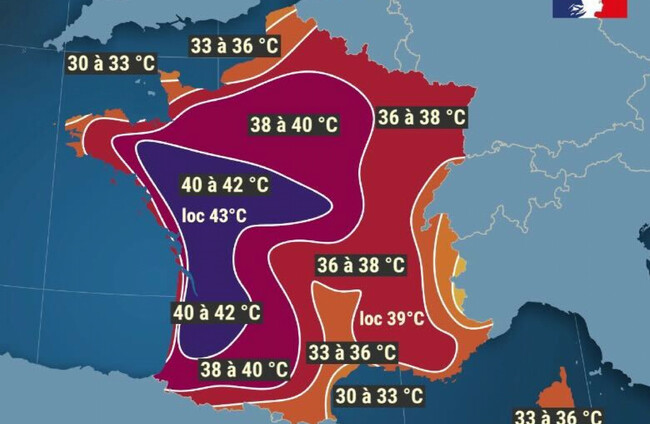
Added to the 31 departments currently on orange alert, more than 90% of the French population is exposed to extreme heat, with temperatures of 39C to 41C expected on Wednesday from Brittany to the Paris region, and in much of the south-west.
John Beeler, a 45-year-old American engineer, said he and his wife were baking in Paris.
“Visiting Paris in this heat is awful,” he told AFP, wearing a fisherman’s hat and holding a small fan.
“We’re suffocating in the streets, we’re suffocating in the subway and we’re even suffocating in our rental,” he said, adding they would be moving to an air-conditioned hotel room.
Italy’s health ministry declared a red heatwave alert in 16 cities on Wednesday, including Milan and Rome.
In the coming days, the heatwave is expected to extend into eastern Europe.
Poland’s weather service issued high-level heat warnings for the western part of the country from Thursday to Saturday, forecasting temperatures could break the record of 40.2C set in 1921.
Croatia’s popular Adriatic coast was also put under red alert for Friday and Saturday.
Hungary, already under a second-level heat alert, said it was raising that to the maximum level from Saturday to Tuesday as temperatures continued to rise.
The current heatwave is “significantly exacerbated by human-induced climate change”, without which the current temperatures would have been 2 to 4C cooler, according to a scientific study published this week.
But some relief could start to come from the west on Wednesday, when Spain’s national weather service said temperatures would drop in most of the country.
By Wednesday afternoon, only parts of the Basque country in the north will still be marked red, and on Thursday no part of Spain will be rated either red or orange.
But no quick relief is in sight across the rest of Western Europe.
From Wednesday until at least Friday, central and southern Netherlands will be under a code orange for extreme heat.
Anyone living in Amsterdam with a city pass may swim for free in six city outdoor pools, while national rail company NS will run fewer trains on a number of routes starting Wednesday due to the expected heat.
In Britain, James Bowen, assistant general secretary at the National Association of Head Teachers, told AFP that “pretty much every school up and down the UK will be having to make some form of adaptation this week in light of the extreme heat.
“I think it’s fair to say that the school estate in the UK is not well prepared for this level of heat,” he said.
After some of France’s most visited sites, such as the Louvre museum and the Eiffel Tower, decided to limit visiting hours, the management of one of Belgium’s best-known monuments, the space-age Atomium in Brussels, said it will close earlier to visitors from Wednesday to Friday.
With reporting by AFP

To embed this post, copy the code below on your site













have your say