Sign in. It’s quick, free and it’s up to you.
An account is an optional way to support the work we do. Find out more.
Sign in. It’s quick, free and it’s up to you.
An account is an optional way to support the work we do. Find out more.
PRICES SOUGHT FOR houses in the second quarter of this year was 35% higher than at the onset of the Covid-19 pandemic, according to the latest Daft.ie House Price Report.
As of the second quarter of 2024, the average listed price for a home nationwide was €340,398.
In addition to being 35% higher than the pre-Covid levels, the figure from Q2 2024 is 6.7% higher than the same period last year, and a quarterly rise of 3.8% – the largest quarterly increase since 2020.
In year-on-year terms, prices are rising in all but two of the 54 markets covered in the Daft.ie report – prices are falling in Dublin 2 and stable in Dublin 6.
Author of the report Ronan Lyons noted that prior to the pandemic, prices nationwide went from rising or stable to falling as “supply had caught up to demand”.
In Dublin, prices in the second quarter of the year were 4.7% higher than a year previously while in Cork and Waterford cities the increase was closer to 10%.
In Galway and Limerick cities, prices were more than 12% higher year-on-year.
A similar pattern holds for the rest of the country.
In Leinster, outside Dublin, prices were up 6.1% year-on-year, while in Munster the increase was 10.4% and in Connacht-Ulster 6.2%.
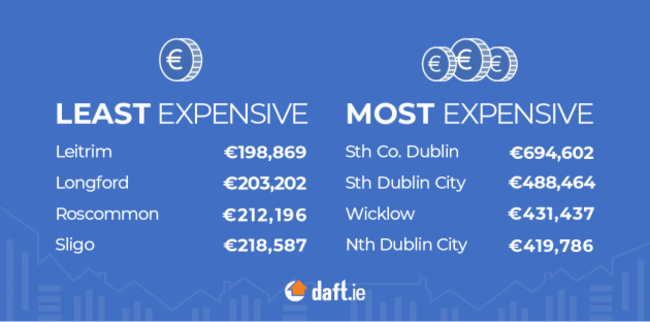
Meanwhile, Leitrim is the county with the lowest average asking prices at €198,869.
This is followed by Longford on €203,202, Roscommon at €212,196, and Sligo on €218,587.
At the other end of the scale, South County Dublin has the most expensive house prices at €694,602, followed by South Dublin City a considerable way back at €488,464.
Wicklow ranks third on €431,437, followed by North Dublin City on €419,786.
The Daft.ie report also notes that “the lack of supply has been a relatively constant feature” over the past five years and nationally, the number of second-hand homes available to buy is down 18%.
As of 1 June, there were fewer than 11,400 second-hand homes on the market, well below the 2015-2019 average of 24,700.
In Dublin, supply in the second-hand home market fell 18% on the same period last year, and down 19% in Leinster (outside of Dublin).
The supply picture is worse in Munster, with supply in the second-hand home market down 20%, and down 15% in Connacht-Ulster.
Lyons said that over the past 20 years, “a clear pattern has emerged in both sale and rental markets: when availability is tight, prices are pushed upwards”.
He said availability in the sales market has been “consistently tight since the start of the year” and therefore it’s “not surprising that prices nationally recorded their largest three-month increase since 2020”.
He added that the “tight availability of second-hand homes reflects the impact of significant interest rate increases”.
“As rates come down again, and in particular as sitting homeowners come off fixed-rate mortgages, supply should improve,” said Lyons.
“This, however, is likely to take time and thus tight conditions may continue for some time.”
-With additional reporting from Press Association

To embed this post, copy the code below on your site












have your say