Sign in. It’s quick, free and it’s up to you.
An account is an optional way to support the work we do. Find out more.
Sign in. It’s quick, free and it’s up to you.
An account is an optional way to support the work we do. Find out more.

A SINGLE MOLECULAR event could be the reason that humans ended up the smartest animals on the planet.
A study in the most recent issue of Science magazine suggests that just one tiny alteration can be the difference in a human brain.
Benjamin Blencowe, a professor in the University of Toronto’s Donnelly Centre, and his team have uncovered how a small change in a protein called PTBP1 can spur the creation of neurons, the cells that make the brain. This could have fuelled the evolution of human brains, making them the largest and most complex among vertebrates.
Brain size and complexity vary enormously across mammals, but it is not clear how these differences came about.
Humans and frogs, for example, have been evolving separately for 350 million years and have very different brain abilities. Yet scientists have shown that they use a remarkably similar repertoire of genes to build organs in the body.
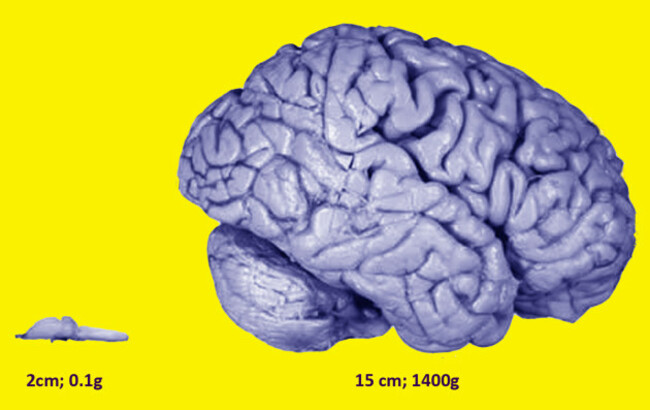
But how do these genes evolve? And could they give clues as to how the human brain evolved?
The key lays in the process that Blencowe’s group studies, known as alternative splicing (AS), whereby gene products are assembled into proteins, which are the building blocks of life. During AS, gene fragments — called exons — are shuffled to make different protein shapes. It’s like Lego, where some fragments can be missing from the final protein shape.
“We wanted to see if AS could drive morphological differences in the brains of different vertebrate species,” says Serge Gueroussov, a graduate student in Blencowe’s lab who is the lead author of the study.
“This is the tip of an iceberg in terms of the full repertoire of AS changes that likely have contributed major roles in driving evolutionary differences,” says Blencowe.

To embed this post, copy the code below on your site













have your say