Sign in. It’s quick, free and it’s up to you.
An account is an optional way to support the work we do. Find out more.
Sign in. It’s quick, free and it’s up to you.
An account is an optional way to support the work we do. Find out more.
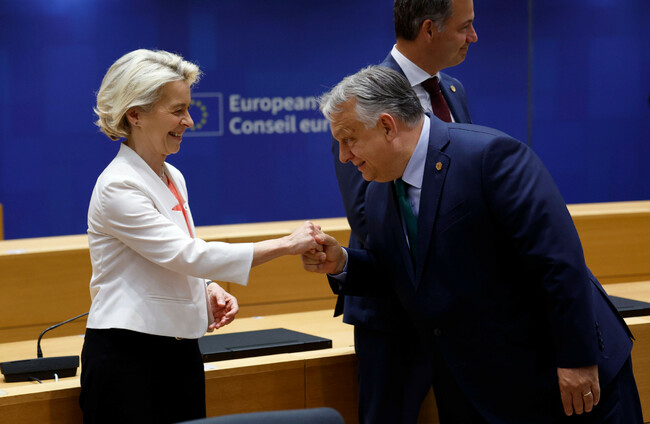
VICTOR ORBAN’S HUNGARIAN government continues to provide headaches for the European Union in a number of areas, some of which have been outlined in an annual Rule of Law Report published today by the EU Commission.
The report covers a range of areas of concern for the EU Commission, including in the country’s justice system, media, civil liberties and corruption.
In a number of areas, the Commission found Hungary has made no progress at all since last year’s report.
“Hungary is a real systemic issue for the Commission about the rule of law,” EU Justice Commissioner Didier Reynders told a news conference presenting the report.
The Commission has recommended eight reforms for Hungary to undertake – one more than last year.
They include improvements to its justice system, boosting oversight of lobbying and the independence of the media regulator, and removing obstacles encountered by civil society organisations.
These concerns are in addition to those EU member states have over what they see as Orban’s rogue diplomacy, which has ramped up lately with trips Russia and China. Orban has also thrown a spanner in the works on more than one occasion when the EU has attempted to supply aid to Ukraine in its fight against Russia.
Judicial system
The EU Commission said that Hungary’s 2023 judicial reform is being implemented and while progress has been made, there are still concerns about political influence over judges and the allocation of cases.
Hungary’s new legal framework aims to limit the risk of arbitrary decisions about the careers of judges, but the Commission assessed that “no further steps were taken to address concerns raised by the National Judicial Council”, the body that administers the courts.
The Commission said that political influence on the prosecution service remains an issue, which it said brings a risk of undue interference with individual cases. The Constitutional Court still reviews the final rulings of lower courts when it comes to politically sensitive cases, the report said.
The report also found that judges’ freedom of expression remains under pressure and smear campaigns against judges are still found in Hungarian media. They are also getting paid less and less.
Press freedom
Media diversity in Hungary remains a concern for the EU, having been highlighted as an issue in previous rule of law reports.
The report assessed that no progress has been made on strengthening the rules and mechanisms regarding the independent governance and editorial independence of public service media.
“No measures have been adopted or are planned to regulate the channelling of state advertising to media outlets, to guarantee the functional independence of the media authority and to ensure the editorial and financial independence of public service media,” the report said.
Journalists and independent media outlets continue to face challenges in doing their work, including “seemingly coordinated smear and de-legitimisation campaigns”, as well as selective access to government premises and events.
When it comes to freedom of information, new legislative changes have introduced restrictions on access.
Corruption
Hungary has adopted a new anti-corruption strategy for 2024-2025, which includes plans for legislation on lobbying and the revolving door system that sees government employees walk out of departments and into corporate jobs – and vice versa. The report found that no progress has been made in this area.
There are also still issues with enforcement and oversight when it comes to asset declarations, the Commission said.
The impact of Hungary’s Anti-Corruption Task Force “remains to be seen”.
“Shortcomings regarding political party and campaign financing remain unaddressed,” the report said.
It noted that some high-level corruption cases have reached the indictment stage, “but the lack of a robust track record of investigations of corruption allegations concerning high-level officials and their immediate circle remains a serious concern”.
The report said the EU will continue to suspend commitments from EU funds and withhold payments to Hungary, “as no new measures have been adopted to remedy the outstanding rule of law and anti-corruption issues”.
Civil liberties
The Commission found that Hungary has made no progress on “fostering a safe and enabling civic space” and has failed to remove obstacles affecting civil society organisations.
Hungary’s ‘state of danger’, which when invoked gives Prime Minister Orban sweeping powers to rule by decree and sidestep parliament, has been extended until November 2024 – another cause for concern for the EU.
The ‘state of danger’ provision was introduced as a constitutional amendment by Orban’s government in 2022 and was immediately employed in May of that year, with the government citing the war in Ukraine as justification.
Additionally, the report found that “the quality of law-making and the frequent changes in legislation remain a significant cause for concern”.
Concerns about the government’s role in financing civil society in general continue, the report said, adding that “obstacles affecting civil society organisations persist, while the new Protection of National Sovereignty Act further undermines civic space”.
Last month, Human Rights Watch along with nine other NGOs said: “The EU should accelerate legal proceedings and seek the suspension of the country’s repressive Law on the Protection of National Sovereignty, which has been used to target Transparency International Hungary and the investigative journalism outlet, Átlátszó.”
Includes reporting from AFP

To embed this post, copy the code below on your site















have your say