Sign in. It’s quick, free and it’s up to you.
An account is an optional way to support the work we do. Find out more.
Sign in. It’s quick, free and it’s up to you.
An account is an optional way to support the work we do. Find out more.
Updated 6.15pm
THE INTERNATIONAL MONETARY Fund has criticised a major policy introduced by the Government in the run up to last month’s elections.
In its first post-bailout review of the nation’s finances, the IMF trained its fire on the Government’s plans to boost mortgage lending by guaranteeing borrowings.
In a conference call this afternoon, former IMF mission chief Craig Beaumont said that the Government should exercise “significant caution in adopting a guarantee framework”.
The report broadly endorses the Government’s economic strategy, while drawing attention to impediments to growth that seem to ensure the recovery will remain sluggish at best.
Mortgage plan warning
The IMF warned against measures contained in the Government’s Construction 2020 strategy, which was published in the weeks preceding the local and European elections.
One aspect of the plan in particular, which would allow borrowers to draw down up to 95% of the value of a home with support from the Government, was singled out for attention.
On the plan, IMF staff say that they:
Caution against such mortgage guarantees in view of the implications for contingent liabilities and credit standards.
‘Major challenges’ on ISIF
In the report, the IMF also forecasts ‘major operational challenges’ in commercial lending from the Irish Strategic Investment Fund, formerly the NPRF.
Prior to the election, the Department of Finance issued a statement saying that the ISIF “is open for business and actively seeking commercial investment opportunities in Ireland”.
However, the IMF has questioned the wisdom of this move, and said the ISIF should be kept on a short leash:
“The continued need for the ISIF should be reviewed periodically, taking into account its performance and developments in the range of private financing options available.”
Cash from the ISIF is also being pumped into the Strategic Banking Corporation of Ireland, also announced in the weeks immediately before the election.
Overall view
The report welcomes an up-tick in major macroeconomic indicators, including unemployment and tax receipts.
However, in keeping with advice from the Government’s own fiscal watchdog issued yesterday, it recommends keeping the €2 billion budget adjustment planned for this year.
It also flags low rates of private and public sector consumption, with low inflation combining with consumer’s desires to save and pay down debt also proving to be a drag on the economy.
Risks to the economy remain, especially an unforeseen market shock, possibly with geopolitical roots. The high percentage of non-performing loans on bank balance sheets is also flagged.
Beaumont said earlier today that he continues to support Ireland’s case for retrospective recapitalisation of the banks, saying that “the benefit of (recapitalisation) is to help offset those risks and reinforce the progress Ireland has made recently.”
The report blames the demise of Labour party leader Eamon Gilmore on “the large fiscal consolidation in recent years together with the limited benefits, as yet, for the majority of the population from the emerging recovery”.
The spectre of overruns in the health service is also mentioned, as is the need for banks to get rid of their remaining commercial real estate loans not transferred to Nama and focus instead on normal lending.
Noonan response
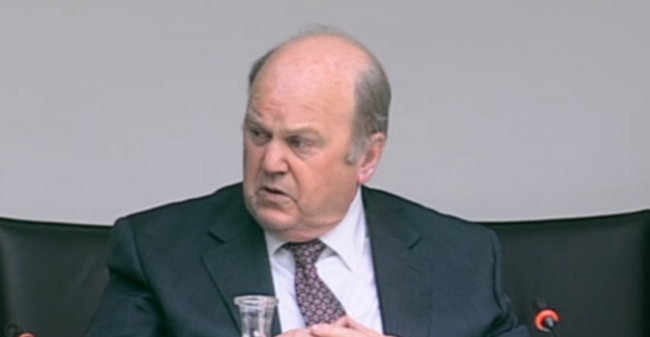
Speaking at the Oireachtas Finance Committee this evening, Noonan welcomed the view of the IMF in addition to that of the European Commission and Fiscal Advisory Council in recent days, saying “they’re experts in their fields”.
However he reiterated that the government was focused on achieving the three per cent deficit to GDP ratio target next year insisting this is what the scale of the Budget adjustment would be based on.
He said that as of the end of last month exchequer figures indicated that an adjustment of €2bn would not be required in the Budget in October to reach the deficit target in 2015.
He added: “We’re not trying to beat that target.”
- additional reporting from Hugh O’Connell

To embed this post, copy the code below on your site















have your say