Sign in. It’s quick, free and it’s up to you.
An account is an optional way to support the work we do. Find out more.
Sign in. It’s quick, free and it’s up to you.
An account is an optional way to support the work we do. Find out more.
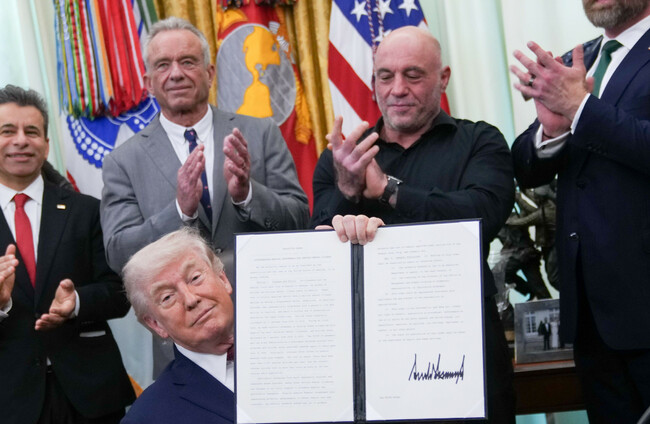
AN EXECUTIVE ORDER signed by Donald Trump to fast track psychedelic drugs for use in medical treatments marks a major shift in US drug policy, experts say.
Trump announced the easing of restrictions on research into drugs that have shown promise in treating people with mental health conditions last month.
Flanked by Health Secretary Robert F. Kennedy Jr, medical officials and podcaster Joe Rogan, Trump signed the executive order that would help federal researchers cut through red tape to allow for quicker studies.
The substances include psilocybin, found in magic mushrooms, and ibogaine, derived from the root of an African plant.
Trump said the order was prompted by text messages from Rogan, who has campaigned for access to the drugs.
Currently, many psychedelics are not approved for medical use as they’re listed as having high addiction potential, limiting the ability for scientists to study them.
Dr Kasia Malinowska, director of the Global Drug Policy Program at the Open Society Foundations, said the move is “incredibly significant”, pointing to decades of research that have brought psychedelics to the brink of medical approval.
She said the field has followed a structured scientific path for around 40 years, building evidence over increasingly large studies.
“What happened now is that this comes sort of outside that pathway,” Malinowska said in an interview with The Journal in Dublin.
“It comes like, you know, a little bit in a Trump way, ‘well I’m going to do it my way’”.
The order could speed up access to treatments for conditions such as PTSD and depression.
As for the factors behind Trump’s motivation, Malinowska noted:
“The primary beneficiaries here, I would say, will probably [be] pharmaceutical companies.”
She stressed that psychedelic treatments involve carefully managed therapy, warning that treatment could become less safe and less effective if pharma companies focus only on making drugs widely available without supports.
Despite these concerns, she said the move could signal a broader shift away from punitive drug policies in the US.
“Is Trump ending drug prohibition? No. But is he opening some doors? Yes.”
She said the real test will be in how the policy is implemented, warning that without proper safeguards, the market could become dominated by a small number of companies.
The impact of this move is likely to be felt globally, Malinowska added, with other countries often following Washington’s lead.
She added that the move could help challenge long-standing views of drugs solely as a threat.
“Those substances can be medicines,” she said, adding that this shift in thinking is important for future reform.
Malinowska has previously worked for the UN Development Programme, and publishes regularly on drug policy as it relates to health, human rights, and governance.
To embed this post, copy the code below on your site














have your say