Sign in. It’s quick, free and it’s up to you.
An account is an optional way to support the work we do. Find out more.
Sign in. It’s quick, free and it’s up to you.
An account is an optional way to support the work we do. Find out more.

THE MARITIME REGULATOR is investigating multiple claims that illegal seaweed harvesting is taking place in special areas of conservation, The Journal Investigates can reveal.
Several complaints surrounding one incident in particular have been submitted to the independent Maritime Area Regulatory Authority (MARA) and the National Parks and Wildlife Service (NPWS) in the past few years.
EU rules state that commercial harvesting activities in special areas of conservation must be regulated and licensed to protect the local habitats.
But the difficulties of catching harvesters in the act to verify whether they hold the correct licence have left regulators struggling to determine who exactly is responsible.
While harvesting small volumes of seaweed for personal use, such as use in a domestic garden or for home-cooking, does not require a licence, harvesting for commercial purposes does.
Records obtained by our team under Freedom of Information show “there have been a number of incidents over the years that have threatened to become confrontational”, including incidents directed towards NPWS staff.
The documents also suggest some harvesters claimed they are working for certain companies, but when regulators later check whether this is true, the companies in question strongly denied any knowledge.
This has left little scope for enforcement action.
A spokesperson for MARA told The Journal Investigates that “establishing responsibility for reported incidents of potentially unauthorised seaweed harvesting can be challenging”.
This is due to “the intermittent nature of the activity, the location of the alleged offence, the timing of reports in relation to when the activity occurred and the availability of evidence”, they added.
Investigations like this don’t happen without your support… Impactful investigative reporting is powered by people like you.
Records obtained by The Journal Investigates suggest that there have been a number of incidents of alleged illegal seaweed harvesting over the last number of years.
Some of these incidents have also taken place in special areas of conservation, including one in the north west of the country.
Records of complaints submitted to MARA on this incident allege that a company is “harvesting a huge amount of seaweed from a number of locations along the shoreline”.
It is also alleged that the same company previously discarded nylon rope used to gather the seaweed in the grass nearby.
The records allege that some of the locals “were threatened by the workers” when they asked whether they had a licence to harvest seaweed.
An NPWS staff member also alleged that “one [worker] was very confrontational with me” at a separate incident where seaweed was being removed from the shore.
MARA is responsible for issuing Maritime Usage Licences for seaweed harvesters and as a result is also responsible for enforcing any breaches under the Maritime Area Planning Act 2021.
Some harvesters may hold pre-existing rights for seaweed harvesting which predate MARA, which was only established in 2023.
These harvesters have until the end of July 2028 to apply for a new licence from MARA, but evidence of these existing rights must be provided to MARA when following up on reported harvesting activity.
Seaweed has many uses, including in the cosmetic and beauty industry, such as seaweed baths, and in agriculture as fertiliser.
It also has a growing use in the food and retail market, due to its high nutritional value and perceived health benefits.
A study from the Dutch government in 2022 suggests that the commercial seaweed market could reach €22 billion globally by 2028.
The same study listed Ireland as among the top exporting countries in Europe alongside Spain, Germany, the Netherlands and France.
A research project led by the University of Galway and funded by Gas Networks Ireland is also “developing innovative uses of seaweed as a source of biomethane”.
Biomethane is the purified version of biogas, produced from the breakdown of organic matter, and is viewed by many data centre providers as a potential source of renewable energy.
Traditional seaweed harvesters have raised concerns about the rapid commercialisation of the seaweed industry, as large companies look to Ireland’s growing industry.
Four companies have submitted 12 applications to MARA for a licence to harvest seaweed across various locations up the west coast.
But these applications have been subject to community pushback, with some arguing that allowing private companies to harvest seaweed for commercial profit could leave them without a say in how the land and environment are treated.
Records released under Freedom of Information show several complaints relating to one incident were submitted to the NPWS and later, MARA.
But both agencies have struggled to determine who exactly is responsible and whether the harvesting is in fact illegal.
An email from the Department of Housing, which includes the NPWS, suggests sending marine advisers to examine the area where the alleged illegal harvesting was taking place, but warns “it is difficult to catch someone in the act”.
MARA has also written to a company accused of being involved, seeking to determine if they or any contractors they employ have been harvesting seaweed in the area, and whether they hold the required licence.
But in a letter seen by The Journal Investigates, this company rejects the accusation, stating “we do not undertake harvesting operations, neither do we employ or contract seaweed harvesters on our behalf”.
The letter adds that they purchased seaweed from two harvesters “who were afterwards shown to be operating” in the same area, but after receiving a complaint “from a local conservationist”, the company “advised the harvesters that we would not be purchasing any further seaweed from them from this area”.
“It is commonplace now up and down the coast that when harvesters are approached or asked they will use the name and details of the companies that they sell to as their ‘employers’,” the company continued.
They also added that they have previously been contacted by “An Garda Síochána, wildlife rangers and locals who have been given our name by persons unknown”, but remained steadfast in their assertion that they “do not employ or instruct any harvesters or persons engaged in harvesting operations”.
This complaint is not the only instance of alleged illegal seaweed harvesting that MARA has come across.
A letter sent by MARA to the NPWS in October last year states that the agency is “following up on a number of complaints relating to seaweed harvesting” along the west coast.
The letter requests help from NPWS staff in “progressing these queries” by requesting information from seaweed harvesters they come across and sending it to MARA for review.
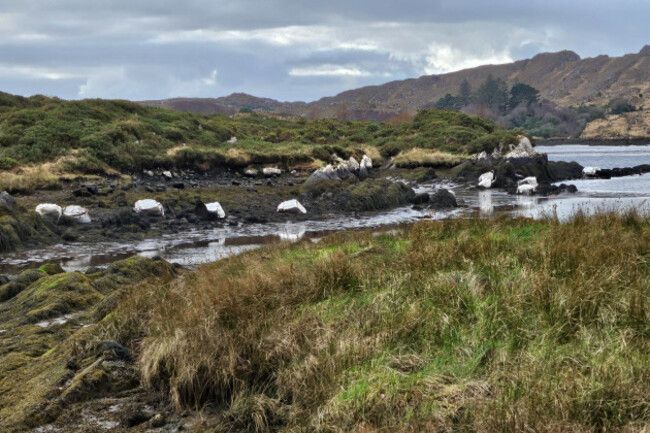
A spokesperson for the agency said that its compliance, enforcement and revenue division has 11 staff members and prioritises cases using a risk-based approach.
Two other Natura-designated sites are named by MARA as having “alleged activity” taking place in two different parts of the country.
Both of these locations are protected, ecologically important sites.
Dolf D’hondt, a marine campaigner, told The Journal Investigates that the issue surrounding traditional harvesting rights and new licences “is a mess”, but he added that “it has always been a mess”, even before MARA.
MARA, he said, “was set up to licence offshore wind development and not really to go into the nitty-gritty of the laws surrounding seaweed”.
Sinn Féin TD Pádraig Mac Lochlainn also said “the potential of seaweed to create jobs and wealth in coastal communities is immense” but licensing similar to fisheries needs to be in place to ensure it is sustainable. He added:
It is clear that MARA is struggling with the legal complexities of historical seaweed harvesting rights.
Mac Lochlainn also called for “urgent amendments to legislation where there is confusion or uncertainty” and for priority to be given to those with traditional seaweed harvesting rights.
Reporter: Conor O’Carroll • Editor: Noel Baker • Social Media: Cliodhna Travers • Main Image Design: Lorcan O’Reilly

To embed this post, copy the code below on your site















have your say