Sign in. It’s quick, free and it’s up to you.
An account is an optional way to support the work we do. Find out more.
Sign in. It’s quick, free and it’s up to you.
An account is an optional way to support the work we do. Find out more.
LAST UPDATE | 7 Mar
A GOVERNMENT-CHARTERED FLIGHT destined for Ireland has departed Oman carrying Irish citizens.
It will stopover in Cairo before continuing to Dublin, where it is expected to arrive at around midnight, a spokeswoman for Foreign Affairs Minister Helen McEntee confirmed.
It is the third flight – and the only chartered flight – to travel back to Ireland from the region since the war with Iran began a week ago, showing no sign of deescalating.
Iran’s hardline judiciary chief said on Saturday the Islamic republic would continue targeting regional neighbours offering its enemies “points… used in aggression against our country”.
“Evidence from Iran’s armed forces shows that the geography of some countries in the region is openly and covertly at the disposal of the enemy,” said Gholamhossein Mohseni Ejei.
“The government and other pillars of the system are in agreement” that “heavy attacks on these targets will continue,” he added.
Ejei is a member of the interim leadership council installed after Iran’s supreme leader Ayatollah Ali Khamenei was killed in US-Israeli strikes that opened the fighting on 28 February.
Iran has repeatedly targeted its Gulf neighbours in response to the aerial offensive, with some strikes aimed at civilian infrastructure – although Tehran maintains it only attacks US assets or bases.
A total of 13 people, seven of them civilians, have been killed in Gulf countries since the war broke out.
One victim, an 11-year-old girl, died in Kuwait after being struck by debris in a residential neighbourhood.
Iranian President Masoud Pezeshkian had earlier on Saturday apologised for Iran’s attacks on its neighbours, promising restraint unless their territory was used to strike Iran.
The Gulf countries have said their territory has not been used in attacks against Iran, and even before the war began, they had repeatedly said they would not allow such attacks on their neighbour.
Nevertheless, Iran’s parliamentary speaker Mohammad Bagher Ghalibaf said that “as long as American bases exist in the region, countries will not see peace”.
“All officials and people are united on this principle,” he added.
⭕️Over 80 IAF fighter jets struck key Iranian regime military infrastructure in Tehran and central Iran.
— Israel Defense Forces (@IDF) March 7, 2026
Targets included:
• IRGC Imam Hossein military university—used for IRGC officer training and assembly compound
• Ballistic missile storage facilities
• Underground… pic.twitter.com/n9oz3mjxF1
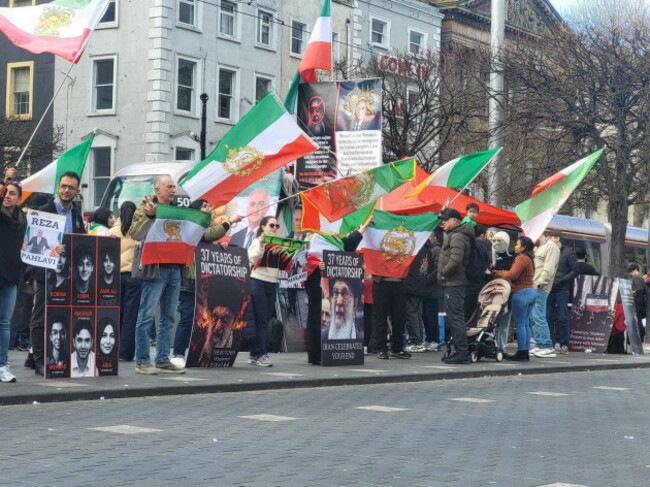
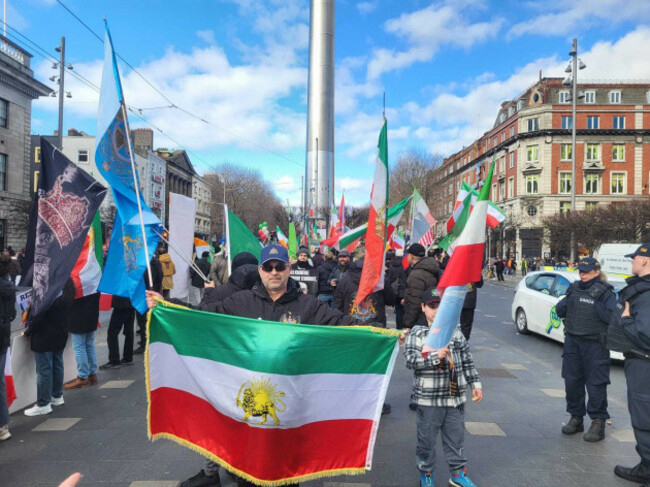
Meanwhile, a small protest took place on O’Connell Street on Saturday, where demonstrators voiced support for the US and Israeli strikes on Iran and called for the overthrow of the country’s Islamic government.
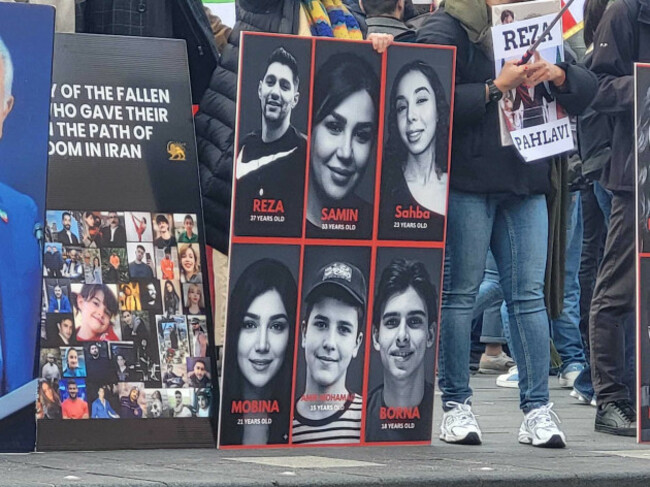
Some protesters waved American flags, historic Persian flags and held posters of exiled Iranian opposition figure Reza Pahlavi.
Pahlavi is the eldest son of Mohammad Reza Pahlavi, the last monarch of Iran before the 1979 revolution that brought the Islamic Republic to power.
Now living in exile in the United States, he has become one of the most prominent figures in opposition to Iran’s current government and has called for a democratic transition and a referendum on the country’s future system of government.
Niki, an Iranian man who said he has lived in Ireland since 2001, said protesters were calling for political change in their home country.
“We want a revolution in Iran. The Islamic government, we’re going to push them back. Our country was taken in 1979,” he said.
He said some demonstrators believed international pressure on the regime could help bring about change.
“We couldn’t push them back for 47 years. Now America and Israel are helping us,” he said.
Another protester, Elahe, who said she moved to Ireland as a student in 2018, said many Iranians abroad were supporting the strikes because they hoped it could lead to political change.
She said protests earlier this year in Iran had been met with violence.
“People went out on the streets across the country and many were shot,” she said, adding that friends and family members had taken part in demonstrations.
Elahe said many Iranians living abroad hoped a future political transition would allow people to decide the country’s future through elections.
“We want a free election to decide what the next government will look like,” she said. “Many of us would go back if Iran became a free country.”
Israel’s military said on Saturday it had struck aircraft belonging to Iran’s Revolutionary Guards at Tehran’s Mehrabad airport, as part of a wave of strikes overnight on the city.
“The Israeli Air Force… completed a broad wave of strikes across Tehran and on military infrastructure located at the ‘Merabad Airport’ in Tehran”, it said in a statement.
“16 aircraft of the ‘Quds Force’ unit of the IRGC were precisely dismantled”, it said, referring to the branch of Iran’s Revolutionary Guards that oversees its foreign operations.
The military accused the Guards of using Mehrabad International Airport, one of two that serve the capital, to send cash and weapons to its proxies in the Middle East, including Lebanon’s Hezbollah.
“Also targeted were several Iranian fighter jets that posed a threat to Israeli Air Force aircraft operating in Iranian airspace”, the statement added.
The army also said strikes overnight hit a key command centre for the Iranian air force as well as a site used to manufacture ballistic missiles.
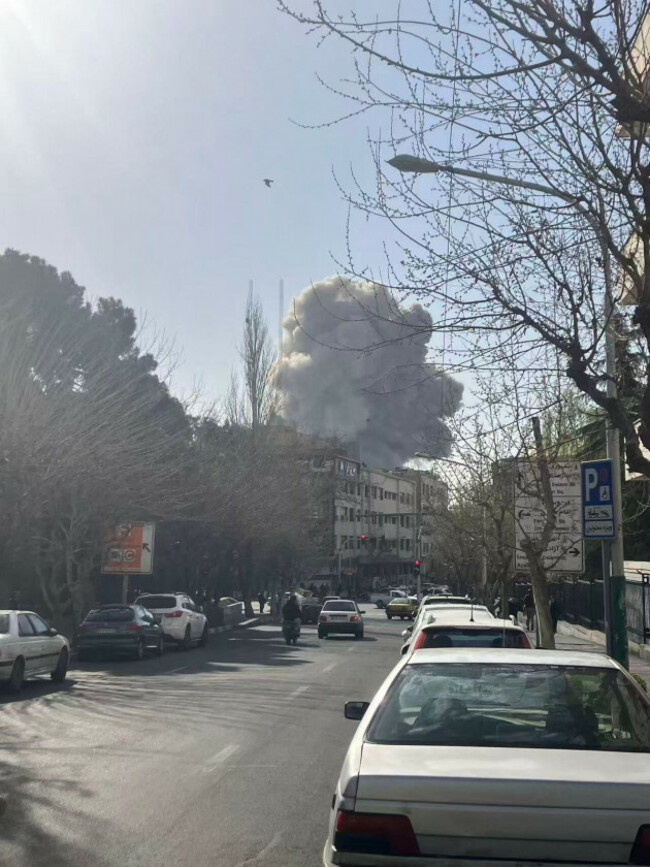
Meanwhile, Iran’s navy said it had launched what it described as a “massive wave” of drone attacks targeting Israel as well as US bases in the Gulf region.
Iranian state media said the targets included American facilities in the United Arab Emirates and Kuwait, along with a “strategic facility” in Israel.
Iran’s Revolutionary Guards said this morning they had also targeted an oil tanker in the Gulf .
“This morning, an oil tanker with the trade name Prima was hit by an exploding drone after ignoring repeated warnings from the IRGC naval forces regarding the prohibition of traffic and the insecurity of the Strait of Hormuz,” the Guards said in a statement carried by Tasnim news agency.
Iran has also warned that US bases across the region could become targets.
In a post on social media, Iran’s foreign minister Seyed Abbas Araghchi said Iranian retaliation would be directed at US bases in the region.
إيرانُ والإخوةُ العربُ عاشوا خلالَ قرون جنبًا إلى جنبٍ بروحٍ من الودِّ والصداقة و الاحترام المتبادل. إنّ المعتدينَ الأمريكيينَ ينطلقون من أراضي أصدقائنا العرب ليستهدفوا الأطفالَ والأبرياء. أمّا ردُّ إيران، فسيكونُ حتمًا موجَّهًا إلى قواعد الولاياتِ المتحدةِ و مؤسساتها
— Seyed Abbas Araghchi (@araghchi) March 6, 2026
“As for Iran’s response, it will inevitably be directed at the bases of the United States and its institutions,” he wrote.
Iran’s Revolutionary Guards also warned they were watching for any attempt by US forces to escort ships through the strategically vital Strait of Hormuz.
The narrow waterway is one of the world’s most important shipping routes, with around a fifth of global oil and gas supplies passing through it.
A spokesman for the Guards said Iran was waiting to see whether US naval forces would move into the area to escort commercial vessels.
“We recommend that before making any decision, the Americans remember the fire of the American supertanker Bridgeton in 1987,” he said, referencing an incident during earlier Gulf tensions.
Shipping traffic through the strait has already slowed dramatically amid fears of further attacks.
The conflict has triggered a sharp spike in energy prices and turbulence in global markets.
International benchmark Brent crude rose to around $92.69 per barrel, while US benchmark West Texas Intermediate surged above $90, marking some of the largest weekly gains in years.
Analysts say fears of disruption to energy supplies from the Gulf, particularly through the Strait of Hormuz, have driven the surge.
Economists have warned that sustained high oil prices could push up inflation worldwide and complicate efforts by central banks to cut interest rates.
In Ireland, prices at the pumps have jumped by as much as 26c per litre, while heating oil prices have also dramatically increased.
The fighting also continues spread across the rest of the Middle East.
Israeli airstrikes have continued in Lebanon, including attacks on Beirut’s southern suburbs and the eastern city of Baalbek, areas where the Iran-backed militant group Hezbollah has strong influence.
Lebanon’s health ministry says at least 217 people have been killed in Israeli strikes this week, while humanitarian organisations including the Norwegian Refugee Council warn hundreds of thousands have been displaced.
António Guterres, secretary-general of the United Nations, urged renewed diplomatic efforts and warned the situation could spiral further.
“This is a situation that could spiral beyond anyone’s control,” he said, calling for “serious diplomatic negotiations”.
Elsewhere, Dubai airport, the world’s busiest for international traffic, said this morning that it had suspended operations after an object was intercepted by air defence over the area.
“For the safety of passengers, airport staff, and airline crew, operations at Dubai International (DXB) have been temporarily suspended. All procedures are being managed in line with established safety protocols,” the government’s Dubai Media Office said.
The escalating conflict has also affected UN peacekeepers stationed in southern Lebanon.
Micheál Martin condemned what he described as a “reckless strike” on a base used by the United Nations Interim Force in Lebanon (UNIFIL), which left two Ghanaian peacekeepers critically injured.
Irish troops based nearby were not injured.
Ireland currently has more than 300 troops serving with UNIFIL in southern Lebanon.
According to Irish defence officials, Irish personnel helped provide firefighting and medical assistance after the strike.
Ireland’s defence forces said all Irish troops remain safe and accounted for, but condemned any attack on UN peacekeepers.
Óglaigh na hÉireann can confirm that all Irish personnel deployed in Southern Lebanon are well and accounted for. Irish troops and bases were not targeted in the attack today on UNIFIL personnel. All necessary force protection measures continue be to observed. We condemn any… pic.twitter.com/5LaJAXOXi2
— Óglaigh na hÉireann (@defenceforces) March 6, 2026
“The role of peacekeepers is sacrosanct,” Martin said.
Meanwhile, US president Donald Trump has said the war could continue for weeks and insisted that any deal with Tehran would require what he called Iran’s “unconditional surrender”.
Russia’s president Vladimir Putin has called for an immediate ceasefire.
With reporting from AFP, Emma Hickey and Eimer McAuley

To embed this post, copy the code below on your site











have your say