Sign in. It’s quick, free and it’s up to you.
An account is an optional way to support the work we do. Find out more.
Sign in. It’s quick, free and it’s up to you.
An account is an optional way to support the work we do. Find out more.

PREDICTIONS DETAILING IRELAND’S future were laid out in a new report by the Department of Finance yesterday, detailing where the country will be in the coming decades – and the dangers posed along the 40-year journey.
The projections were made in ‘Future Forty’, a new long-term economic assessment of Ireland’s needs to 2065 which examines long-term impacts of global trends and other shifts on Ireland’s economy and public finances.
In the analysis, over 2,000 scenarios were modelled to come up with a ‘Central Scenario’ which draws from the central projections.
What did they focus on, and what did they find?
Overall, the report’s possible future outcomes point to a continued growth in living standards, but this progress will increasingly slow over the long-term.
This was attributed mainly to demographic shifts, slowing productivity, climate costs and a slowdown in corporation tax receipts.
The report attempts to predict a potential turning point in the housing crisis, where “pent-up demand” is finally met and the need for a largescale building programme is less vital.
It also highlights that the challenges the EU is seeing by the Trump administration over the past year may not be going away anytime soon, and may in fact be the beginning of a “decoupling of national or regional economies from each other”.
A caveat before we go further. The report is devised on a ‘no policy change’ basis which anticipates that the composition of tax revenue will remain steady over the time horizon – except for corporate tax receipts, which are currently deemed to be “windfall” and are projected to decline between 2030 and 2040.
The report predicts that “pent-up demand” for homes is not expected to have been satisfied until at least 2040.
However, that outcome is reliant on the government meeting an annual output of 60,000 newly built houses by 2030.
Supply is assumed to reach 60,000 by 2030, a significant acceleration on the 30,300 delivered last year, “and then remain at that level until no longer required”.
The authors said this would be a “significant acceleration” given there were “just 30,330 new dwellings” built last year.
To meet the targets, the State needs a boost to both the construction labour force as well as capital into the sector, in order to bolster the industry’s capacity.
One scenario estimates that an extra 50,000 workers are needed to meet these targets.
These labour issues reared their head at a recent construction industry conference, where company bosses revealed they’re sending their staff abroad for work because of uncertainty here, while the Taoiseach appealed for more migrant workers to boost Ireland’s output.
The Department of Finance analysis further couches its predictions by noting that they are “entirely contingent” on future government maintaining that 60,000 new homes per year output for another decade at the minimum.
Housing Minister James Browne has put on a brave face in response to the report, insisting today that he can “end the housing crisis in my term” in office.
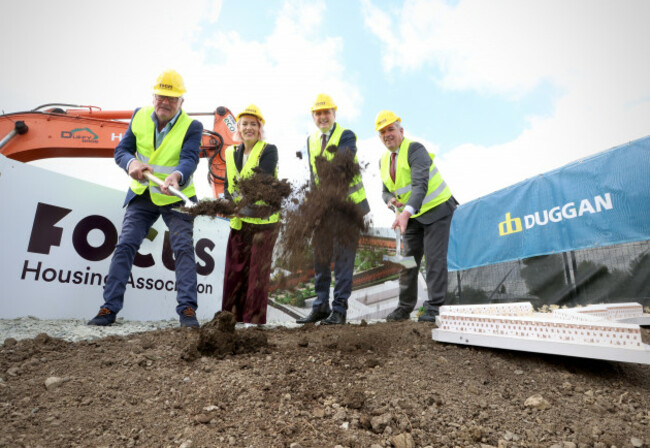
Although they are not modelled as part of the analysis, the report notes that there may be additional financial challenges for the State as an “indirect consequence” of the housing sector struggling.
It warned that a failure to meet targets combined with continued growth in house prices “may reduce the purchasing power of many Irish households”.
Aside from potentially dampening economic growth, it could also require the State to increase financial supports for a “larger share” of citizens and businesses.
Another fear the report mentions is how climate breakdown may see some of the housing stock severely damaged or lost due to coastal erosion.
A “potent threat” to the Irish economy over coming decades is ‘deglobalisation’, according to the Department of Finance’s report.
This refers to the decoupling of national or regional economies from each other, following decades of deeper integration across most of the world via the EU and the World Trade Organisation.
This would be partly due to the protectionist policies pursued by the US also taking further hold across other parts of the world’s economy.
Under the future outcomes, the central scenario would see a ‘slowbalisation’ whereby trade and international investment holds steady but may not increase.
A more risky scenario is a “gradual fragmentation” brought about by a disentangling of World Trade Organisation frameworks, resulting in trade and investment falling with different nations outside of the EU and other trade blocs.
On this, the report added:
The overall impact of deglobalisation on Irish public finances is unclear, but it is very likely that the direction of the impact will be negative. For a small open economy, much of the State’s tax revenue is a direct or indirect result of global economic integration.
A major issue that impacts on the State finances and the capacity of its workforce is Ireland’s ageing population.
The amount of people over the age of 65 is around 860,000, but this will nearly triple to two million in the future, under the report’s projections.
What this means that instead of having four workers for every pensioner, there will only be two workers.
This was recently highlighted by Central Bank governor Gabriel Makhlouf, who warned that the national retirement age will need to rise as Ireland’s population ages to meet this challenge.
However, when launching the report yesterday, Finance Minister Paschal Donohoe said that the pension age is “settled” and there are no proposals to raise the age.
Minister @Paschald has today published a report providing a long-term fiscal and economic assessment for Ireland out to 2065. #FutureForty
— Department of Finance (@IRLDeptFinance) November 4, 2025
Read More : https://t.co/yTp6WW71ZJ pic.twitter.com/ACsF5qNGXC
Trade-offs for any decision against raising the pension age include recent PRSI increases for employers, Donohoe said.
Another issue highlighted is the cost of providing healthcare and long-term care, not only in the context of soaring costs but also in the context of our ageing population.
The report’s authors flag how Ireland faces challenges in the the medium-to-long term thanks to what it calls “megatrends” affecting the advanced economies globally.
These are categories it says are often summarised as the ‘Four Ds’, and are demographics, decarbonisation, digitalisation, and deglobalisation.
These are all forecast to result in structural changes across productivity, labour, and capital, otherwise known as the key areas for any country’s economic growth.

To embed this post, copy the code below on your site












have your say