Sign in. It’s quick, free and it’s up to you.
An account is an optional way to support the work we do. Find out more.
Sign in. It’s quick, free and it’s up to you.
An account is an optional way to support the work we do. Find out more.
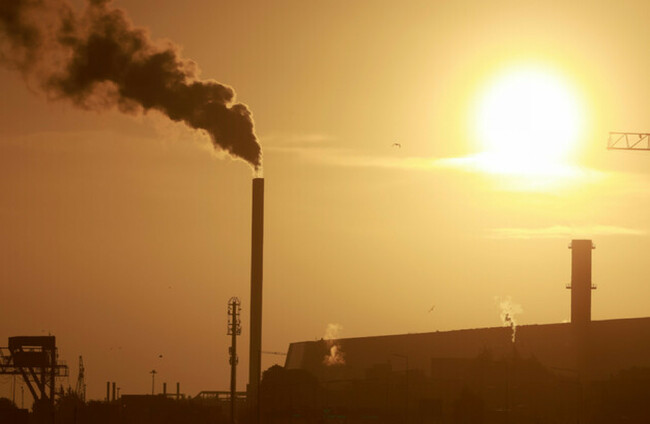
IRELAND IS ON course to deliver only half the reductions of greenhouse gas emissions required by 2030.
The Climate Action Plan and other associated policies call for greenhouse gas emissions to be reduced by just over 50% by 2030, when compared to 2018 levels.
However, new projections by the Environmental Protection Agency (EPA) show that Ireland is on course to reduce emissions by only 25%, if “realistic” additional planned measures are taken.
When only existing government measures are taken into account, Ireland will reduce emissions by only 13%.
And while Ireland will be close to meeting its first carbon budget covering the period from 2021-2025, nearly all sectors are on track to exceed their sectoral emissions ceilings for the second carbon budget for 2026-2030.
A carbon budget is the total amount of emissions, measured in tonnes of CO2 equivalent, that may be emitted during a specific time period.
It sets a ceiling on the maximum amount of greenhouse gas emissions that are permitted in each sector of the economy during a carbon budget period.
Ireland’s carbon budgets were proposed by the Climate Change Advisory Council and approved by the government in 2022.
The transport and industry sectors are projected to be the furthest from achieving their sectoral emission ceilings in 2030.
Depending on the level of implementation of measures outlined in government policies, total emissions from the agriculture sector will decrease between 4% and 19% over the period 2018 to 2030.
A 4% reduction is projected with the existing measures in place, while the 19% decrease would follow “with additional measures”.
The “with additional measures” scenario takes account of existing measures, as well as additional planned measures which are under discussion and have a “realistic chance of future implementation”.
The EPA said changes in nitrogen fertiliser usage and lower anticipated livestock numbers contribute to projected emission savings in the agriculture sector.
However, both scenarios would see the agriculture sector fall below the 25% reduction target.
Emissions from the transport sector, meanwhile, are projected to reduce by up to 28%, with additional government measures such as having at least 751,000 electric vehicles on the road by 2030.
However, this is significantly below the 50% targeted reduction by 2030.
Elsewhere, residential emissions from fuel combustion for home and hot water heating are projected to decrease by up to 18%, but this too is well below the target of a 40% reduction.
The EPA said a lower uptake of home energy improvement measures, including planned heat pump installation in existing dwellings, has lowered predictions for emissions savings by 2030.
The EPA also looked at the “industry” sector, which includes emissions arising from industrial processes.
The majority of this sector’s emissions come from fuel combustion in manufacturing, followed by emissions associated with the mineral industry, mostly from cement production.
Emissions from this sector are projected to reduce by 12% against a sector reduction target of 35%.
Meanwhile, the EPA said the continued rollout of renewable electricity generation, as well as increased importation of electricity from interconnectors, is contributing to reductions in Ireland’s emissions across the electricity sector.
With existing measures, the EPA projects a decrease in emissions of 55%, while with additional measures such as an increase in wind and solar power, a decrease of 61% could be achieved.
Both, however, are below the sector reduction target of 75%.
The EPA warned that delayed delivery of planned renewable energy projects such as offshore wind has lowered potential emissions savings.
Elsewhere, emissions from the land use sector are projected to increase massively without additional measures.
This sector covers forest land, cropland, grassland, wetlands and harvested wood products.
There is currently no national sectoral emissions ceiling for this sector, though it is subject to EU targets.
With additional measures, a 4% increase is projected with additional measures, but with existing measures a 72% increase is forecast.
The Climate Action Plan 2024 suggested that regulations for the sector will be adopted.
The EPA warned that when Irish forestry reaches harvesting age, it shifts from being a carbon sink to a source of emissions.
This sector is projected to contribute 9.2% of Ireland’s total emissions by 2030.
However, the EPA said additional planned policies and measures, such as increased afforestation and peatland rehabilitation, would dramatically reduce the extent of the emissions increase.
Elsewhere, Ireland is projected to exceed its EU Effort Sharing Regulation target of a 42% reduction in greenhouse gas emissions when compared with 2005 levels.
This EU initiative sets binding targets which are tailored for each member state based on things such as its wealth and GDP.
Member states who exceed their EU targets are given a “credit”, while those that miss targets must buy credits from other member states.
Member States selling credits should use such revenues to tackle climate change.
The EPA estimates that Ireland is on track for a maximum reduction of 23% under the EU Effort Sharing Regulation.
Meanwhile, an EPA source said it could not comment on how much these credits could cost Ireland as a result of missing these targets.
EPA director general Eimear Cotter said the report highlights that Ireland faces a “significant challenge” in meeting its 2030 targets given the short time frame.
She said the trends “demonstrate that progress is achievable but accelerating delivery is critical”.
“It is imperative given the increasing demand for electricity across several sectors, that renewables are delivered at the pace and scale required to meet this demand,” said Cotter.
Elsewhere, EPA programme manager Dr Conor Quinlan remarked that “it is imperative that ambition and action is maintained across all sectors if we are to meet our targets and realise the benefits of decarbonisation for our society”.
Green Party leader Roderic O’Gorman said the report “shows us the consequences of this lack of action”.
“The government should be setting out the extra actions it is going to take to try and make up the difference,” said O’Gorman.
“Instead, it is passively sitting back, which means Ireland is going to have to pay very significant fines due to the government’s inaction.”
Unsure of what exactly is happening with the earth’s climate? Check out our FactCheck Knowledge Bank for essential reads and guides to finding good information online.

To embed this post, copy the code below on your site















have your say