Sign in. It’s quick, free and it’s up to you.
An account is an optional way to support the work we do. Find out more.
Sign in. It’s quick, free and it’s up to you.
An account is an optional way to support the work we do. Find out more.
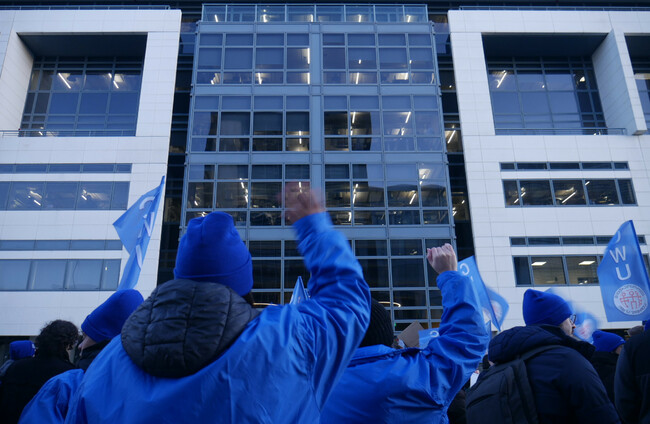
“IT’S GOOD to be here, but it’s also scary, because I’m realising the scale of what we’re facing.
“I just met a guy who was laid off by my firm two years ago, now he’s being laid off again. That’s terrifying,” says Peter*, a 54-year-old tech worker.
There’s a nervous buzz in the room at the Communications Workers’ Union’s (CWU) first ever tech worker branch meeting in Dublin.
Peter is here having joined the union last year after working in the sector for many years with no union representation. He works at Shopify, the e-commerce platform.
“How they assess our performance seems to be getting tougher, and the CEO has said that managers need to prove that AI can’t do a job if they want to increase headcount… once I heard that news, I started to look at union options,” he said.
Typically, the CWU has represented employees of An Post and call centres rather than people working at large multinational tech firms like the ones here.
That is changing. The big tech employers have no legal obligation to recognise unions and yet, in the last year, tech worker membership of the CWU has doubled to 1,000 people.
That might sound small – it’s just a fraction of the union’s 14,000 members – but it’s the biggest unionisation surge the sector has ever seen in Ireland.
“That’s changing. What we’ve seen is a sector riddled with restructuring, with outsourcing, with mass redundancies,” he said.
Some of the workers who chose to attend the meeting are afraid that publicly associating themselves with a union could see them face personal blowback.
One worker who attended the event told The Journal that his company is ”already conducting small rounds of layoffs that seem to be organised almost arbitrarily in order to cut headcount, so of course I’m worried that this could lead to being targeted”.
So what’s driving the surge?
John Bohan, an organiser for the CWU, has been the man on the ground behind many of the campaigns and representations the union has made on behalf of tech workers in the last 12 months.
He co-ordinated landmark strike action carried out by workers at Covalen, a Meta client-company that provides the tech giant with outsourced workers for roles in AI annotation, legal operations, and content moderation.
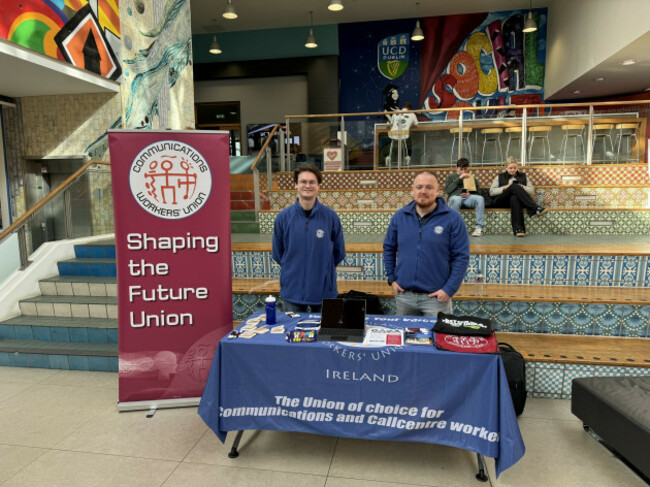
It was the first time that tech workers carried out industrial action in Ireland, and Bohan says that the issues that drove that strike in January are the same that are driving more people in the sector towards the union.
“The biggest threat these workers face is the increasing consolidation of power in big tech, the endless drive for profit of the big players. We’re seeing AI as a smokescreen for classic bad employment practices – the reality is the bosses have simply decided they don’t need to treat workers well any more, and workers need leverage to push back on this,” he explains.
Bohan argues that AI isn’t actually enabling firms to replace human workers with automated systems yet, but that it’s essentially the new buzzword being used by employers who want to cut headcount and put additional work on remaining staff.
“You reduce the headcount, squeeze more productivity out of workers, and say AI makes them more efficient. Employers have always done this to maximise profit margins; AI is just functioning like a smokescreen,” he says.
He notes that it is important that the union has seen organic growth in the tech sector in the last year, rather than workers simply joining as a form of insurance in response to lay-off processes being initiated.
“Workers are joining because someone in their workforce is organising,” he said.
At the conference, Bohan led a panel discussion for workers who have organised union drives in various big tech firms: Covalen, TikTok, and Accenture are all name-checked, all of which have announced plans to reduce the number of employees recently.
TikTok announced around 300 redundancies in Ireland last year, while Dublin-headquartered Accenture announced plans for a $865m (€744m) restructuring programme which included reducing its global headcount by more than 11,000 workers.
Covalen informed around 400 employees that they were at risk of redundancy last November.
All the workers on the panel stressed that AI systems being brought into their firms – specifically in the space of content moderation – don’t make their jobs easier or reduce their workloads in the way that higher management say it has.
They each spoke about the impact of restructuring and lay-offs, and the increasing prevalence of outsourcing on their own working lives and that of their colleagues.
One worker in Accenture spoke about the company’s refusal to engage with the union when it was representing her in a WRC case, but she also outlined at length how the union was able to assist her despite this.
Ian McArdle of the CWU stressed the need for legislative changes in Ireland that would put in place statutory protection for worker representatives who want to organise their workplace.
He said that most of all, unions need a statutory provision for collective bargaining, so workers can negotiate collectively with “power, dignity, and with respect”.
There were plenty of rounds of applause when workers from different companies gave speeches on their experiences, and their hopes for increasing unionisation in the sector. A need for dignity in the workplace came up repeatedly.
Steven*, a worker at Covalen, summed it up: “They’re heavily reliant on us. That’s one thing I hope everyone in this room knows, even though they don’t let you know that.”
Rebecca*, a worker from TikTok, echoed his sentiment: “With AI coming in it’s getting harder and harder for people on the ground.”
“These companies don’t exist without us. We have to get together because you can feel very isolated even within a big firm… people are facing lay-offs, people are on extended leave for burnout, and that’s happening across the sector. The minute we start talking to each other and organising, we take back a lot of power,” she added.
TikTok maintains that Ireland remains a key location for the firm, and that it has long used a combination of automated systems and AI to complete work.
Additionally, it is understood that TikTok has been utilising AI in the space of content moderation, so human workers have to see less graphic content. The firm believes that this has led to a 76% decrease in graphic content being viewed by human workers in the last year.
An Accenture worker described the impact on morale after the team working on a project she was assigned to was significantly reduced.
“Our team has gone through restructuring, and it’s insane now. It’s like, you know the people on the Titanic with the violins? That’s how we feel,” she said.
Accenture maintains that its staffing levels in Ireland have remained consistent in recent years.
Another worker who was previously made redundant spoke of feeling like they are “caught in a cycle” that is only becoming more common in the sector.
“I was laid off in my first job in the sector, and then redundancies started happening again in January [at my current company]. It’s very devastating, because you feel as though you are caught in a cycle.
“The tech industry needs this union movement, and that’s why I’m here. If we are going to live in this sci-fi dystopia, this new reality that’s coming up, then we need to respond to that by being human,” they said.
At the end of the first ever tech workers’ alliance meeting there was a sense of hope, and for some, that it was a relief to meet others in the same position.
But there was also a sense that there is a massive volume of work ahead if this union movement is going to gain any power in the sector.
Some politicians attended: Sinead Gibney of the Social Democrats vowed to bring what she’d heard up with the Oireachtas Artificial Intelligence committee, and Paul Murphy of People Before Profit encouraged the workers there to realise how much power they already have.
If the Irish government is going to listen to what the CWU and these workers are demanding though, they are going to have to make their pitch on a much wider scale.
“This movement isn’t happening in a vacuum,” Bohan told the conference. “The kind of times we’re living in, they’re fucking nuts. They’re crazy.”
“The CEOs of these companies are properly putting the boot in to workers all over the world… and we’re giving away half our wages in rent, healthcare is expensive, education is expensive, and so is family, we need to take some power back.”
The success of CWU’s mission will depend on the union getting that message out to a much wider base of people than the 60 or so in the room – but then again, it’s a room that didn’t exist a year ago.
*Some of the names used here are changed to protect workers’ employment.
To embed this post, copy the code below on your site














have your say