Sign in. It’s quick, free and it’s up to you.
An account is an optional way to support the work we do. Find out more.
Sign in. It’s quick, free and it’s up to you.
An account is an optional way to support the work we do. Find out more.
LAST UPDATE | 4 Sep 2024
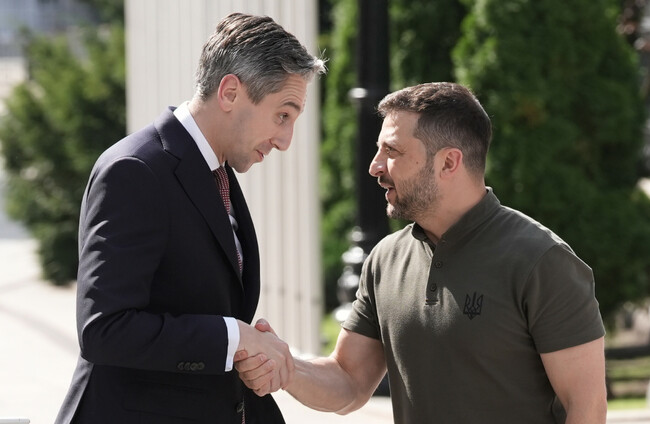
UKRAINIAN PRESIDENT VOLODYMYR Zelenskyy has expressed his “gratitude to Ireland” during a meeting with Taoiseach Simon Harris in Kyiv.
The Taoiseach signed a cooperation deal with Zelenskyy at the Ukrainian leader’s office at Horodetskyi House in the city.
Harris also announced details of a €36 million funding package to organisations working in Ukraine and neighbouring countries.
Services for victims of gender-based violence, work to return abducted children and the construction of prefab homes for refugees are among the projects to be supported by the new tranche of Irish funding.
The visit comes a day after 53 people were killed and 200 injured when two Russian ballistic missiles struck a military training facility and hospital in Poltava, 200 miles south east of Kyiv. Elsewhere, children were among seven killed in an overnight strike on Lviv.
The attacks occurred as Ukrainian forces attempted to secure territory in Russia’s Kursk border region after a surprise incursion that began last month – and as the Russian army moves deeper into eastern Ukraine.
Harris’ engagements today saw him visit Hostomel and Borodyanka, two areas which had been badly damaged by Russian strikes in the early days of the invasion.
“I want to see first hand and with my own eyes the impact of war on the continent of Europe,” he said.
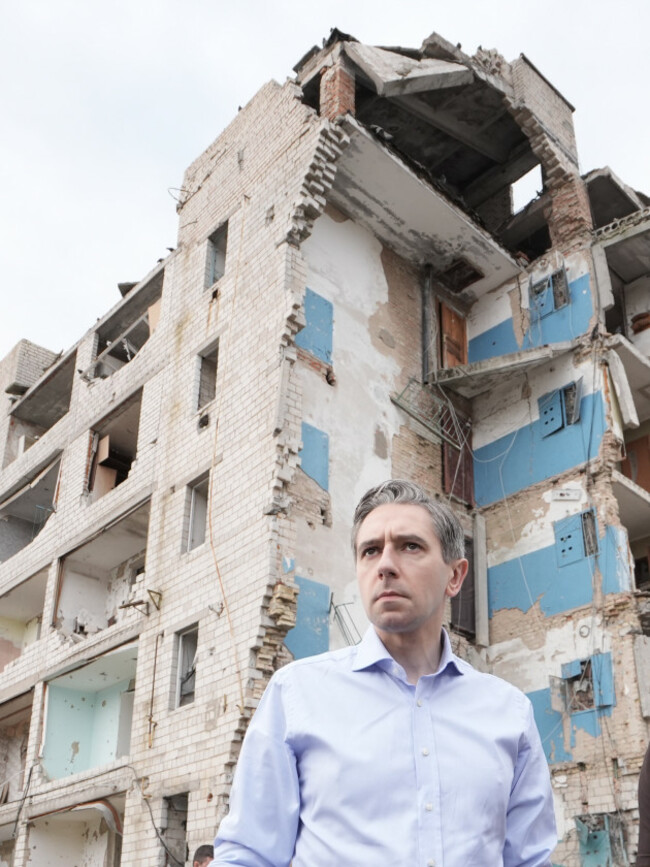
Harris saw a prefabricated home, which is now occupied by a family that had previously been displaced, and a newly built kindergarten – both part of projects which Ireland financially supports.
The funding is for essential humanitarian assistance, rehabilitation and eventual reconstruction, and it will contribute to Ukraine’s longer term goals including peace, stability and political aspirations.
Harris expressed Ireland’s full support for the Ukrainian bid for EU membership while also discussing continued humanitarian assistance.
The latest cash will bring Ireland’s total funding to Ukraine since February 2022 to more than €380 million, including approximately €130 million in stabilisation and humanitarian support.
Harris also visited the Child Protection Centre in Kyiv prior to his meeting with Zelenskyy, where Ireland supports work towards the return of thousands of Ukrainian children abducted into Belarus and Russia.
Following the bilateral meeting, Zelenskyy told a press conference that he thanked Ireland for its support of work on returning abducted Ukrainian children to the country.
“Ireland’s participation in the reconstruction of Ukraine will be a substantial support for our people and our countries and our European way of life,” he said.
“I thank the people of Ireland, I know that after the beginning of the invasion of Russia of our land, you’ve accepted and really have warmly welcomed more than 100,000 citizens of Ukraine.”
The deal includes common work on demining Ukraine, which Zelenskyy said will save Ukrainians and improve the resilience of Europe.
He added that the deal also includes common work on cyber security.
Zelenskyy said he also “really valued” that Harris’ trip came amid severe attacks on Ukraine.
We value that while Ireland is military neutral, Ireland does not stay neutral morally.
“We are grateful to you, Mr Taoiseach, and to the people of Ireland for very specific and clear and principled support and a position countering Russian terror.”
He thanked Ireland for financial support and said: “It is really important we are together protecting lives, especially now we need it facing the winter when Russia goes on striking our energy infrastructure.”

Harris, who earlier laid a wreath to honour Ukraine’s war dead at Maidan Square, told reporters: “The people of Ireland stand with the people of Ukraine.”
Asked by members of the Ukrainian media about the Irish Government’s decision to decrease financial support for newly arriving Ukrainians in Ireland, Harris said: “Ireland will always continue to support people from Ukraine”.
He said the roughly 109,000 Ukrainians who have been welcomed in Ireland “made an incredibly positive contribution to Irish society”.
However, he said refugee systems are always under review in terms of sustainability.
He noted the changes applied to people who were being provided with free food, accommodation and a right to work.
Pressed on whether he supported a visa waiver for Ukrainians post-war, Harris said he hoped there would be a situation where that would not be necessary due to Ukraine joining the EU.
Asked if he supported Ukraine’s request to use long-range missiles at Russian targets, Harris said that would be a matter for the countries supplying such weapons as Ireland’s assistance is around non-lethal aid.
Zelenskyy said it would be a matter for further discussion with Ukrainian Prime Minister Denys Shmyhal but added he was “really thankful” for the support thus far.
Harris said he was “particularly pleased” to invite Zelenskyy for an official visit to Ireland, to which the Ukrainian president nodded.
Ireland’s assistance this year prioritises prevention and response to sexual and gender-based violence, support for maternity services and rebuilding of homes for people forced to flee conflict and now living in collective centres.
Tánaiste Micheal Martin said: “Our support for Ukraine is unwavering. Ireland will continue to stand with the people of Ukraine for as long as necessary.”
The government said it will continue to work in Ukraine through long-standing partners with proven ability to reach those most in need.
The UN Office for the Co-ordination of Humanitarian Affairs’s (OCHA) Ukraine Humanitarian Fund will receive €5 million.
The money will go to non-governmental and civil society organisations across Ukraine, including assisting 1.5 million women and girls and more than 480,000 people with disabilities.
The United Nations High Commissioner for Refugees (UNHCR) is to receive €5.5 million.
The UNHCR winter plan aims to support 600,000 people with cash assistance to cover additional winter needs.
Ireland has supported the Core Homes Project, which is on target to build 300 prefab homes for families to return where their previous homes were destroyed.
The United Nations Population Fund (UNFPA) has been allocated €3 million, to provide “live-saving sexual reproductive health and gender-based violence services”, including rape support.
Ireland will provide he International Federation of the Red Cross and Red Crescent Societies (IFRC) with €3 million.
Unicef has been allocated €2 million as part of the government’s focus on the reintegration of children who have been abducted to Russia and Belarus.
The International Committee of the Red Cross (ICRC) has been allocated €5 million. Ireland’s funding will also support high-level international interventions to reunite families with children who were forcibly deported from Ukraine.
The World Bank IDA Crisis Facility Special Programme for Ukraine and Moldova has been allocated €3 million with a particular focus on food security.
The International Monetary Fund (IMF) Ukraine Capacity Development Fund, which focuses on macroeconomic stabilisation, EU membership, and post-war reconstruction, will receive €2 million.
The Lithuanian Central Project Management Agency (CPMA) will be given€3 million to support the building of bomb shelters for schools in Ukraine by local companies. It also goes towards rebuilding schools that have been damaged.
Moldova will receive €2 million for its management of a large flow of refugees and its pursuit of EU membership.
The World Health Organisation (WHO) Ukraine Health Appeal has been allocated €1.5 million.
Ireland has also set aside €1.115 million in Peace and Stability Funding.

To embed this post, copy the code below on your site









have your say