Sign in. It’s quick, free and it’s up to you.
An account is an optional way to support the work we do. Find out more.
Sign in. It’s quick, free and it’s up to you.
An account is an optional way to support the work we do. Find out more.
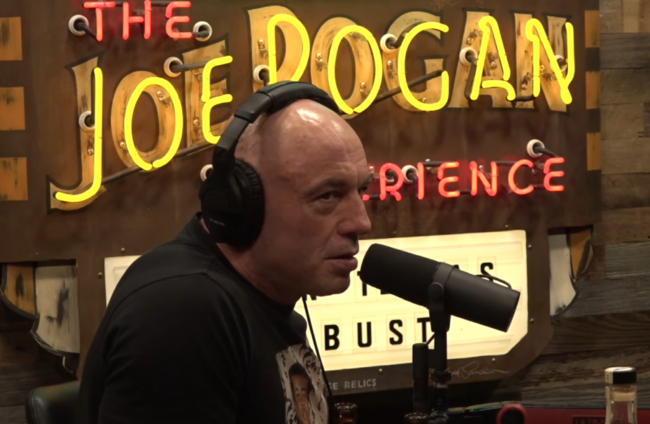

JOE ROGAN IS generally regarded as the world’s most successful podcaster.
That means you either see him as a truth teller, an irresponsible platformer of bad ideas, or the loud mouth from the bar who has somehow amassed 20 million subscribers.
Maybe he’s all this and more at the same time. But the interesting thing about Rogan isn’t what he thinks, how divisive he is, or who his guests are. It’s how long his conversations last.
When Donald Trump appeared on his podcast during the 2024 presidential campaign, the conversation lasted almost three hours. Three hours.
Imagine informing the producers of Morning Ireland that they had to take a single politician for all of one morning’s programme and half of the next day’s. Rogan’s longest episode ran for five hours and 19 minutes.
And he’s not the only podcaster going long. The average episode among the 25 most popular podcasts in Britain now lasts 54 minutes. In the US, it’s 64 minutes.
This is a remarkable amount of editorial real estate compared with the typical radio interview.
It allows disagreement to develop rather than detonate. Somebody can explain why they believe something, touch on historical context, acknowledge an inconvenient fact, qualify their argument and perhaps even change their mind.
A recent example from Ireland was an episode of Matt Cooper’s Path to Power podcast that featured Leo Varadkar and Senator Conor Murphy talking about the possibility of a United Ireland. It was measured, interesting, and calm.
It probably helped that the episode was pre-recorded and therefore, decoupled from the daily news agenda. It was 51 minutes long. That’s more than half of one Morning Ireland, if you take away the ads.
So what’s happening here? If we’re constantly told that audiences have shorter attention spans, how come successful podcasts are growing so long? And can legacy radio learn anything from this trend?
The reason that podcasts have evolved this way is clear. They’re not beholden to the clock the same way radio shows are. They can take their time. Plus, as they’re often preaching a particular world view to the converted, or focused on a niche topic that interests their listeners, they can keep it up for longer for their audiences.
Contrast that with a generalist news programme that has to reflect the news of the day, in some instances, set the agenda, and always fit in ten minutes of advertising.
It’s no wonder that experts on wars, housing crises, migration, climate policy and artificial intelligence are given eight minutes or less to explain things that take a lifetime to understand.
Or two opposing guests are assembled and fired up to go at each other, with the presenter not acting as a referee, but another aggressor that has to be fended off.
Occasionally it makes for good radio, but mostly it’s a tired format that’s overly combative and rarely informative.
Nevertheless, Ireland still loves radio. The latest Joint National Listenership Research (JNLR) book came out this week showing that 78% of Irish adults listen to the radio every day. That’s some pretty good penetration.
But it’s been flagging over time. Daily reach has fallen from around 85% in 2012. Reach in younger audiences has fallen even faster, from 82% to 65% in the same timeframe. A
nd listeners are spending less time with traditional radio. The JNLR can’t tell us where those missing listeners have gone. But the Reuters Digital News Report provides one clue: 12% of Irish respondents now use podcasts for news each week.
Let’s be clear, Irish radio is still in rude health. Radio hasn’t lost its audience so much as begun to age with it.
Some of the standard components – magazine-style programming that covers parenting, holidays and cooking, double headers, vox pops, expert voices – can sound a little stale when compared with the charisma, cliquey-ness, longer duration and dedicated themes of a podcast.
Given that nearly all of our national media outlets – print and broadcast – produce successful podcasts, it’s clear that the changing consumer habits are recognised.
This recognition doesn’t seem to have filtered through to all editorial teams though. I guess, it’s like William Gibson said: “The future is already here – it’s just not evenly distributed.”
Slower news
Most newsrooms are still structured around the adrenaline of breaking news – whoever gets a story out first wins. But in a modern information age where news breaks first on social platforms, before being verified elsewhere, perhaps speed is less important. Perhaps audiences are also hungry for slower news.
There is a slow journalism movement – a reaction against the accelerating news cycle – that had a moment about ten years ago.
The slow news movement argued that journalism should wait for the dust to settle before explaining what had actually happened. Its principles were admirable: less breaking news, more context; fewer hot takes, more hindsight; greater attention to why something’s happening, once we understand what has actually happened.
Delayed Gratification, the quarterly slow news magazine proudly announces “Last to Breaking News since 2011” on its website.
The extraordinary popularity of long conversations suggests the slow-news instinct was sound.
Audiences will spend time understanding complicated subjects with the right hosts over audio. Slow news may have struggled as a publishing proposition. But it works as a podcast.
None of this means Joe Rogan or his ilk could replace the excellent presenters and producers who make radio in Ireland.
A functioning democracy benefits from interviewers who interrupt politicians, challenge nonsense and know what the Children’s Hospital is expected to cost.
But Rogan & Co. have stumbled across something that broadcasters might learn from.
For most of radio’s history, airtime was scarce, so broadcasters became brilliant at squeezing conversation into the gaps between news, advertising, weather and sport.
Digital media has removed that scarcity, but much of radio still behaves as though every conversation is on the clock. People haven’t lost their attention spans. Give them the right person, the right subject and the freedom to explore it and they’ll happily listen for an hour. Maybe three.
After decades spent making audio news shorter, faster and punchier, the success of podcasting proves that audiences occasionally want someone to slow down, go deeper and take their time.
Steve Dempsey is a media and technology expert and commentator
To embed this post, copy the code below on your site












have your say