Sign in. It’s quick, free and it’s up to you.
An account is an optional way to support the work we do. Find out more.
Sign in. It’s quick, free and it’s up to you.
An account is an optional way to support the work we do. Find out more.
LAST UPDATE | 20 Aug 2025
KNEECAP’S LIAM Óg Ó hAnnaidh has returned to court in London to face a terror charge relating to his alleged public support of Hezbollah during a gig by the Belfast rap trio last year.
Legal argument relating to the timing of when the charge was brought took up the entirety of today’s proceedings, with Judge Paul Goldspring adjourning the case until 26 September when he will decide on the issue and therefore whether the court has jurisdiction to hear the case.
Ó hAnnaidh has been released on unconditional bail until that court date.
Should the judge agree with Ó hAnnaidh’s legal team, the prosecution would fall and Ó hAnnaidh would not have to enter a plea or face a trial.
If the judge sides with prosecutors, then Ó hAnnaidh would have to enter a plea. In pre-trial public statements, the rap group have indicated that Ó hAnnaidh would plead not guilty.
Ó hAnnaidh spoke at the beginning of the hearing to confirm his name and date of birth.
At the beginning of proceedings, the judge inquired with Ó hAnnaidh’s legal team about the extent to which the Irish language interpreter present in court would be required.
His representative said that the interpreter would be required “when needed, but consistently”. At this point the judge said that the layout of the court was not ideal for this purpose. He suggested that Ó hAnnaidh move down from the dock to the main area of the courtroom to sit alongside the interpreter.
The judge’s ruling on the legal argument will determine whether a plea is required and if a full trial is likely to go ahead.
During the last court appearance, Ó hAnnaidh’s legal team argued that the charge was brought outside the six-month limit from when the offence was alleged to have been committed on 21 November 2024.
Barristers for the Crown Prosecution Service have contested this during this morning’s submissions and argued on a number of grounds.
Brenda Campbell, KC, for Ó hAnnaidh delivered a submission in court in which she argued that the charge was instituted outside the six-month time limit for the charge, which would be on 21 May 2025.
Ó hAnnaidh was not arrested before being charged and was instead charged by way of a postal requisition.
This method means that an individual is informed by post of a charge they face and the date they need to attend court.
Campbell argued that the timing of the requisition has a bearing when proceedings are instituted.
Prosecutor Michael Bisgrove argued in court that the charge was issued by police on the day of the deadline, 21 May.
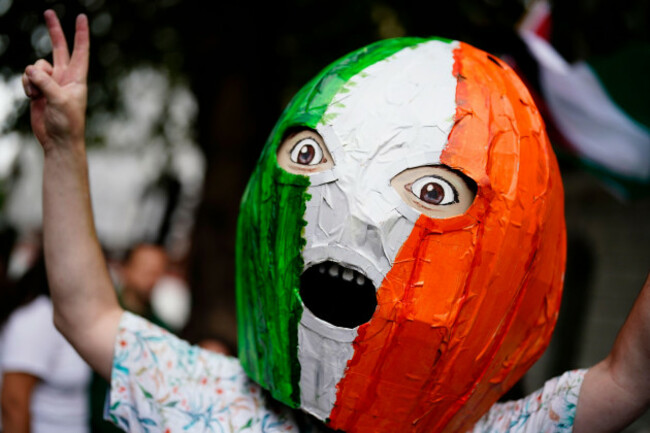
As was the case when Ó hAnnaidh last appeared before Westminster Magistrates’ Court in June, hundreds gathered for a protest outside the court building, organised by a number of pro-Palestine groups.
Kneecap's Mo Chara back in court in London. Police a lot more visible than last time, Met Police issued a warning to protesters in advance to remain in a defined area outside court.
— Rónán Duffy (@ronanduffy_) August 20, 2025
Context too of the mass arrests recently at protests for the newly proscribed Palestine Action. pic.twitter.com/U14hGCrMjp
Unlike the last occasion, however, UK police issued a warning to anyone planning on protesting, saying that protesters must remain in a defined area and that “Public Order Act conditions” are in place.
“We’ve imposed Public Order Act conditions to prevent serious disruption being caused by a protest outside Westminster Magistrates’ Court tomorrow,” Met Police said on social media.
“Protest in support of Liam Óg Ó hAnnaidh and aligned causes must remain in the red area. Any stage must be erected in the green area.”
In response to this on social media, Kneecap said that it “massively appreciates the support of what we know are the majority of the public, who can see this farce for what it is”.
“It is a distraction from war crimes that the British state support,” the statement continued.
The police warning did not seem to have much impact on the planned protests outside court, as large crowds remain outside the building.
Sinn Féin MP John Finucane was among those who spoke from a podium set up outside. Finucane said supporters “will not remain silent during a genocide”.
He ended his speech by saying: “Free Palestine, Free Mo Chara and tiocfaidh ár lá.”
Liam Óg Ó hAnnaidh (Mo Chara) is facing the same charge as many of the pro-Palestine Action protesters, but his charge relates to allegation of public support for Hezbollah, another proscribed organisation. Legal argument expected to dominate today's hearing. pic.twitter.com/wGsrMBsKxa
— Rónán Duffy (@ronanduffy_) August 20, 2025
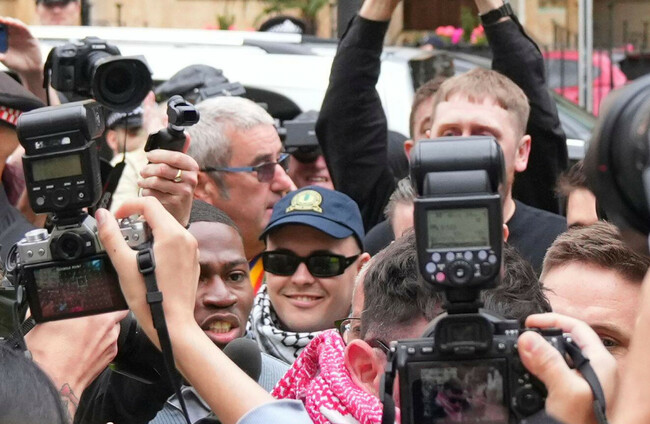
As Ó hAnnaidh entered court shortly before 10am, protesters chanted ‘free Mo Chara’, and dozens of posters and pro-Palestinian flags were held up in support of the rapper.
Despite the police cordon around the door of building, there was some pushing as Ó hAnnaidh made his way in, as a mass of photographers followed and court staff were overwhelmed.
Ó hAnnaidh is one-third of Belfast rap trip Kneecap and performs under the stage name Mo Chara. He is facing charges of displaying a flag in support of Hezbollah, a proscribed organisation in the UK, during a gig in the O2 Forum, Kentish Town last November.
During the June hearing, the allegations against Ó hAnnaidh were summarised by prosecutor Michael Bisgrove, who said that the case was “not about Mr Ó hAnnaidh’s support for the people of Palestine or his criticism of Israel”.
Instead, he said it “deals with a video recording showing that, in November of last year, Mr Ó hAnnaidh wore and displayed the flag of Hezbollah, a proscribed terrorist organisation, while saying ‘up Hamas, up Hezbollah’.”
Ó hAnnaidh has recruited a team of high-profile lawyers with experience of UK courts to administer his defence.
The legal team includes Darragh Mackin, of Phoenix Law, who represented families of the Stardust fire, and Brenda Campbell KC, who acted in the recent inquests in the Stardust case.
Speaking outside Westminster Magistrates’ Court in June, Mackin framed the case as one about freedom of expression.
“Oppression fears the freedom of expression, but the reality is Kneecap will stand up for freedom of expression and defend not only their rights but the rights of artists all around the world,” he said.
During the June hearing, the judge had said that unsuccessful attempts were made to have an Irish language interpreter present in court but that efforts would be made to secure one for the next hearing.
Unlike the previous court appearance when the accused’s named was listed as ‘O’Hanna’, an online listing for today’s court appearance contains several special characters, suggesting that the Irish language version of his name was entered into a computer system.
Should the matter go to trial, there will not be a jury determining the verdict but a district judge instead.

To embed this post, copy the code below on your site











have your say