Sign in. It’s quick, free and it’s up to you.
An account is an optional way to support the work we do. Find out more.
Sign in. It’s quick, free and it’s up to you.
An account is an optional way to support the work we do. Find out more.
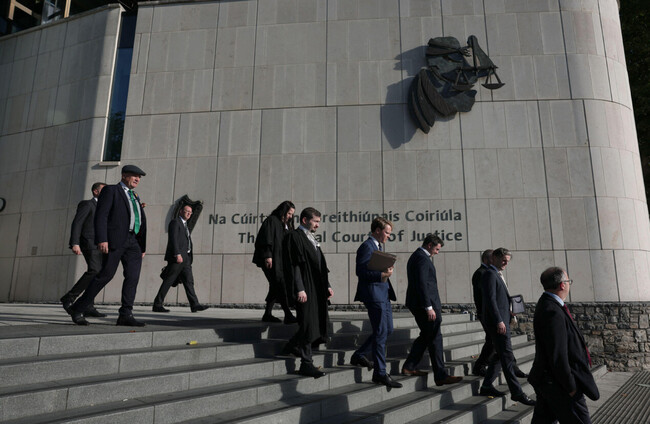
A JUDGE HAS criticised aspects of the legal aid fee scheme as “grossly unfair” and “demonstrably illogical”.
In a judgment delivered on Tuesday, Judge Mary Rose Gearty found that provisions governing the grouping of charges and the timing of payments to solicitors exceeded the justice minister’s powers under the Criminal Justice (Legal Aid) Act 1962.
The 1962 act provides that free legal aid may be granted, in certain circumstances, for the defence of persons of insufficient means in criminal proceedings.
Criminal aid solicitor John Quinn brought the case to the High Court over his ongoing dispute with justice minister Jim O’Callaghan.
The row between solicitors and O’Callaghan has been ongoing since the introduction of changes to the criminal legal aid fees model on 1 July. O’Callaghan claims these were made in an effort to curb what he described as “abuses” of the old scheme.
Where a solicitor used to receive €240 for a first appearance with a legal aid client and €60 for each appearance thereafter, they now receive a flat €520 fee when a case concludes with up to five court appearances.
Solicitors have said the new system is unworkable and have withdrawn their services.
They are seeking a second payment if a case lasts beyond 10 court appearances, as well as multiple payments of €520 where a client has multiple charges levelled against them by the state.
The dispute has caused months of disruption in the courts, where thousands of cases have been adjourned.
In a judgment today, Judge Greally said it was “grossly unfair” that payment of fees “will be at some uncertain future date in every case, some fees will be long-delayed, and some will never become payable” – an aspect of the scheme that exceeded the powers of the minister.
She also found that the requirement to await a final court order could leave solicitors unpaid for completed work, including where an accused person fails to appear, and a bench warrant remains outstanding, or where a client changes solicitor.
In August, the minister tweaked the scheme by agreeing to split the payment, so that two-thirds of the fee will be paid at the commencement of a case, with the remaining third paid either when the case concludes or after 12 months, whichever comes first.
However, the Law Society said at the time that this did not address solicitors’ concerns.
The judge also found it “demonstrably illogical” to link certification and payment to when charges are listed, without regard to the number or complexity of the cases involved.
The arrangements could result in one payment covering some complex, unrelated charges listed together, while additional or substitute charges concerning the same alleged conduct could attract separate certificates if listed separately.
Judge Gearty accepted that the minister could lawfully set an omnibus fee and that a single certificate could record the grant of legal aid for multiple cases.
“The defect in the provision lies not in setting the amount of €520 as a set fee, or the absence of a payment per charge, but in the criterion by which charges are grouped,” she said.
However, she found the arrangements linking certification to the listing of charges “demonstrably illogical”, and the requirement to await a final court order before payment invalid.
Final orders haven’t been made by the court yet, pending further submissions, and the matter has been listed for mention again next Tuesday.
Responding to the judgment in a statement, a spokesperson for O’Callaghan said the minister is “considering the judgment” and noted that aspects of the new scheme “have already been adjusted or are the focus of ongoing discussions”.
There were calls in the Dáil this afternoon from members of the opposition for the justice minister to deliver a statement to the Dáil in relation to the judicial review.
Sinn Féin’s Pádraig Mac Lochlainn said the comments from the High Court judge were “damning”.
“We need statements and questions urgently in the Dáil to find out what the government’s going to do to sort out this chaos and crisis as urgently as possible,” he said.
Meanwhile, Social Democrats TD Gary Gannon said statements are needed “fast” from the minister.
He described the situation as a “farce” of O’Callaghan’s “own creation”.
Labour leader Ivana Bacik said the judgment must be “extremely embarrassing” for the justice minister.
Taoiseach Micheál Martin told the Dáil that the justice minister has already agreed to reform a number of aspects of the scheme and said he has “every entitlement” to reform the criminal legal aid system.
He said the government will “consider” today’s judgment.
With reporting from Stephen McDermott and Jane Matthews.
To embed this post, copy the code below on your site













have your say