Sign in. It’s quick, free and it’s up to you.
An account is an optional way to support the work we do. Find out more.
Sign in. It’s quick, free and it’s up to you.
An account is an optional way to support the work we do. Find out more.

HOMEOWNERS ARE BEING reminded by Revenue to check their Local Property Tax (LPT) arrangements as the date determining liability for next year’s charge approaches this Sunday.
The annual liability date is 1 November. This means that the person liable for a residential property on Sunday will be responsible for paying its 2027 LPT charge, even if they subsequently sell or transfer it before 31 October next year.
However, Sunday is not the deadline for submitting a return or paying the bill. Those dates depend on whether the property is newly liable and how the owner chooses to pay.
For many people already paying LPT, their existing arrangements will continue automatically.
Here’s what you need to know.
If your property was liable for LPT in 2026 and you have already submitted a return covering the 2026–2030 valuation period, you do not need to file another one for 2027.
Revenue says anyone who has not yet submitted that return should do so immediately.
You do not need to revise your valuation simply because your home has increased in value since the valuation date of 1 November 2025.
Different requirements apply to properties becoming liable for the first time.
These include newly built homes completed after 1 November 2025 and on or before 1 November 2026, as well as refurbished properties that became occupied or suitable for use as a dwelling during that period.
For these properties, owners must submit an LPT return by 2 December 2026 and arrange payment.
If the property has not previously been registered for LPT or Stamp Duty, it will also need to be registered with Revenue.
LPT is a self-assessed tax, meaning the liable person is responsible for determining the property’s value.
For the current valuation period, the relevant date is 1 November 2025, rather than its value today. That valuation determines the charge through to 2030.
For a newly built or refurbished home becoming liable in 2027, you must assess what it would have been worth in its completed state on 1 November 2025, even if it was unfinished or uninhabitable then.
Most properties fall within valuation bands, so owners select the appropriate band rather than declare an exact value.
Properties worth more than €2.1 million must be assessed using a specific market value.
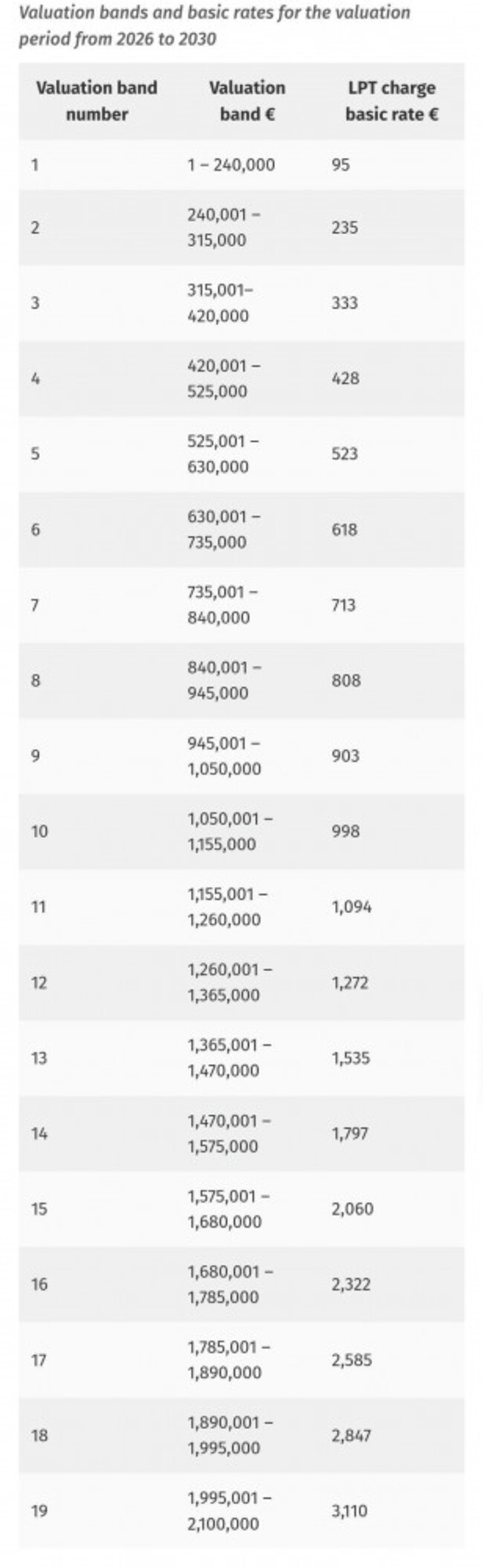
There are 19 valuation bands covering properties worth up to €2.1 million.
The basic annual charges are:
These are the basic charges, before any local authority adjustment.
For properties worth more than €2.1 million, the bill is calculated by adding together:
Local authorities can adjust the basic rate upwards by up to 25% or downwards by up to 15% for 2027.
Cavan, Leitrim and Sligo county councils will apply a 25% increase on the basic rate, while Laois will apply a 20% increase.
Dún Laoghaire-Rathdown will apply a 15% reduction, South Dublin a 7.5% reduction and Fingal a 5% reduction. Dublin City, Louth and Meath will charge the basic rate.
For example, a property in band three has a basic charge of €333. With a 25% local increase, that becomes €416.25; with a 15% reduction, it becomes €283.05.
You can check your bill using Revenue’s LPT calculator, selecting the relevant year, local authority and valuation band.
If you already pay through a recurring method, Revenue says that arrangement will automatically carry forward to 2027.
That includes monthly or annual direct debit and deductions from wages, an occupational pension, social welfare payments or Department of Agriculture payments.
If you used a non-recurring method, such as a one-off card payment, you need to arrange payment for 2027 through your Revenue property record.
You can also change your payment method through the LPT online service.
The main dates are:
Card payments are processed on the day they are submitted. Anyone who has changed banking provider should also check that Revenue has their correct bank details.
Certain properties qualify for exemptions, while people meeting specified conditions may be able to defer payment.
Owners of newly liable properties must claim any relevant exemption on their LPT return.
If you already had an exemption or deferral in 2026, it will carry forward to 2027. However, Revenue says you should check that you still meet the qualifying conditions.
Further information is available through Revenue’s guidance for 2027.

To embed this post, copy the code below on your site















have your say