Sign in. It’s quick, free and it’s up to you.
An account is an optional way to support the work we do. Find out more.
Sign in. It’s quick, free and it’s up to you.
An account is an optional way to support the work we do. Find out more.
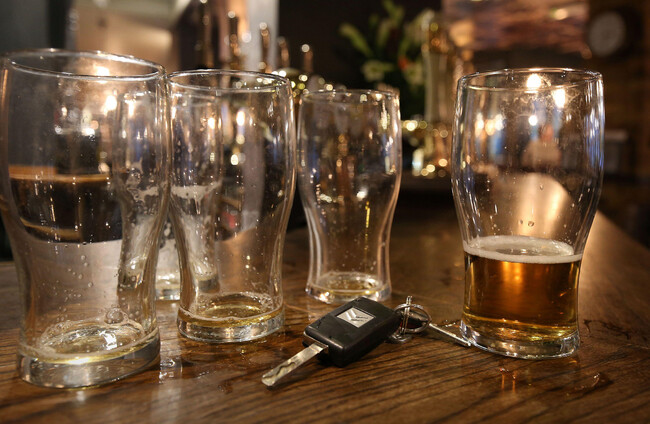

EVERYONE IN A pub is an expert on how much they have had to drink. Ask at nine o’clock and you will get a precise answer. Two pints, maybe two and a half, and a packet of crisps for ballast. Ask at midnight and the answer gets vaguer, and a lot more confident.
That gap between what we think we can handle and what is actually in our blood is at the heart of a row that blew up and fizzled out in about 24 hours earlier this month.
The Road Safety Authority (RSA) issued a tender for 20 breathalyser terminals for pubs, hotels, golf clubs and big sports venues, plus another 20 for summer events like Electric Picnic and the Galway Races. The estimated value was €1.5 million. A day after the news broke, after what is understood to have been ministerial intervention, it was stood down.
“I welcome the decision not to proceed with this procurement process. It is the right decision,” said Minister of State for Road Safety Seán Canney.
Social Democrats transport spokesperson Aidan Farrelly had called the plan “disgraceful” and “neglectful”. His sharpest line was the best one. The message to drivers, he said, should be “never ever drink and drive, not drink as much as you will get away with, which is what this policy conveys”.
The RSA hit back that its “message on drink-driving has not changed: if you are drinking, don’t drive”. It also points out that the €1.5 million is the estimated total across a potential seven-year contract, covering event terminals as well as the pub and hotel units, and that its machines have already been used 121,390 times at events.
I have sympathy for the minister. I also have some for the RSA, which is an unusual place for me to be. From the outside, the government’s relationship with the authority does not look cordial. The muddled messaging on what to do when a car is coming at you the wrong way on a motorway, and now this, leaves the rest of us feeling like children listening to Mammy and Daddy arguing downstairs.
The RSA ran a pilot between August 2024 and February 2025 at venues and events across the country. More than 24,000 tests were carried out. The headline finding was startling. Some 45% of people who blew into the machine thought they were under the legal limit and were not.
It gets more worrying. Of those over the limit, 64% said they planned to drive. Among those who wrongly believed they were fine, 77% planned to drive. Young men aged 18 to 34 were most likely to get it wrong, and a 10-second test that tells them so has a certain logic.
And the context is grim. 182 people died on Irish roads last year, the highest figure in five years. Nobody at the RSA is short of motivation.
And yet, this is where I come down with the minister and Farrelly. For years, the message in this country has been simple and hard-won. Do not drink and drive. Not “drink a bit and check”. Just don’t.
Put a machine on the wall of a pub and the message changes, whether you intend it to or not. It says there is a number that is acceptable. It turns a rule into a game. Anyone who has watched a group of friends at the end of a night knows what happens next. Someone has a go, gets a reading just under the limit, and wins. Someone else gets a reading just over and demands a rematch.
There is a deeper problem. “Under the limit” is not the same as “unimpaired”. Research suggests driving skills start to slip at the very lowest readings, and the RSA itself has cited French research finding that even 0.01 can triple the risk of death or serious injury in the small hours. A machine that flashes green at 0.04 is telling a driver they are fine when the science says otherwise.
A breath test is also a snapshot. It tells you what you blew a few minutes ago, not what you will blow in 40 minutes, when the alcohol is still being absorbed. These machines even estimate how long you need to wait before it is safe to drive. That is a countdown clock, and people love beating a countdown clock.
Even allowing for the RSA’s point that the sum stretches over years, it is the sort of money that would put a lot of very decent, nearly new family cars on driveways. Instead, it was about to buy boxes that tell people what most of them already suspect.
Consider what that money could do on the road. In 2010, gardaí carried out 566,760 roadside breath tests. Last year it was just under 190,000, a fall of about two thirds. Drink-driving arrests have dropped from more than 10,000 to around 4,900 over the same period. Gardaí point out that detections rose by 5% in 2025, which is true, but fewer tests means fewer chances to catch anyone.
Alcohol Action Ireland, citing European Transport Safety Council figures, says we have the lowest level of roadside breath testing in the EU. That is about 18 or 19 tests per 1,000 people, against 109 in France and 576 in Estonia (2021 figures). It is why I find the “people underestimate” argument only half convincing. If your chance of being stopped is that low, the deterrent is mostly theoretical.
And the harm is not theoretical. An RSA analysis of coronial data from 2016 to 2020 found that 35% of driver fatalities with toxicology results had alcohol in their system. For deaths between 10pm and 6am, it was 70%.
I have written in this column before about alcohol interlocks, which stop the engine starting if the driver has been drinking. Sweden has used them for decades, and we are still talking about them. The most effective deterrent is the one that does not rely on the person who has had four pints making a sensible decision.
The most reliable breathalyser in Ireland has always been the person who says, “I’m driving, I’ll have a Coke.” That used to be an awkward thing to announce. Now it is barely noticed, and zero-alcohol beer is on tap across the country.
Guinness Zero is my personal favourite, and in a pub that treats it with the same respect as a normal pint it is almost as good a drink. There is no hardship in a few Guinness Zeros, compared with feeling sorry for yourself on your fifth Coke or Lucozade.
That cultural change did not come from a terminal on a wall. It came from years of hard-hitting campaigns and ordinary people deciding the night out is not worth the risk. The RSA deserves credit for a good part of it.
Which is why this misstep stings a bit. A pilot was sensible. A rollout across at least 12 counties was not. Farrelly asked how involved the Minister for Transport had been, and called for the RSA to answer to the Public Accounts Committee. That seems reasonable.
The pilot’s lesson still stands. We are bad at judging our own impairment, and worst when it matters most. That should shape our advertising and our enforcement. It should not shape a machine that gives people a number to aim for.
If you are going to drive, do not drink. If you are going to drink, do not drive. Book the taxi, mind your friend’s keys. It does not need a €1.5 million-funded device to tell you so.
Paddy Comyn is the head of automotive content and communications with DoneDeal Cars. He has been involved in the Irish motor industry for more than 25 years.
Journal Media Ltd has shareholders in common with DoneDeal Ltd.
To embed this post, copy the code below on your site








have your say