Sign in. It’s quick, free and it’s up to you.
An account is an optional way to support the work we do. Find out more.
Sign in. It’s quick, free and it’s up to you.
An account is an optional way to support the work we do. Find out more.
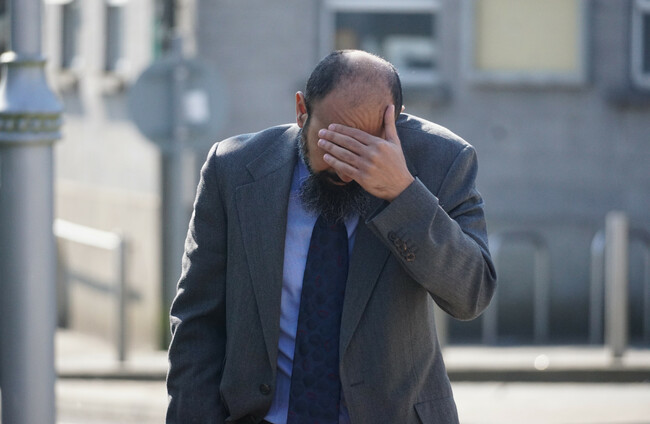
A DOCTOR HAS been spared jail after a court heard how a “catastrophic” tyre defect triggered a crash that fatally injured his six-year-old daughter on the M6 on her birthday.
Babak Meshkat (46) of An Cimín Mór, Cappagh Road, Galway, was charged following a garda investigation into a crash on the motorway, at Rochfortbridge, in Co Westmeath on 8 February 2024.
Hana Meshkat had been unbuckled in the back seat of her father’s BMW X5 for just a minute before the car lost control.
He had been driving over the speed limit to get to Dublin Airport to collect her grandparents, who were visiting Hana as a surprise as it was her birthday that day.
Due to severe head injuries, she passed away nine days after the crash at Children’s Health Ireland (CHI) hospital at Temple Street in Dublin.
Meshkat pleaded guilty at Mullingar Circuit Criminal Court after the charge of dangerous driving causing death was reduced to a lesser offence of careless driving causing death.
The father of three, who sat silently during the sentence hearing today, was fined €5,000 and banned from driving for 12 months.
Judge Cephas Power described it as a tragedy.
“There is no sentence of this court that can act as a greater punishment than the daily pain and suffering that Mr Meshkat now endures,” the judge said.
“There is no sentence of this court that can act as a greater deterrence against acts of unsafe driving and the horror of the circumstances of this case, now known to have been caused by a combination of factors.”
He said there was a “latent defect in the BMW which the accused was driving leading to a catastrophic failure in the rear tyre of the vehicle”.
The second factor was the unsecured child “who unbuckled her belt 60 seconds before the incident”, an the third “to a much lesser extent” was the speed at which the car was driving.
“All of those factors led to the death of one so loved by her parents and everyone who knew her,” he said.
The judge noted the accused remains grief-stricken and the effects personally were profound and continue.
The court heard the accused has PTSD, constant flashbacks and suicidal ideation.
He lived about eight kilometres from the hospital where he works and occasionally needed to drive for emergency call-outs, hospital attendance, or to bring family members and children to various activities, the judge also noted.
The court heard that when he lost control of the vehicle, the airbags deployed and the vehicle flipped up and down on the embankment before coming to a rest back on the motorway.
Examination of the crash data ascertained that the accused and his son, sitting in the front, were restrained, but 60 seconds before the incident, Hana had unbuckled her seatbelt and was therefore no longer restrained.
He became aware a moment before the crash that Hana had undone her seatbelt.
His speed four seconds before the crash was 173 km/h, and the limit on the motorway is 120 km/h.
The average speed of the BMW had been 138 km/h.
The roadway conditions were ascertained from several sources. Witnesses said there was poor visibility and heavy or light misty rain. Met Éireann indicated at the time of the incident that there was light rain with some poor to moderate visibility.
“Crucially, in this case, the forensic examination determined that the trigger event for which the Director of Public Prosecutions does not hold the accused responsible – he is not responsible for the triggering event – was that the tread of the right rear tyre of the vehicle delaminated, that is to say, the outer layer of the tyre, which comes into contact with the roadway, was completely detached from the bottom of the tyre.”
Forensic evidence established that the rear wheels of the BMW were aligned with excessive negative camber. This meant the top of the tyres tilted inwards. The bottom inside of the tread made greater contact with the road, causing excessive wear.
The court heard the tyres were wide, and looking at them, they appeared in order. The car would have to be raised on a ramp for the tyre wear to be visible.
The court heard that this feature was present on the BMW 5 Series, most likely designed for driving on the Autobahn, the roads in Germany.
The attempt by a driver to correct this “made the vehicle impossible to control, leading to a catastrophic failure and a total loss of control”.
The court heard Hana was thrown from the vehicle because she was unbuckled in the back.
“The accused was witnessed by those present in an extremely distressed state, screaming for his daughter and begging for her to be okay.” He was seen turning her on her side and assisting her before she was transferred to Temple Street Hospital.
The accused cooperated with the investigation and has no previous convictions, the judge said.
The car had been serviced regularly, was only two years old, and the tyres were heavily worn despite being bought just nine months beforehand.
The judge also noted the evidence that, but for the delamination of the tyre, this case would not be before the court; that this was the primary event; and that it was accepted by the DPP.
The negative camber was intentionally engineered into this particular model. Gardaí corresponded with BMW, but received no acknowledgement from the company’s headquarters.
The judge said there was excessive speed, but the evidence was clear that the car would have gone out of control even at 120 km/h. He added that it was simply not possible to say whether the tragic outcome would have been any different.
He highlighted that this case did not have the usual aggravating factors, such as previous convictions, alcohol consumption, or knowingly driving a defective vehicle.
Judge Power said the aggravating factors were the 60 seconds after the accused was alerted that his daughter had unbuckled her seat belt, the speed he was driving, and that he ought to have slowed down and taken emergency action.
He accepted that it was not the primary cause of the incident.
The court heard that Mr Meshkat was born in Iran, moved with his family to London for a year before settling in Norway when he was nine.
After finishing school, he won a scholarship to study medicine abroad and chose the Royal College of Surgeons in Ireland, commencing his medical studies in 1998, where he met his wife.
He completed his training in Ireland and worked as a general surgeon with a speciality in other fields.
The court heard Mr Meshkat struggles to cope with the trauma but is now focused entirely on caring for his family and his patients.
In his evidence, he had described the moment the tyre blew out and his desperate attempt to slow the car down before the vehicle flipped.
Judge Power described the character references submitted to the court — including several from patients treated by the doctor and colleagues he worked alongside — as exceptional. They spoke of a highly skilled surgeon with great compassion and empathy for others.
A victim impact statement from the family recalled a child who was bubbly, full of life, outgoing, and brimming with confidence and personality — someone who captivated everyone she met with an infectious laugh, a keen sense of humour, and a joyful spirit. She loved art, Irish dancing, and music.
They described how their lives have been left with profound grief, anxiety and panic that have since engulfed their daily lives.
The judge said he had to consider the impact on the family members. He noted from his wife’s submission that their surviving children, having already lost their sister, have had to live with the very real possibility of also losing their father to a custodial sentence.
He held the doctor’s culpability was ranked at the upper lower end of the scale, and a custodial sentence was not warranted.
To embed this post, copy the code below on your site












have your say