Sign in. It’s quick, free and it’s up to you.
An account is an optional way to support the work we do. Find out more.
Sign in. It’s quick, free and it’s up to you.
An account is an optional way to support the work we do. Find out more.
MATHS WEEK STARTS today and, as is our annual tradition, we’re setting our readers some puzzles. Give them a go! You can check out other events being held over the next seven days here.
“WHY DO WE do maths?” is a question long asked by suffering schoolchildren.
“When will I ever use this?”
If you didn’t ask it yourself, chances are you heard a classmate ask it.
There is now a new slant on this question: “Why should we learn maths when AI can do it for us?”
We had better have an answer to this if we are to motivate learners.
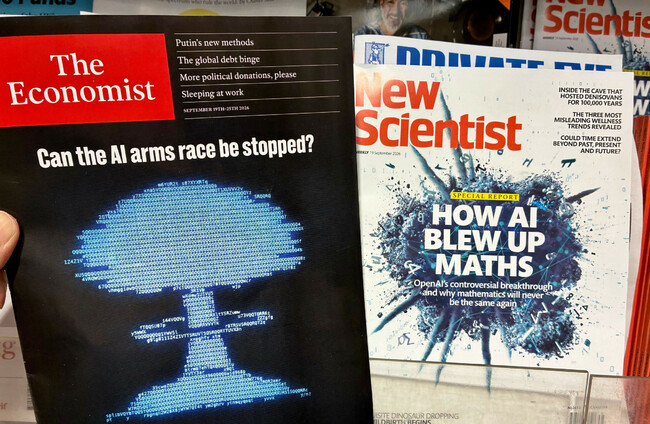
During the past week, OpenAI announced that an experimental AI system had produced hundreds of new results on open mathematical problems.
Although mathematicians are still examining the results, the scale and speed of the work suggest that AI may be moving from being mainly a mathematical tool to something more.
It has forced the mathematical community to think and talk about the future of the discipline.
It is worth remembering that AI systems themselves are built on mathematics, and mathematicians helped create them. But mathematicians are now having difficulty dealing with the deluge of outputs.
Can the results all be checked by humans? And if not, how can we be sure that they are correct?
What about non-mathematicians who use maths extensively? Engineers, scientists, economists and people working in finance may increasingly find that AI can do much of the mathematical work for them. So what is a good argument for learning maths?
One answer is the old argument that we should still learn arithmetic, even though calculators can do the calculations, because we need to have an idea of what the correct answer should look like. Besides, we need to know what to ask the calculator.
Although AI is orders of magnitude more powerful than a calculator, a similar argument still has merit.
One thing is certain: the educational future is uncertain. The challenge for education may therefore be less about teaching students simply to do mathematics, and more about teaching them to think mathematically.
Mathematical thinking means recognising patterns, developing problem-solving skills, asking good questions, making conjectures, reasoning logically, modelling problems, estimating, testing ideas, and judging whether answers make sense.
If we are to argue that these are good reasons to learn maths, then we must ensure that mathematics education is designed to develop these skills.
They include recognising patterns in numbers, shapes and data; asking good questions; estimating; reasoning logically; testing and proving ideas; abstracting; generalising; approaching problems in different ways using words, numbers, equations, diagrams and graphs; and understanding uncertainty.
Puzzles are an effective way to develop problem-solving skills, and during Maths Week we will have daily puzzles to challenge you.
We will start today with 10 short questions to test your numeracy skills: no calculators or AI allowed!
1) What is one half plus one quarter?
2) What is four divided by a quarter?
3) Assuming you want three items, which is better value: three for the price of two or 50% off each item?
4) Adam is twice as old as Ben who is twice as old as Ciara. If Ciara is 12, how old is Adam?
5) What is the next number in this sequence: 1,2,4,7,11?
6) A square room has an area of 16 square metres. What is the length of each wall?
7) An item costs €110. It will be reduced by 20% in the sale. How much will it cost then?
8) There are chickens and pigs in a farmyard. There are 12 heads and 32 legs. How many of each?
9) What is five times one third of half of six euros?
10) Which is largest? (a) 80% (b) 4/5 (c) 0.81 (d) 5/6
Come back tomorrow at 7.30pm for the answers and a brand new puzzle.

To embed this post, copy the code below on your site















have your say