Sign in. It’s quick, free and it’s up to you.
An account is an optional way to support the work we do. Find out more.
Sign in. It’s quick, free and it’s up to you.
An account is an optional way to support the work we do. Find out more.
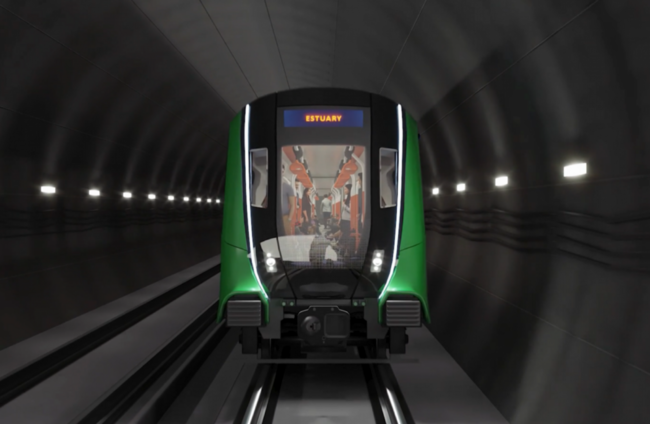
MUCH HAS BEEN written about the long-awaited MetroLink since it was first announced seven years ago.
The proposed 18.8km Dublin rail line, which will be the single biggest public transport project in the history of the State, will have 16 stations stretching from Swords to Charlemont with an end-to-end journey time of 25 minutes.
Since it replaced the original planned north-south train network for the capital in 2018, most of the focus around MetroLink has been on delays to the project, criticism from billionaires and disagreements over the route of the line and where it should terminate.
There has been less focus on the fact that it is going to be a fully automated rail line with driverless trains.
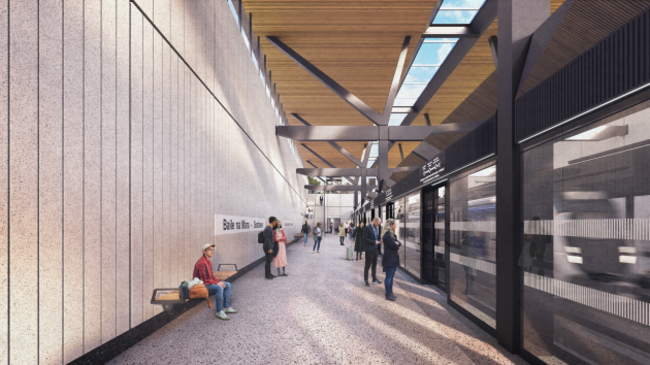
Transport Infrastructure Ireland (TII) told The Journal that MetroLink will be a level 4 grade of automation, meaning it will be a driverless system.
The project’s website states that while other train lines are adapting automation into their existing systems, “MetroLink has a significant advantage as we can design for automation from the start”.
Brain Caulfield, a professor in transportation at Trinity College Dublin, told The Journal that while it will be the first driverless method of public transport in Ireland, we’re really only catching up to the rest of the world.
“Driverless metros are kind of the norm now in cities,” he said. “Any new metro system that’s being built right now is driverless.”
The MetroLink trains will run using a computer-based signalling system. They will have an assigned speed, and starting, stopping and the opening and closing of doors will be fully automated.
There will be operational, security and safety staff working from a 24-hour control centre that will monitor the trains, stations and platforms through CCTV, sensors and other advanced technology. There will also be direct passenger communication systems in every carriage.
Caulfield said the main benefit of the driverless system will be able to maintain consistent, smaller headway in between trains that will allow for more of them on the track, boosting passenger capacity and shortening waiting times for a train.
“The projection is that there will be 50 million passengers per year on Metro. That’s not possible without this technology.”
Driverless systems don’t come cheap, which may be one of the reasons why the estimated cost of the MetroLink has risen since it was first announced back in 2018.
The most recent cost estimate for the MetroLink from TII totalled €9.5bn, though this figure was published in 2021.
In 2020, a leaked report from Transport for London said that introducing driverless trains across the city’s Underground would cost £7bn (€7.9bn) and represent “poor value for money” as the high costs would mean “the financial payback is negative”.
However, TII said that the challenge for London stems from “retrofitting a system that is over 150 years old”.
“Converting legacy infrastructure to driverless operation is complex and costly. MetroLink, by contrast, is purpose-built for automated operation,” a spokesperson said.
“This approach is now the global standard for new metro systems, and similar projects worldwide have successfully adopted this model. As a result, the cost concerns seen in older networks do not apply in the same way to MetroLink.”
Metrolink will be modelled on the fully automated Copenhagen Metro and the Barcelona Metro, which is 25% driverless.
TII said their MetroLink team contacted both operators and visited both metros back in 2017 “to inform early thinking” on how it might operate.
The Copenhagen Metro has been driverless ever since its first line opened in 2002. It is now around 43km long with 44 stations in total and trains running every 3-6 minutes. Last year, it transported around 126 million passengers.
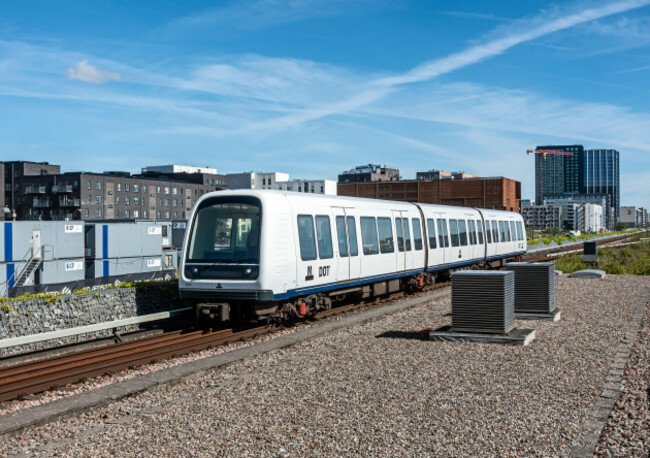
The automated trains are monitored, controlled and programmed from two control centres in the city run by operational, security and safety staff. Passengers can contact controllers directly from the train carriages.
The trains run at an assigned speed and stop at stations according to a schedule, though the control centre can intervene at any point.
The system is “a world class example of doing it right”, according to Caulfield.
“Copenhagen started the time that we were supposed to start our first metro line. They’re onto their second metro line,” he said. “In Denmark, they were able to push ahead and build it during the recession, when we cancelled everything.”
He pointed to the Sydney Metro as another great example of a driverless system. “What they’re doing is very similar to what we want to do here.”
Given it will be the first brush that the people of Dublin have with a driverless transport system, it’s fair to say that some people may find it somewhat unnerving or uncomfortable not having a person sitting upfront at the controls.
TII said it is confident the public will use MetroLink “with trust and ease”, stating: “With more than 40 fully driverless metros operating worldwide, the GoA4 approach is a proven, safety-first global standard.”
Along with staff in the 24-hour control centre, there will be staff at stations to help passengers and to respond to any incidents.
There will also be integrated safety features, like platform screen doors. Caulfield said this will be the main thing that people notice about the trains.
“Before you get into the metro, these glass doors will open up and then you’ll be able to walk into it. It completely segregates the track from passengers.”
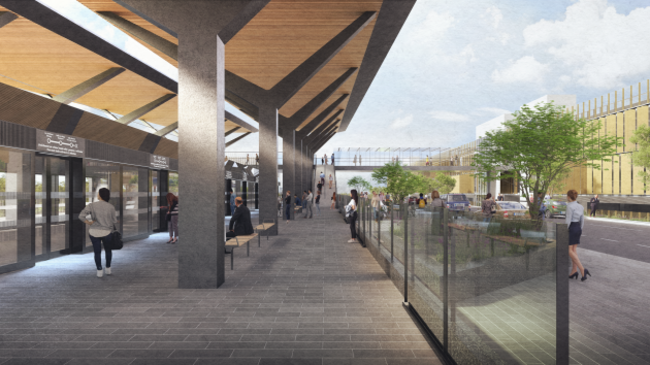
In addition, TII said public information campaigns will be developed and implemented during all phases of the project that will explain how the system will operate and “clarify how automation enhances safety and reliability”.
Caulfield does not believe people will be too worried.
“The Metro will be running for a good few months before passengers are let onto it, so that they make sure that any issues are ironed out,” he said. “It will have been tested to within an inch of its life before it’s handed over to us and it will be constantly monitored.
“Back 20 years ago when we were meant to build it, maybe [driverless trains] were a bigger deal. Not anymore. There’s lots of Irish in Sydney that use it every single day of the week.”
While he admits he is excited to see it up and running, he’s not holding his breath. “It’s going to take a while.”
Despite being granted planning permission in October, a question mark still remains over when we will actually see MetroLink operating.
A legal challenge brought by a group of residents in Ranelagh in November had threatened to derail the estimated 2027 construction commencement date, with TII warning that it meant delay was “inevitable”.
But the proceedings were withdrawn just before Christmas following a mediation process. As part of the deal that saw the judicial review, TII committed to buying ten homes on Dartmouth Square.
For the moment, it’s back to waiting for construction to begin.
“I’ll believe it’s happening when contracts are signed and shovels start going into the ground and things start to get moving. Hopefully that’s closer than we think,” Caulfield said.
One thing he is keen to see once it is delivered, is a quicker turnaround time for its next phase.
“When we finish building it, let’s start building the next one. Let’s not wait another thirty years and pat ourselves on the back. Let’s go again straight away,” he said.
“We know that we need to do all of this, and we’ve known this for a long time. Let’s get it done quickly.”

To embed this post, copy the code below on your site
















have your say