Sign in. It’s quick, free and it’s up to you.
An account is an optional way to support the work we do. Find out more.
Sign in. It’s quick, free and it’s up to you.
An account is an optional way to support the work we do. Find out more.
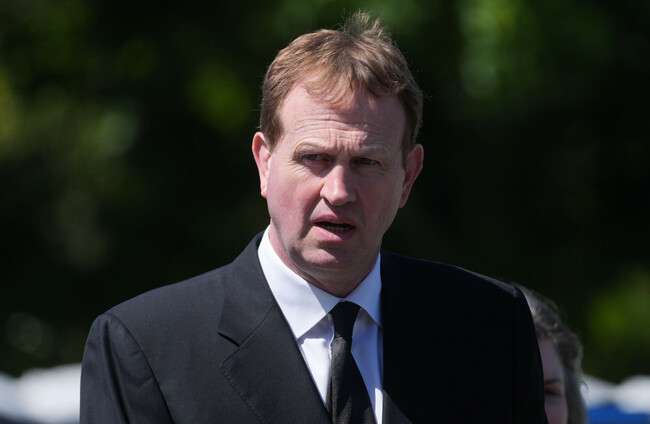
JUSTICE MINISTER JIM O’Callaghan has said he is “very concerned and appalled” at the attacks against the migrant community over the summer months.
In one instance, a man who was attacked by a group of teenagers has decided to return to India as a result of the assault.
Other recent incidents have included a man being stripped and beaten after a false accusation in Tallaght, a man being assaulted on his way home from a friend’s apartment, and an attack on a six-year-old girl in Waterford.
This resulted in the Indian embassy in Dublin recently warning citizens “take reasonable precautions for their personal security and avoid deserted areas, especially in odd hours”.
The minister said members of the Indian community are “very shook” by the incidents.
“They were very offended by it and when they met me wondered, what was it that they or any migrant had done to merit such a criminal and appalling attack,” he said.
The minister said he wanted the Dáil to debate the issue of migration in the first week back so as to provide important context around the facts and figures around immigration and migration in Ireland and to communicate that Ireland has a rules-based system.
“In order to come into Ireland people have to comply with the rules and if they comply with the rules they are extremely welcome here. However, if they do not comply with the rules we will just have to enforce the rules to ensure we keep control over our migration system,” said O’Callaghan .
In providing further detail to the House, the minister said approximately 15% of all nurses and midwives working in Irish hospitals at present come from India.
“We have a significant number of people working in our health service who play a significant role. It is worth pointing out that in 2023, more than 23% of all nurses and midwives directly employed by the HSE were migrants, with nearly 15% of them coming from India,” he added.
In 2023, nearly four in every ten doctors registered with the Irish Medical Council were trained outside Ireland, and one in four were trained outside the UK and the EU, said the minister.
“These numbers illustrate that the health service is very much dependent on the excellent work providing by migrants who have come to Ireland to work. It is not just our health system, however, that is dependent on migrants who have come here to work.
“If we look at our construction sector, statistics were produced in 2023 showed that in that year, there were 27,500 migrant workers in Ireland’s construction sector,” he said, stating these workers, who have come here legally, are helping to build the much needed houses this country needs.
“Regarding the contribution that migrants have made to Irish society, it is important to emphasise that people who are here lawfully make an extremely strong contribution and they are welcome by the vast majority of Irish people,” said the justice minister.
Delving into the statistics around the population of Ireland over the years, the minister said the population increased by approximately 98,700 people in a period of 12 months.
“That is very significant population growth and it derives from the following. We had a birth rate of 54,200 and a death rate of 34,800 in the year up to April 2024.
“We also had immigration into Ireland of 149,000 people. I will break down that figure as it is important we have the context in terms of the demographics for the discussion we are having this afternoon,” he said, outlining that:
“Those are the 149,000 people who immigrated into Ireland in the year ending April 2024,” he said.
The majority of the people who come into Ireland come in on the basis of visas that have been granted by his department, outlined the minister.
In 2024, there were approximately 201,000 applications of all types of visas.
Of those 201,000 applications, 150,000 visas were granted.
O’Callaghan said many of those visas are short-term visas – some are nine-month visas – but there is also a significant number which are student visas.
Approximately 61,000 student permissions were issued in 2024.
The minister said the main type of migration into Ireland is visa-granted migration.
In terms of the numbers leaving Ireland, some 69,000 people left the country during the 12-month period up to April 2024.
Of those:
In 2019 a total of 4,700 people arrived seeking international protection in Ireland.
In 2020 and 2021, during the pandemic, the numbers were small at 1,500 and 2,600 but then in 2022 and 2023 we had 13,500 people applying for international protection in each of those years.
Last year 18,500 people applied, the minister said, adding that the numbers have reduced this year.
He said consequence of high numbers of people coming in seeking international protection is that there is an obligation on the State, as there is on other EU countries, to provide accommodation for persons who are coming in here.
“That has been a politically contentious issue and has given rise to concern in communities,” said O’Callaghan.
The minister said it is important the demographic context is known when discussing migration, stating that it is a “positive news story that in Ireland we have changed the narrative from people leaving the country and having to go elsewhere to get their successful life to people who now want to come in to Ireland”.
During the debate, a number of TDs spoke about experiences their constituents had had in recent times, with Green Party leader Roderic O’Gorman and former minister that had oversight of the international protection system, said “overt racism” is now a regular experience for some people now.
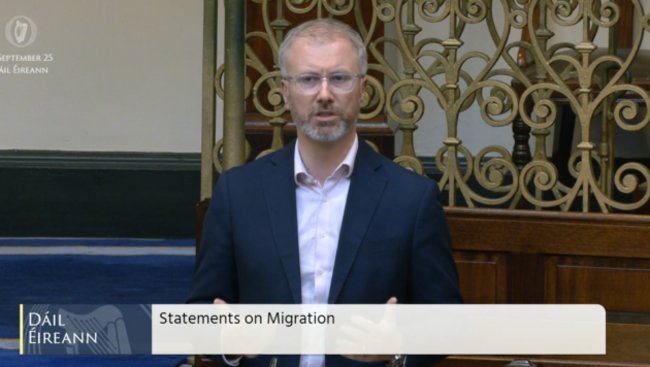
One email he received from a constituent from Pakistan, whose partner is Irish, outlined how the pair were walking to the train station one day hand-in-hand, “when the gang of young lads saw them and started to use various racial slurs”.
“What struck me most about her email was she wasn’t surprised, this has become normalised for her. She baked this sort of experience in. Overt racism is now a regular experience for this woman, and I think that does represent a change in Irish society.
“There has always been racism in Ireland, but I don’t think 15 years ago, people would have been as blatant as to just corner someone walking along the street and start this sort of racist abuse. There has been a change, and I believe that the online space is a major driver of that change,” said O’Gorman.
Speaking to people specifically from the Indian and South Asian communities, O’Gorman said that he was told they remain committed to Ireland and do feel welcome, but they also reported increased levels of verbal abuse.
People Before Profit Ruth Coppinger spoke about the case of a six year old girl being pushed off her bike whose mother is an Indian nurse here in Ireland. Over the summer, she heard countless reports of similar instances, telling the Dáil today that only recently she had to report an attack in a playground “on somebody of colour”.
She said there is a “worrying trend” that many children and teenagers are involved in some of these attacks, stating that they are imbibing racist ideas from older people, from social media, and from the world around them.
Coppingere also told the minister that a repeated complaint she is hearing is that when incidences are being reported to the gardaí some are finding the authorities “very dismissive”.
“There’s no record seemingly kept in many cases. And that was a widespread complaint,” she told the justice minister.
Social Democrats Wicklow TD Jennifer Whitmore told the minister that the government has completely failed to put in the services and resources to ensure there is inclusive integration of people when they come into this country.
“And that is why it feels so significant to so many communities out there. You were not prepared. The reality is, Ireland is a very, wealthy country, and migration is going to be a feature of our lives, and it will continue to be, but your government has failed to actually to forward plan…
“What that failure means now is that the country that we love, the country we are so proud of… we are changing. There is an element of change coming into our country, and we’re seeing people being attacked because of the colour of their skin, because of their accent, what they’re wearing, their dark hair, dark eyes. And that is not the type of country we want to be,” said Whitmore.
Last week, Taoiseach Micheál Martin outlined that he was extremely concerned about the the number of attacks being carried out and spoke about how many businesses are now very worried about their workers.
He said that this is something the government will have to tackle strategically, indicating that some form of an action plan is forthcoming.
Need more clarity and context on how migration is being discussed in Ireland? Check out our new FactCheck Knowledge Bank for essential reads and guides to finding good information online.

To embed this post, copy the code below on your site











have your say