Sign in. It’s quick, free and it’s up to you.
An account is an optional way to support the work we do. Find out more.
Sign in. It’s quick, free and it’s up to you.
An account is an optional way to support the work we do. Find out more.

YOUNG PEOPLE ARE struggling to live independently and afford rent in Ireland as the youth labour market still grapples with the fallout of the 2008 financial collapse.
A report published today by the National Youth Council of Ireland (NYCI) has drawn attention to the employment difficulties facing young people.
The report, which looks at youth unemployment, found that the number of young people in employment in Ireland has never fully recovered since the 2008 financial crisis.
It found that while youth unemployment has significantly reduced since the crisis, the relative position of young people in the labour market has worsened.
This is in part due to rents increasing at a rate far above wages.
Between 2000 and 2008, around 400,000 people aged 15 to 24 were in employment.
That number fell by more than half between 2008 and 2012. It gradually recovered in the years that followed, but after reaching 320,600 in the third quarter of 2021, progress appears to have stalled.
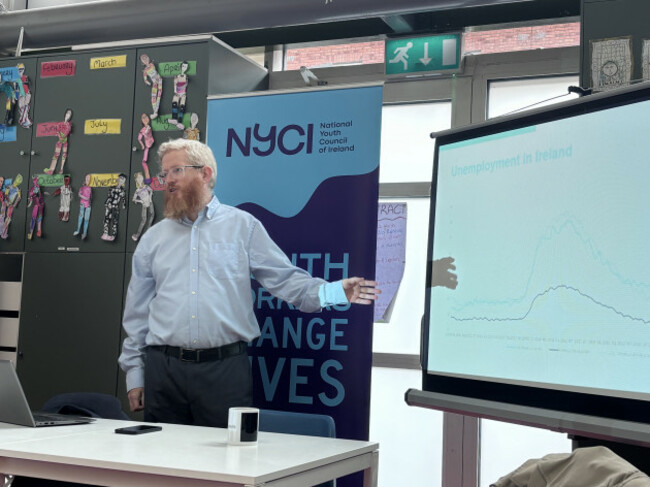
Launching the report today at the YMCA youth centre in Dublin City, Kathryn Walsh, director of policy and advocacy at NYCI, said:
“The fall in youth unemployment since the financial crisis is real and important. But it does not tell us whether young people can find secure, fairly paid work or build an independent life.
“Despite near-full employment, many young people are facing sub-minimum wages, unaffordable housing, social exclusion and continued pressure to emigrate.
“A job should offer young people the chance to build an independent life and a secure future, but for too many that is not the reality.”
The report noted that emigration by Irish citizens increased from around 13,000 annually before the financial crisis to 35,000 in 2025.
Author of the report, Oisín Gilmore, senior economist at TASC, said today that while falling youth unemployment is welcome, it is not enough.
“A serious youth employment strategy must consider whether young people can access decent work, adequate income and secure housing, and how employment might provide a route to an independent life for young people in Ireland,” he said.
Gilmore made the point that between 2017 and 2022, the proportion of people aged 25 to 34 living at home with their parents rose from 27% to 40%. This compared to 2% for the same age cohort in Finland and Sweden, he said.
He also noted that the average national rent has increased from €800 per month in 2015 to €1,755 per month in late 2025, while average wages have not grown at the same rate.
Meanwhile, young people present at today’s report launch spoke of how they feel the sub-minimum wage rate is “exploitative”.
Currently, employees in Ireland aged under 20 can earn an age-based, sub-minimum youth wage.
For example, an employee aged 18 is entitled to 80% of the full adult minimum wage rate. Upon turning 19, they are entitled to 90% of the full rate, and upon turning 20, they are entitled to the full adult minimum wage rate.
In the first half of 2025, the proportion of workers under 20 receiving sub-minimum wage rates increased from around 15% historically to 30%.
NYCI is calling for the abolition of sub-minimum youth wage rates.
Gilmore noted that the Low Pay Commission also called for the abolition of sub-minimum wage rates in 2024, but this recommendation has not been acted on by the government.
Some young people present at today’s launch also highlighted difficulties they have had in finding part-time work while in university, as well as trouble finding entry-level opportunities after graduating.
Sai Gujalla, one young man who spoke at today’s launch, shared how he is currently commuting five days a week from Galway to Dublin city for his job because he can’t find affordable accommodation near his employer. He said he has “got used to it now” but doesn’t have much time for anything outside of work with his five-hour daily commute.
Another young man who spoke to The Journal at today’s launch, but who wished to remain anonymous, shared his difficulties finding a part-time job while in university.
The young man will begin an undergraduate degree in youth work later this month and will commute to Maynooth University from his home in Dublin city, but has so far been unable to find a part-time job.
“Where I’ve applied, they want people with a more flexible schedule. I’m in college five days a week, and I’ll be in from 8:00, and I won’t be getting home until about 4:00 or 5:00. So I won’t even really have time, especially with commuting back and forth,” he said.
“I help out a bit in my house, pay rent, obviously. I put money towards groceries and stuff like that. I get grants, I get SUSI, but it’s never really enough to help. So I’m going to still try to look for part-time work, and hope I get it, but I don’t have high hopes,” he said.
He said that despite this current challenge, he is “very thankful and grateful” for the work done by the YMCA, where staff have supported him to explore what sort of career he would like and helped show him what opportunities are available.

To embed this post, copy the code below on your site














have your say