Sign in. It’s quick, free and it’s up to you.
An account is an optional way to support the work we do. Find out more.
Sign in. It’s quick, free and it’s up to you.
An account is an optional way to support the work we do. Find out more.

THOUGH HARD TO believe, there was a time when gyms were the preserve of the well-off. Back in 2019, fitness mogul Ben Dunne reflected on this era, which set the stage for his chain of reasonably priced gyms around Ireland. He noted that in the 1990s, fitness and leisure clubs “were highly priced and not at a reach for a lot of the population”.
This changed over time.
By the 2010s, low-cost gyms became commonplace. Chains like Flyefit and Dunne’s own BD Gyms led the charge on this, with the former introducing monthly gym memberships priced at €29, back in the good old days.
Suddenly, the gym was not just accessible to new demographics, but also pretty good value for many.
Fitness mania subsequently gripped the nation, with people qualifying as personal trainers and yoga instructors left, right and centre. This was a boon for community gyms and council-run leisure centres, who upped their game as the expectations of gym-goers evolved beyond treadmills and cross-trainers.
This isn’t a phenomenon specific to Ireland. Social media helped to make fitness less intimidating across the board, through #gymtok and YouTube videos offering clarity on form and how to use gym equipment.
However, as participation at the gym became accessible for wider demographics, celebrities, tech bros and the corporate girl bosses of the world sought out something extra special to differentiate themselves from the masses.
The real breeding ground for today’s outlandish fitness culture was Los Angeles. It spawned the “gymfluencer” class: attractive, chiselled, put together fitness enthusiasts who never seem to get sweaty or red-faced in the face of exertion like the rest of us.
Clad in expensive activewear, these individuals embody the idea that visibility is currency. So it’s crucial that they’re in photogenic luxury gyms, that oscillate between resembling a Scandinavian millionaire’s home or the inside of an alien spaceship.
The days of fluorescent lighting in warehouse-like, run-of-the-mill gyms with motivational graffiti murals on the wall are over, as far as this lot are concerned.
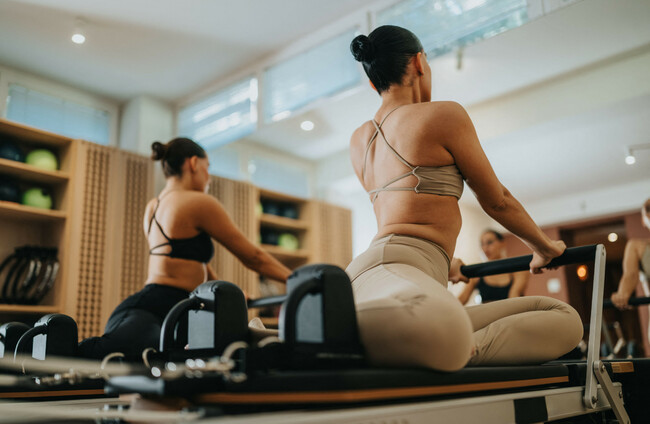
As these luxury fitness facilities have served as the backdrop of celebrity and influencer Instagram posts, their appeal has trickled down to regular people, who have been convinced that it’s normal to spend €28 on a single reformer pilates class.
That hour-long workout costs about as much as many people pay for a month’s gym membership.
To many, the cost is eye watering. But it’s justified by the ‘experience’, which is the carefully curated combination of decor, vibes, lighting and the workouts, which are spoon-fed to gym-goers by expert trainers. It’s no longer just a physique that is aspirational, but the entire setting.
Experiential gyms are popping up all over the capital city, with inventive add-ons that get their customers to spend even more money once they’re inside the building.
South Dublin’s Perpetua Fitness offers branded merch (which is notably absent from the offering of budget gyms like Flyefit and BD). Perpetua’s Irish founders have solidified their luxury credentials by providing services to 50 Cent and even Superman (by which, I mean Henry Cavill).
Los Angeles fitness studio Barry’s is a relatively new entrant to the Irish market. Its studios across the US include ‘Fuel Bars’ which serve low-calorie, high-protein smoothies and shakes.
Its changing rooms are adorned with Dyson hairdryers and digital lockers that aim to seamlessly take its members from “a sweat session to a board meeting” – underscoring that these gyms aren’t selling exercise, but rather, the idea of the important person that you become when you step inside.
South William Street’s Saint Studios, which has been used by singer Tate McRae, goes down a similar route.
In addition to offering pricy reformer pilates classes, it offers “premium amenities” like luxury changing rooms, working space, ceremonial matchas and protein smoothies. Laden with ingredients like creatine, collagen and spirulina, they’re served in branded cups that allow you to advertise your lifestyle to others, long after you’ve left the studio.
Even deeper down this rabbit hole, you’ll find Eden One, which offers “soirées celebrating art, culture and gastronomy” at events designed to “inspire and connect”. The gym also has a cocktail menu and an “elegant” dinner menu, as well as events facilitated by brands like Lululemon.
With the increased opportunity to commodify the workout experience, we’re seeing the mid-range gyms take this approach.
Everlast, a recently-opened mega-gym in the former site of Henry Street’s Debenhams, sits atop floors and floors of athletics equipment and sports brands in the new flagship Sports Direct.
Memberships for this gym are steeper than those you’ll find at budget gyms, and while the facility has an impressive list of amenities, many of them (like reformer pilates, saunas and icebaths) are paid add-ons.
The Point Square’s new UFC gym also features a retail shop, a café and a premium membership tier, which includes access to fancy red light therapy, infrared saunas and cryo-therapy.
Across the entire fitness market right now, the evolution of products and services seems to point to some new pathology among the general public. Perhaps it’s social media and the fact that a workout that’s not posted online, is a workout that’s wasted (see: Strava).
For some, a €30 class might be worthwhile if you get a nice selfie at the end. Yet, it feels like an oversimplification to pin this on vanity.
I don’t mean to be disparaging towards individuals who buy into all of this, because really, there’s an underlying cultural shift compelling regular people to try and match the lifestyles of movie stars and wealthy influencers, on the average person’s salary.
But, don’t forget where you came from. There’s something to be said for a few sets of leg curls in an industrial estate followed by a supermarket’s own-brand protein shake.
Kelly Earley is a writer and podcaster from Coolock, who has a deep interest in culture, technology, community and social justice. She writes for The Journal every week.
To embed this post, copy the code below on your site















have your say