Sign in. It’s quick, free and it’s up to you.
An account is an optional way to support the work we do. Find out more.
Sign in. It’s quick, free and it’s up to you.
An account is an optional way to support the work we do. Find out more.
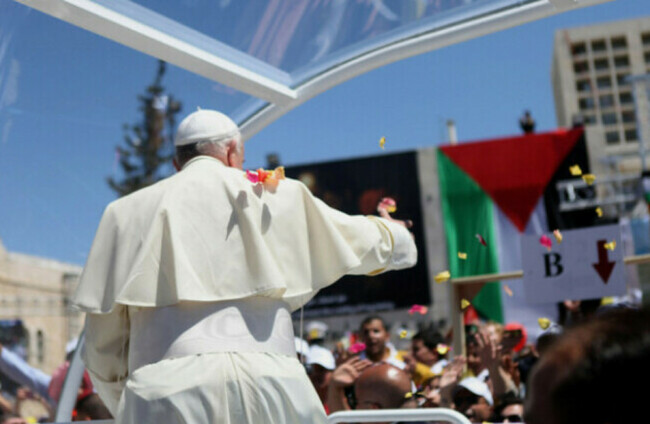
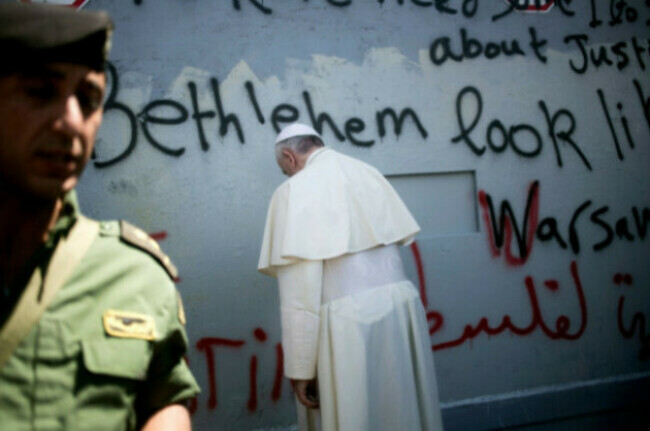
DURING A GENERAL audience in January 2025, the late Pope Francis described how he called the only Catholic parish in Gaza daily.
He started calling just two days after the bombing of Gaza began on 9 October 2023 and remained in daily contact until his passing.
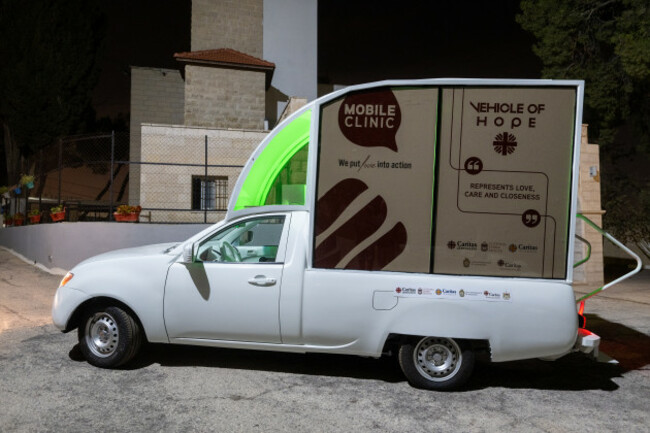
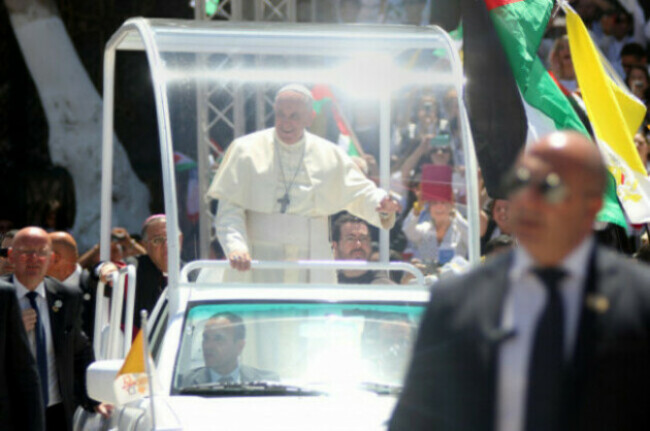
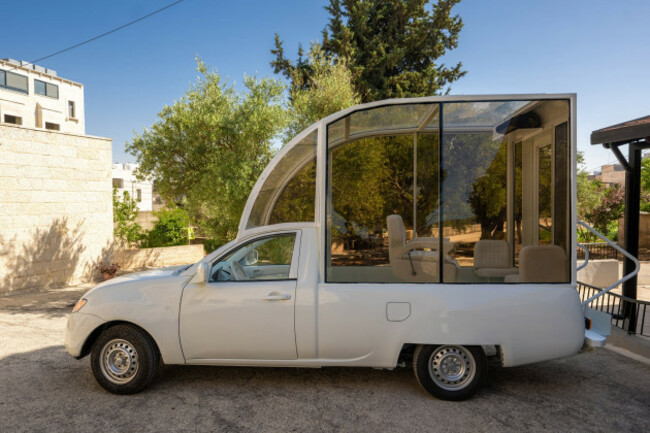
Less than a month after his death on 21 April last, it was revealed that Francis had given his blessing for a Popemobile he used for a 2014 papal journey to the Middle East to be converted into a mobile health clinic for the children of Gaza.
The so-called ‘vehicle of hope’ would be able to treat around 200 children a day.
“It’s very important to remember that it’s not only a gimmick, it’s a serious initiative that is needed,” remarked Peter Brune, the secretary general of Catholic aid organisation Caritas Sweden.
It was the bishop of Stockholm, Cardinal Anders Arborelius, who suggested the idea to Francis. “It’s a beautiful idea, go for it,” was the reply from the late pontiff.
But a year on from Francis’s death, the vehicle of hope has not yet entered Gaza, despite being ready for many months.
It lies parked a few miles from Gaza, awaiting permission to enter despite repeated pleas.
Brune told The Journal: “People all over the world are asking, ‘why isn’t the vehicle of hope being let into Gaza?
“The reason is quite simple – the Israelis are not giving us the permission for it.
“It’s very frustrating but it also gives us an opportunity to highlight that the situation is really getting worse again in Gaza for the affected children.”

A source said it is hoped that Israel might soon think it better to allow the vehicle to enter Gaza, than to have a “constant reminder that Israel is not granting it permission”.
The source added that the recent public spat between US president Donald Trump and Pope Leo might also offer an incentive for the US to allow access.
The thinking is that the US intervening to grant the vehicle access would go some way to “getting credit from the Catholic community worldwide”.
The vehicle used to carry the late Pope Francis on his 2014 visit to the Holy Land has been converted into a clinic. The former Popemobile is designed to treat children in Gaza, but it’s not clear if Israeli authorities will allow it into the enclave. pic.twitter.com/smlWxktKQ7
— Al Jazeera English (@AJEnglish) November 27, 2025
The vehicle will have a doctor, nurse and driver on board providing a range of services such as administering vaccinations and medical treatment.
“There will be a queue,” said Brune.
“Apparently, word of the initiative has spread in Gaza and in that sense, it really also is a symbol of hope, a vehicle of hope, which means a lot to people in their distress.”
Brune added that Caritas is “well-known and well-respected” on the ground in Gaza and noted that it has lost staff to the conflict.
“They’re really focused on their work,” said Brune, “and they don’t even have time to think about the dire situation they’re going through.”
“The children of Gaza have their right to proper medical care, and the world is watching.”
Caritas has around 130 staff on the ground in Gaza but a source said getting aid into the region often “depends on the mood of the Israeli person in charge”.
Caritas is one of 37 aid groups that were banned by Israel from operating in Gaza.
However, Caritas joined with other aid groups to appeal the decision to Israel’s Supreme Court.
Medecins Sans Frontieres (MSF) is among these 37 organisations and last week warned that “while the intensity of the conflict has decreased, the reality in Gaza remains catastrophic”, with Israel “deliberately obstructing aid.”
Israel’s Supreme Court decided to freeze this ban until it reaches a final decision.
It’s understood that Caritas has also lodged its own appeal, arguing that the ban shouldn’t apply to it because it is a religious entity rather than an NGO.
Swedish Cardinal Anders Arborelius presented the initiative to Francis and last November, he travelled to Bethlehem to inaugurate the vehicle of hope.
“In the town where Christ was born, where God chose not to remain distant from human suffering but to enter it, we blessed a modest instrument of healing,” Arborelius said in a statement today to coincide with Francis’s first anniversary.
“Since then, the vehicle has not moved. It remains parked near Manger Square, only a few miles from Gaza, waiting for permission to enter. Despite repeated appeals, access continues to be denied.”
Arborelius said he met children from Gaza during his visit last November and that their “bodies and faces bore the marks of war: injury, fear, loss, and despair”.
In his statement today, he said: “This initiative is not political. It is not a provocation. It is an act of mercy.
“And mercy is never something small. In a world formed by power, fear, and calculation, mercy is one of the clearest signs that we have not given up on our humanity.
“In Gaza today, children face not only violence, but the collapse of basic health care.
“In such circumstances, even a small mobile clinic can become a lifeline.”
He added that “humanitarian aid must never be made subject to political calculation”.
“To deny medical care to children is to cross a moral line that should disturb us all.”
“The mobile clinic is ready, together with a close to a dozen other mobile clinics. Medical teams stand prepared. Only permission is lacking.”
Arborelius added: “History will judge us by how we respond to the suffering of children in Gaza and elsewhere.
“But before history judges us, we must answer to something deeper: the call of conscience, and for believers the call of God, who asks whether we were able to recognise the dignity of every human life when it was most wounded and most defenceless.
“Sometimes that call asks very little of us. Sometimes it asks us simply to let a vehicle pass.”

To embed this post, copy the code below on your site













have your say