Sign in. It’s quick, free and it’s up to you.
An account is an optional way to support the work we do. Find out more.
Sign in. It’s quick, free and it’s up to you.
An account is an optional way to support the work we do. Find out more.


This article is part of a six-day series exploring the realities of life inside the West Bank, from a reporting trip carried out by Eimer McAuley, news correspondent with The Journal, in the week between Ireland’s two football matches with Israel.
JUST NORTHWEST OF Jerusalem, the small Palestinian village of Nabi Samwil is home to more than 400 people who are living in limbo.
Jerusalem is the nearest centre for employment and hospital care, yet most residents cannot travel there. A gate blocks the path towards the city, topped with barbed wire.
Although Nabi Samwil lies in the occupied West Bank, its residents are also cut off from much of the surrounding territory by checkpoints and movement restrictions.
Before the 1967 war, more than 1,000 people lived in the village. Most fled during the fighting. After Israel occupied the West Bank, the Israeli military demolished Nabi Samwil’s historic centre in a single day. The remaining residents were displaced to a nearby area, where around 400 people live today.
In 1995, Israeli authorities designated 350 hectares as Samuel National Park, encompassing the village and its historic mosque. According to Human Rights Watch, the designation has made it difficult for Palestinian landowners to obtain building permits.
Israeli settlements have expanded around the village in almost every direction. In recent years, access has become increasingly restricted. Since September 2025, residents have had to obtain individual identification cards and permits to travel in and out of the surrounding West Bank.
For the new principal of the local primary school, a Jerusalem resident who started the job just a month ago, the difficulties of reaching the village came as a shock.
“We have 15 teachers here, and only two are from the locality. Those coming from Ramallah and elsewhere have to get up at 5am to arrive for an 8am shift, despite it being a short drive. The journey home can take even longer,” she says.
“I’ve taught in Jerusalem before, but Nabi Samwil is a different story.”
The school follows the Palestinian curriculum, but the principal says restrictions on teaching it in East Jerusalem have created additional difficulties for staff travelling through checkpoints. Teachers have developed a protocol for concealing schoolbooks in their cars to get them through.
“Symbols of national identity are not allowed. Anything that stands for Palestine can be perceived as anti-Israel.
When we sing the national anthem in the morning, for instance, we wonder: should we do that or not?
The restrictions on Nabi Samwil’s residents are not always visible to visitors. One consequence, however, is impossible to miss: rubbish litters the village.
Sanitation services from the West Bank are permitted to enter only twice a month, an improvement on the previous allowance of once a month.
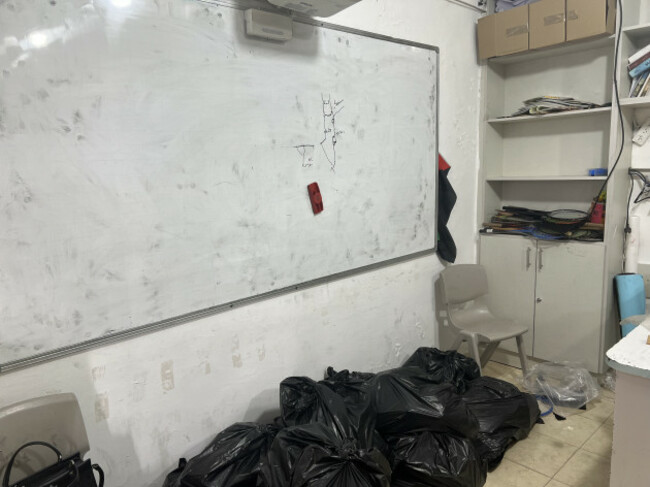
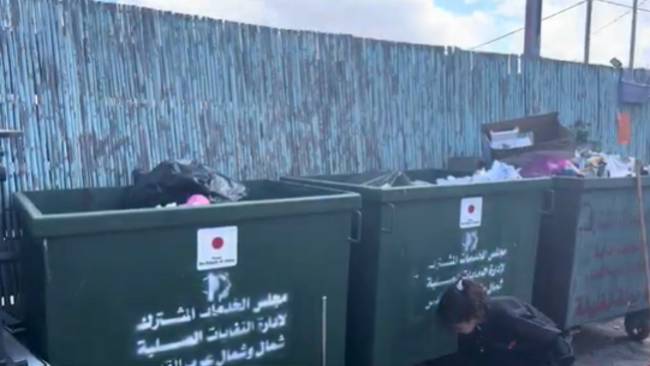
As a result, rubbish accumulates along the streets and creates particular problems for the school, whose staff are instructed by Israeli authorities to keep waste within the school grounds.
During lessons, pupils can be seen carrying small classroom bins to dumpsters in the play area. The dumpsters themselves were donated by the Japanese government. Yet black rubbish bags still line the classrooms where the school’s 82 pupils learn each day.
“It’s not nice for the pupils. We have wasps everywhere and problems with pests,” the principal says.
A local council member says Israeli authorities proposed that villagers pay for workers from a nearby settlement to collect rubbish more frequently. The offer was rejected.
“They deny us access to our own sanitation services and then tell us we can pay to access theirs. Can you imagine anyone agreeing to that?” he asks.
He says entering and leaving the village has also become increasingly difficult. His own sister, who moved away after getting married, can no longer visit because she does not have an access permit.
“Some people who have become desperate for work have travelled to Jerusalem to try to earn money. When they have been caught, they have been fined and, in some cases, jailed. Six people have also been banned from travelling to the West Bank, so they are stuck here,” he says.
Now the village faces another threat. This year, the Israeli Civil Administration, under Finance Minister Bezalel Smotrich, issued an acquisition order covering Nabi Samwil’s mosque complex and 28 acres of surrounding land, including access routes to and from the village.
The order marks an unprecedented step, according to critics, because it encompasses a Muslim religious site administered as a waqf, or Islamic religious endowment. It comes amid growing concern among Palestinians over calls by Temple Mount activists to destroy Al-Aqsa Mosque, one of Islam’s holiest sites.
Authorities justified the order on grounds of “public benefit”, citing plans for archaeological work around the tomb of the Prophet Samuel.
Peace Now, an Israeli non-profit organisation that opposes settlement expansion, is one group which described the land acquisition as “unprecedented”.
“The Civil Administration has moved on to taking control of heritage sites and is now appropriating religious sites, creating tension in some of the most peaceful and sensitive places in the West Bank,” a spokesperson said when the order was issued.
For villagers, the consequences extend beyond the mosque itself. The order has cut them off from a vital local spring and neighbouring Palestinian farmland.
Residents can still pray at the mosque, although access was temporarily blocked earlier this year. The order has also brought further restrictions on movement into and out of the area.
At the village school, meanwhile, the youngest pupils are only beginning to understand the constraints shaping their lives.
“They don’t go on school trips. In the past, they occasionally travelled to other parts of the West Bank, but that has become more difficult. They all say they would like to visit Al-Aqsa Mosque, but that is the dream of many West Bankers,” the principal says.
For Nabi Samwil’s children, even a school trip or a visit to one of Islam’s holiest sites can feel out of reach. In a village hemmed in by checkpoints and restrictions, the simplest journeys have become aspirations.

To embed this post, copy the code below on your site










have your say