Sign in. It’s quick, free and it’s up to you.
An account is an optional way to support the work we do. Find out more.
Sign in. It’s quick, free and it’s up to you.
An account is an optional way to support the work we do. Find out more.

THE GENERAL IN charge of the NATO strategy to protect critical undersea cables and pipelines has said that the military alliance believes Russia has mapped the infrastructure off the coast of Ireland.
General Hans-Werner Wiermann – head of Critical Undersea Infrastructure Co-ordination – spoke to The Journal at NATO’s Headquarters in Brussels.
Wiermann said the cables and pipelines were high on the agenda in security meetings within the EU and at NATO.
He also outlined new plans to open a control and command centre at Northwood in the UK to monitor, in real time, threats and attacks on undersea infrastructure off the coast of Europe.
Ireland’s undersea cables and pipelines include two natural gas interconnectors that connect Ireland to a supply hub in Scotland. In addition, there is an electricity cable running between the Welsh and Irish coasts.
There are also several undersea internet cables on the west coast of Ireland.
Wiermann believes that the most likely location for any attack on cables would be in shallow waters – like those found in the Atlantic within the Irish Exclusive Economic Zone.
The German General said that NATO has increased the number of ships patrolling the seas above the cables and pipelines, and this will now begin to be managed by the new centre.
He said that NATO, in conjunction with the European Union, were examining the risk to the cables off the Irish coast.
“And I wouldn’t be surprised if the problem of the cables reaching Ireland in very shallow waters would not be a significant portion of the debate currently being held at NATO and at the European Union.
“And through our close contacts with the European Union, we are looking at [the] problem as well,” he said.
In recent months Russian ships were monitored by the Irish Air Corps and naval service off the Irish coast. Sources have confirmed that NATO vessels and aircraft were also watching the ships.
Wiermann said that NATO has confirmed that Russian ships had carried out extensive mapping of undersea cabling and pipelines in seas around Europe and he said that it was a “fair assumption” that they had mapped those in Irish controlled waters.
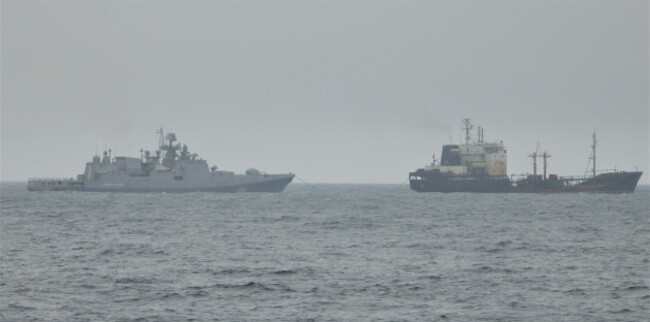
Wiermann said that Ireland’s responsibility was to ensure security within the 12 nautical miles of territorial waters off the coast but said that NATO were conducting operations above the infrastructure outside that area on the “high seas”.
When asked if NATO would consider operations off the Irish coast to protect the cables without involving Ireland he said that was a possibility.
“I talked in more general terms about the international waters and the high seas. And of course, to the west of Ireland, is high seas.
“There needs to be a risk assessment. So what is coming in to Ireland? How does it affect our societies? How does that affect our military operations?
“And of course, we may come to the conclusion that the one or another cable may be of significant importance to what NATO does and what people in NATO and allies do.”
“So I wouldn’t exclude that,” he said, referring to the possibility of NATO operations to protect the infrastructure – noting that his observation applied to every cable or pipeline “that is in international waters and high seas”.
Wiermann said that tech giants like Meta and Google had placed data cables on the seabed. He believes that such companies should consider using their substantial revenues as a way to protect the cables.
There are about 100 cable cutting incidents across the globe annually, he noted – explaining that this could, at times, be a trawler accidentally fishing above the site but adding that there was a possibility of “malign” activity.
Earlier this week Reuters reported that Dmitry Medvedev, the former Russian president who is now deputy of Russia’s Security Council said that there were “no constraints” left to prevent Putin’s regime from blowing up communication cables.
It is understood that the Irish Government has been considering joining a NATO project to protect such infrastructure.
Ireland is a member of the NATO-led Partnership for Peace, which enables non-NATO members to co-operate with the alliance on specific projects.

To embed this post, copy the code below on your site














have your say