Sign in. It’s quick, free and it’s up to you.
An account is an optional way to support the work we do. Find out more.
Sign in. It’s quick, free and it’s up to you.
An account is an optional way to support the work we do. Find out more.

In Calling 353, a brand-new series for The Journal, bestselling Motherfoclóir author and podcaster Darach Ó Séaghdha casts a linguistic eye on how we talk about what it means to be Irish, the signs we post to each other about Irishness – and what really lies beneath it all.
YOU MAY HAVE noticed a phrase “parish pump politics” getting bandied about in recent months, possibly in relation to fuel price protests or the interests of an independent politician or two. You may have seen this in print a few times over the years and wondered if this is a particularly Irish phenomenon or expression. But have you ever actually stopped to ask what exactly a parish pump is?
I have.
First things first; although some locally-focused independent politicians may own petrol stations, a parish pump is not a petrol pump.
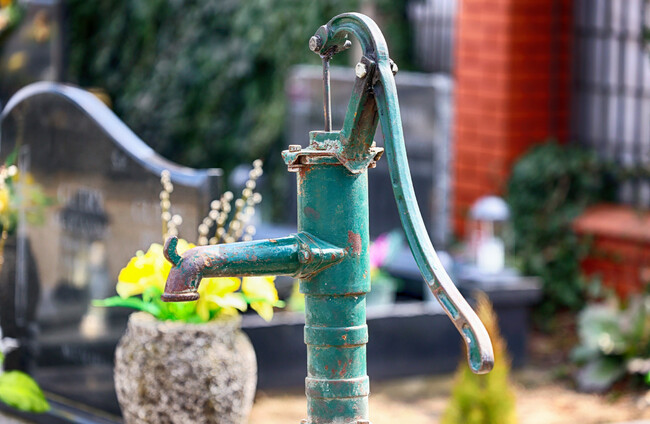
That is just a coincidence, because a parish pump is a water pump.
In the days before running water in homes, a visit to a well or water pump was required and if you lived outside a large town, there might only be one water pump per parish. Because everyone wants water, a water pump was a natural meeting point where gossip could be exchanged and notices could be posted. And it is this idea of the parish pump as a fountain (sorry) of local information from which the other meanings flow.
A parish pump could serve as a soapbox for political candidates, as well as a place where election topics might be discussed. And as the repair of the parish pump could be an election topic, this meaning also became associated with the term, muddying the waters (sorry) a bit. The term began over in Britain in the early nineteenth century as these facilities were constructed.
The idea of a physical space serving as a meeting point for chatty voters in key demographics isn’t limited to parish pumps, of course: we have water-cooler conversations for people who work in offices together but don’t know each other intimately, and soccer moms in America (as well as the “school-gate mums” targeted by New Labour) who represented groups with a range of views who meet at a single place with a single purpose who could be united behind a single issue.
I was thinking about this yesterday as I, along with queue of other shoppers, were waiting for the local Re-Turn machine to be fixed and a conversation about that scheme and various other environmental policies spontaneously occurred amongst people who might not otherwise ever speak to each other.
Are Re-Turn Machine Queue politics different from Parish Pump politics?
This leads to the next implication in the phrase: that parish pump politics are trivial, or only matter to a small amount of people. As far back as the 1850s there are reports in newspapers of laughs and groans at the very mention of the parish pump, a phrase already so over-used that it had become a punchline without a joke like “chicken fillet rolls” or “the immersion” would be today.
And yet, while this mockery was ongoing, a doctor called John Snow identified a water pump on Broad Street in London as the source of a cholera outbreak in the city in 1854. This discovery was one of the most important public health breakthroughs in the nineteenth century, but apparently that water pump wasn’t a “parish pump” because it happened in Soho.
The word “parish” is the key factor here, and while the phrase “parish pump politics” originated in Britain, its use in Ireland has tilted slightly because of the different implications of parish here.
England has parish councils which are the lowest tier of local government. You might remember during lockdown, a councillor in Handforth called Jackie Weaver briefly became famous after a parish council meeting she chaired went viral. We don’t have these in Ireland, but we have the parishes of the Catholic Church, whose influence and involvement in politics at a local and national level could be described as divisive. This has added depth to the disapproving nature of the term here.
Those of you with an interest in American politics (there may still be a few left) may have noticed New York mayor Zohran Mamdani recently talking about about combining big ideas (like free childcare) with “pothole politics”.
The humble pothole has taken on a deeper significance in political discourse around the world in that it represents the kind of problem that the child who dreams of growing up to be a president or prime minister isn’t really interested in, but it is a problem that is felt every day by local voters and noticed immediately when it is fixed.
Mamdani, an outstanding communicator, has managed to connect this infamously local issue with his larger vision by undertaking to fix all the potholes, and to give regular progress updates. And this points to the last implication of parish pump politics: that the benevolence of the state is a zero-sum game and the parish needs to “win” funds which might otherwise be spent elsewhere.
Journalists, economists and politicians in Ireland will often use borrowed terms like “mom and pop stores/landlords”, “do the math”, “ball park figure” and “game changer” which don’t really fit with the way people actually speak here. But “parish pump politics” is an unusual example of a term that began elsewhere and evolved through use to fit the ways we talk about things.
Darach will be back next Sunday with more thoughts on the words that unite us.
To embed this post, copy the code below on your site













have your say