Sign in. It’s quick, free and it’s up to you.
An account is an optional way to support the work we do. Find out more.
Sign in. It’s quick, free and it’s up to you.
An account is an optional way to support the work we do. Find out more.
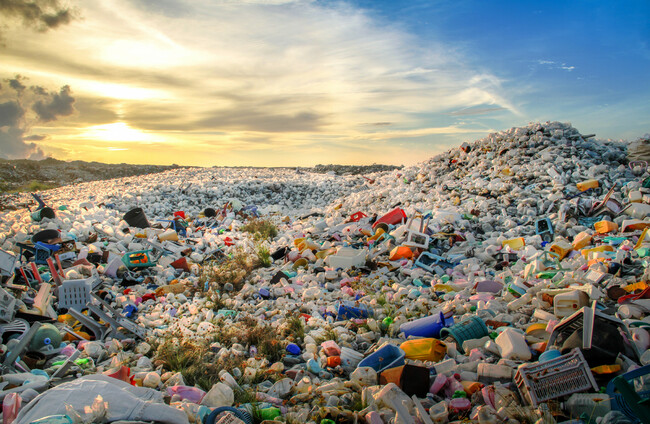
OVER 1.2 BILLION tonnes of fossil-fuel based plastic will be produced annually by 2060 according to findings released by the Organisation for Economic Co-operation and Development (OECD) today.
Plastic waste will exceed one billion tonnes if current trends continue, three times the amount from 2019.
The 38-country economic organisation also found that even under aggressive plans to cut demand for plastic, plastic production would almost double in less than 40 years.
Such globally coordinated policies, however, could hugely boost the amount of plastic waste that is recycled, from 12% to 40%.
There is increasing international alarm over how widespread plastic pollution has become.
Infiltrating the most remote and otherwise pristine regions of the planet, microplastics have been discovered inside fish in the deepest recesses of the ocean and locked inside Arctic ice.
Microplastics are plastics less than five millimetres in length which are often created when larger objects begin to break down.
They can be found in food, drinking water, air and the human body.
An report by the United Nations estimates that people consume more than 50,000 plastic particles per year, and many more if inhalation is considered.
In December 2020, microplastic particles were found in the placentas of unborn babies for the first time and a 2022 study found microplastics in 80% of 22 anonymous human blood samples.
The debris is estimated to cause the deaths of more than a million seabirds and over 100,000 marine mammals each year.
OECD secretary general, Mathias Cormann, said today: “Plastic pollution is one of the great environmental challenges of the 21st century, causing wide-ranging damage to ecosystems and human health”.
Since the 1950s, roughly 8.3 billion tonnes of plastic have been produced with more than 60% of that tossed into landfills, burned or dumped directly into rivers and oceans.
Some 460 million tonnes of plastics were used in 2019, twice as much as 20 years earlier.
The amount of plastic waste has also nearly doubled, with less than 10% of it recycled.
Based on current trends, the use of plastics is projected to roughly double in North America, Europe, and East Asia.
In other emerging and developing countries, it is expected to grow three- to five-fold, and more than six-fold in sub-Saharan Africa.
The new report also contrasts a business-as-usual trajectory with the benefits of more ambitious global policies of reduced plastic use and pollution.
Driven by economic growth and an expanding population, plastics production is set to increase under either scenario.
Currently, nearly 100 million tonnes of plastic waste is either mismanaged or allowed to leak into the environment, a figure set to double by 2060.
“Co-ordinated and ambitious global efforts can almost eliminate plastic pollution by 2060,” the report concludes.
It could also curtail the amount of planet-warming greenhouse gases projected to seep into the atmosphere.
Currently, the full life-cycle of primary plastics — from production to disintegration — contributes about two billion tonnes of CO2 or its equivalent in other gases, roughly three percent of human-caused carbon pollution.
With additional reporting by Jamie Mc Carron

To embed this post, copy the code below on your site














have your say