Sign in. It’s quick, free and it’s up to you.
An account is an optional way to support the work we do. Find out more.
Sign in. It’s quick, free and it’s up to you.
An account is an optional way to support the work we do. Find out more.

LAST UPDATE | 27 May
CANADA HAS RECENTLY projected strength and unity in response to pressure from the US. International observers may therefore be surprised to learn that the country is now facing a looming unity crisis.
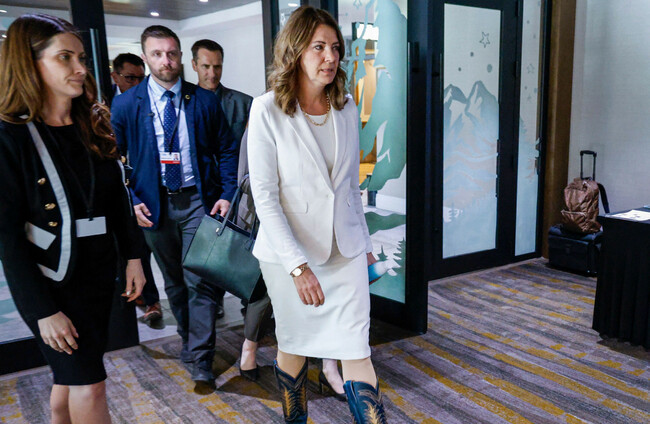
Alberta premier Danielle Smith has announced that voters will go to the polls in October on whether the province should begin the legal process toward a future referendum on leaving Canada. Smith says she wants to resolve the issue democratically.
In response, Canadian prime minister Mark Carney called the vote a ‘dangerous bluff‘ and said that the federal government would review the question to see if it triggers the Clarity Act, under which parliament can decide if a provincial referendum question is clear before it goes to voters.
Albertans will be asked to vote on 10 questions, including on immigration and access to public services. The most contentious ballot will ask whether Alberta, in western Canada, should remain a province of Canada or whether its provincial government should begin the legal process required to hold a binding referendum on separation. Another proposal being put to voters will ask if Alberta should take greater control over borders to reduce immigration levels and prioritise economic migration.
Smith herself says she would vote for Alberta to remain in Canada, but said Albertans should decide the issues directly.
But that raises a broader question increasingly facing democracies worldwide: when divisive constitutional questions arise, is asking the public directly always the democratic thing to do? The answer is more complicated than we might assume.
Tensions have long simmered between Alberta, an oil-rich and politically conservative province, and Ottawa, mainly over energy and environmental policy.
An Albertan separatist movement argues that successive federal governments have constrained Alberta’s economic interests and that the province contributes more to the rest of Canada than it receives.
Support for outright separation remains a minority position, but it has become politically significant enough that Smith has now proposed an unusual “referendum on a referendum”: voters will not decide on independence itself in the autumn vote, but on whether to begin a constitutional process that could eventually lead there. The proposal has provoked alarm from
First Nations communities, whose Treaty rights could be adversely affected by the province’s separation from Canada.
The use of referendums is hotly debated. Some see them as the purest form of democratic participation, directly engaging the voices of citizens on major questions of law and policy.
Others are much more sceptical, pointing to the risks of disinformation, polarisation and possible negative impacts on minority rights. As we grapple with the rise of generative AI and deepfake technologies, these concerns seem more acute than ever.
But comparative experience suggests that referendums are not inherently democratic or undemocratic. A great deal depends on the conditions surrounding them: the clarity of the question, the quality of public information, the role of institutions and whether citizens have meaningful opportunities to deliberate rather than simply give a “top of the head” response. The deeper question is not simply whether referendums are democratic per se, but under what conditions they can meaningfully express democratic will.
One important distinction is between voting and deliberation. A referendum should ideally form part of a broader process of citizen consultation, participation and public reasoning, rather than being treated as a single isolated moment of decision-making. Citizens can decide difficult questions, but democratic legitimacy is strengthened when they have opportunities to engage with complexity before being asked to vote.
This is one reason that citizens’ assemblies have attracted so much international attention. They create structured environments where ordinary citizens can engage with difficult questions in a slower, more informed and less adversarial way. Citizens hear from experts, advocacy groups and people with lived experience; they have space to learn, discuss, weigh competing arguments and sometimes revise their views.

The involvement of experts matters here, not because experts replace democratic decision-making, but because they help citizens understand the legal, constitutional and practical realities surrounding difficult choices. The goal is not to eliminate disagreement – reasonable people can have reasonable disagreements. Rather, it is to create conditions in which citizens can engage reflectively with complexity and choose between reasonable alternatives, rather than react immediately within highly polarised environments.
This matters particularly in cases such as Alberta, where constitutional questions do not exist in a vacuum. Any question of provincial separation will impact upon Indigenous Treaty rights and constitutional obligations, which cannot be simply voted away. Legitimacy here requires not only asking citizens what they want, but equipping citizens with knowledge of the constitutional context in which the choices sit.
Clarity around the available choices also matters. The Brexit referendum highlighted the difficulties that arise when a vote authorises a course of action (to “leave”) but leaves fundamental questions open as to what that action actually means. Similar questions arise in Alberta.
What would a binding vote to separate actually mean in practice? An independent Albertan state; integration with the US; a renegotiated relationship with the rest of Canada; or something else entirely? Democratic legitimacy requires not only that citizens have a voice, but that they have clarity on the choices available to them.
Ireland offers an instructive example, in particular the abortion referendum. The referendum in that case did not occur in isolation but took place at the conclusion of a broader reform process that combined deliberative and participatory mechanisms, including a citizens’ assembly and a referendum.
Of course, simply attaching a citizens’ assembly to a referendum process does not automatically make it democratically legitimate. Questions of design, agenda-setting and process matter too.
Ultimately, the lesson is not that citizens should be excluded from deciding difficult constitutional questions. If anything, deliberative democracy research suggests the opposite: ordinary citizens are remarkably capable of engaging seriously with complexity, provided our institutions are designed to support informed participation.
In the end, in Alberta and elsewhere, democratic legitimacy requires more than placing a question on a ballot. It requires institutions and processes that help citizens deliberate together and form reasoned judgments before asking them to decide.
Dr Seána Glennon is an Irish lawyer and a Postdoctoral Fellow at the University of Ottawa Public Law Centre.
To embed this post, copy the code below on your site














have your say