Sign in. It’s quick, free and it’s up to you.
An account is an optional way to support the work we do. Find out more.
Sign in. It’s quick, free and it’s up to you.
An account is an optional way to support the work we do. Find out more.
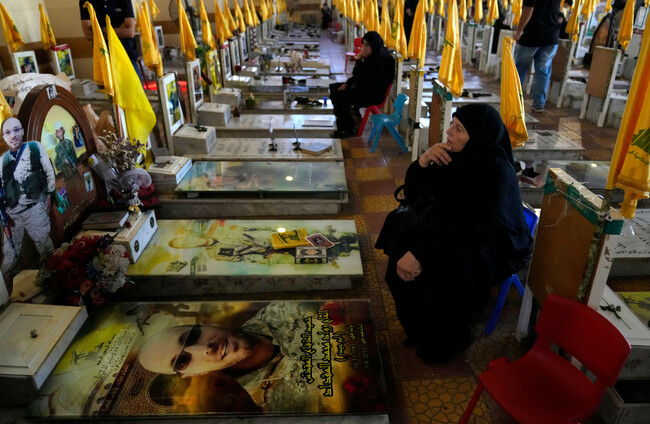

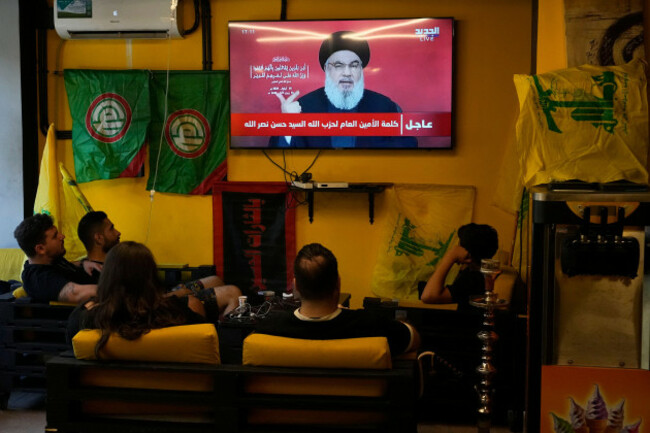
YESTERDAY I WAS in Dahiyeh in southern Beirut as men gathered in cafés in the afternoon on Thursday to watch the first speech of Hezbollah leader Hassan Nasrallah since the wave of blasts that rocked Lebanon this week.
Hezbollah members stood in vehicles at roundabouts in the neighbourhood, which is a stronghold for the paramilitary group, while nearby people gathered for a second day of funerals for victims of the blasts which killed 37 people including two children.
Minutes after Nasrallah’s speech began, Israeli jets flew low in the sky, with people in Dahiyeh walking outside to survey the sky. I heard a loud crackling sound as flares were dropped by the jets.
In his televised speech, which continued on undistributed by the jets, Nasrallah described the attacks that injured nearly 3,000 and has been widely attributed to Israel as a “hard and severe blow” that amounted to “a declaration of war.” The leader of the Iran-backed Shia paramilitary group said: “The enemy crossed all rules, laws and red lines” and that “What has happened over the last few days obviously requires us to take a stand.”
On X, Emily Hokayem, a Director for Regional Security at the International Institute for Strategic Studies, described Hezbollah as “battered by Israel” and “doubted by many in its constituency.” He suggested that an “Israeli ground campaign that will validate and energise its muqawama (resistance) ethos and sense of purpose” could help Hezbollah to rebound.
In his speech, Nasrallah reinforced Hezbollah’s alliance with Hamas in Gaza, a group which is also backed by Iran: “We say to the enemy: the Lebanese front will not stop until the war in Gaza is over! We’ve been saying this for almost 12 months. Despite all the massacres, the wounded and the sacrifices, I say this, whatever the obstacles and sacrifices, the resistance in Lebanon will not stop its support for Gaza, the West Bank and Palestine!”
Hezbollah does not have support across Lebanese society and largely draws its base from Lebanon’s Shia Muslim population. For years before the latest war began last October, international groups and Lebanese parties had called for the group to dismantle its armed wing — which many view as a destabilising force in the fragile Arab state which no longer serves a purpose in Lebanon three decades after the civil war finished.
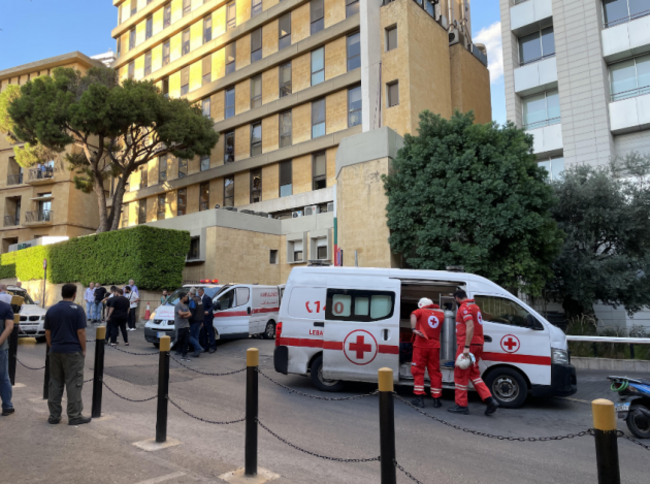
In the aftermath of this week’s attacks, ambulances ferried victims to hospitals across Beirut including in middle-class Christian neighbourhoods where Hezbollah would draw little support. Sections of Lebanese society usually quick to criticise the group have been quieter this week and many have expressed sympathy with the victims of the attack, which were largely drawn from Hezbollah’s military wing. “This is not the right time to talk politics,” said Samir Geagea, the leader of Lebanese Forces, a Christian party in Lebanon.
“The technological capabilities of this attack which are tremendous is shocking and in itself sends chills down people’s spines,” says Ronnie Chattah, a Lebanese political analyst and host of the Beirut Banyan podcast.
Lama Fakih, the Middle East and North Africa Director at Human Rights Watch said: “Customary international humanitarian law prohibits the use of booby traps – objects that civilians are likely to be attracted to or are associated with normal civilian daily use – precisely to avoid putting civilians at grave risk.”
In Beirut, Chattah says that “anytime there’s a regional war being played out in this country, emotions run high by default and especially when the Palestinian cause is attached emotions are amplified.” Fighting against Israel has provided Hezbollah with something of a “psychological victory” and their “indirect supporters” may be increasing in Lebanon who see a continued role for Hezbollah as a barrier against an Israeli invasion.
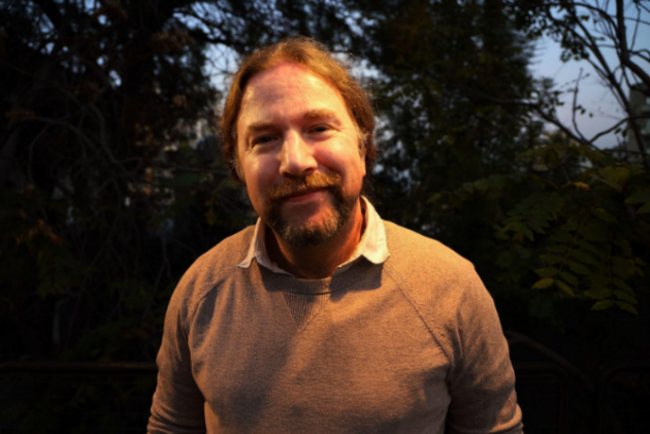
“As long as [Hezbollah are] fighting the Israelis, they’re the good guys, even when what they do over time in Lebanese affairs and Lebanese security and Lebanese politics could be detrimental, if not destructive.” But Chattah believes that support in Lebanon for the armed Islamist group will go down once this latest round of fighting with Israel ceases. In the long term, he believes there is little public appetite for Hezbollah to continue to have the ability to “initiate war when most Lebanese, if not all, were not expecting to be in one.”
In Israel, the attacks using Hezbollah wireless devices are seen as a point of pride and a targeted strike on an enemy organisation. In Jerusalem, a man handed out sweets after the military operation, while one Israeli in Tel Aviv who I spoke with described the general mood as “We are so brilliant, look at the super clever way we hit them” but said some questioned the strategic aim of the attack. Any sort of political deal or end to the fighting seems further away than ever.
Two Israeli soldiers and a civilian were killed by anti-tank missiles fired by Hezbollah into northern Israel on Thursday morning, while that night Israel struck hundreds of Hezbollah military targets in southern and eastern Lebanon in one of the most intensive bombardments since the war began last October. In Gaza, the death toll has exceeded 41,000 this month.
Today it has been reported that after months of saying a cease-fire and a hostage-release deal were close at hand, senior US officials are now privately acknowledging they don’t expect Israel and Hamas to reach an agreement before the end of President Biden’s term.
While on Wednesday, Saudi Arabia’s de facto ruler, Crown Prince Mohammed bin Salman, declared that the kingdom would not normalise diplomatic relations with Israel before the establishment of a Palestinian state — this appears to be a hardening of Saudi’s’ position on the issue, as Arab outrage over Israel’s continuing military campaign in Gaza calcified.
Sarit Zehavi, the president of Alma, an Israeli think tank focused on security and a resident of Northern Israel, says that the attacks in Lebanon gave her “hope.” She says the military operation “showed me that we can operationally damage Hezbollah like to injure almost 4000 Hezbollah military operatives.”
She says: “It was a great achievement” which inflicted damage on the “military capabilities of Hezbollah.”
But Zehavi says she’s waiting to see how the Israeli government translates the attack into a “strategic achievement” such as demanding Hezbollah and Hamas agree to a ceasefire with the release of the hostages or “maybe threatening another attack if they won’t [agree to a] ceasefire.”
Hannah McCarthy is a journalist based in Beirut.
To embed this post, copy the code below on your site











have your say