Sign in. It’s quick, free and it’s up to you.
An account is an optional way to support the work we do. Find out more.
Sign in. It’s quick, free and it’s up to you.
An account is an optional way to support the work we do. Find out more.
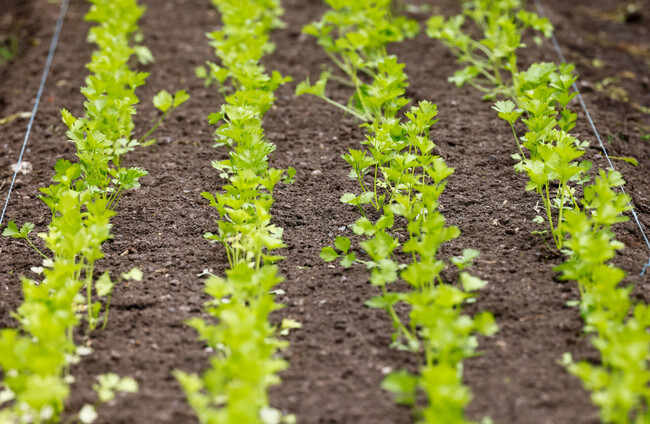

AN ACRE OF carrots pays the exact same in EU subsidies as an acre of cows, yet I find myself reading numerous analyses of our food system which would lead you to believe otherwise.
So how are livestock farms not incentivised over vegetable production, and why is it not pro-dairy government policy but market returns that crushed our horticulture sector?
In short, ever since 2004 the EU hasn’t incentivised or allowed incentives of any form of food production over another. Since then, all payments have been frozen at what farmers received in 2000-2002, a time I was more interested in Pokemon than cows. If you want to stay in the Common Market, no national government is allowed to encourage any form of agriculture over another. This means farmers have no incentive to have 10 cows or 100 instead of acres of carrots, to convert their land to forestry or grow lavender plants.
Horticulture in Ireland was once the preserve of small family farms doing most of the labour of weeding, cutting and tilling either by hand or with small machinery. I grew up hearing of legs chapped by wellies on frosty winter days pulling spuds and sore knees pulling weeds from turnips when my parents were set to work as children. These farms often supplied ultra-local supply chains, with only the richer soils of the East Coast fit to feed the growing cities and even for export.
A set of government decisions, such as repealing the Groceries Order in 2006 by our now Taoiseach Michael Martin, along with a lack of access to plant protection products available to continental competitors, have made it more difficult to compete, leaving those farms one simple choice: convert or die.
Post 2015, when the artificial restriction on milk production of ‘Milk Quota’ ended the freeze in place since 1983, I visited a number of farms which had held on in the vegetable trade. Often on the best of soils these farms were rapidly ploughing up fields normally set aside for spuds or cabbage and converting to grassland. That had nothing to do with mythical government incentives for dairy but was entirely for economic reasons. Organisations and individuals who condemn the cow for existing in place of locally produced vegetables must grapple with a simple problem: Irish consumers mostly don’t care.
Those who lament this propose numerous hair-brained schemes and incentives, but the answer is brutally simple: if we really want to return to more locally produced vegetables, pay for them. Higher retail prices in supermarkets don’t guarantee higher payments for farmers, with many producers citing issues with the companies who operate as middlemen between them and retailers.
The reality is, though long-term low prices guarantee these will push down farm gate prices, to believe otherwise is economic illiteracy. Quite simply, all other policy efforts will fail unless we implement this ‘one simple trick’ of paying farmers a fair price. That is, though quite a hard sell when the cost of living is pushing many to consider emigration, but before we really dismiss it, let’s look at what is truly driving that cost crisis.
According to official CSO data, compared to 1996, food has risen 46% in the Consumer Index, quite an increase, except for the fact that nine commodities have risen faster. The category ‘Insurance and financial services’ rose a whopping 399%, with ‘Housing, water, electricity, gas and other fuels’ rising 318%. Nor does banning the likes of ‘below cost selling’ actually mean your food shop will spiral, because ultimately supermarkets simply shift the cost of these ‘loss-leaders’ onto other products in the store.
France, for instance, has a permanent ban on below-cost sales, yet a litre of milk in France is in fact slightly cheaper, at around €1.19 vs our €1.40, while a kg of potatoes will set you back a whopping 10c more. Yet 13% of farms in France are in horticulture compared to our less than 1%.
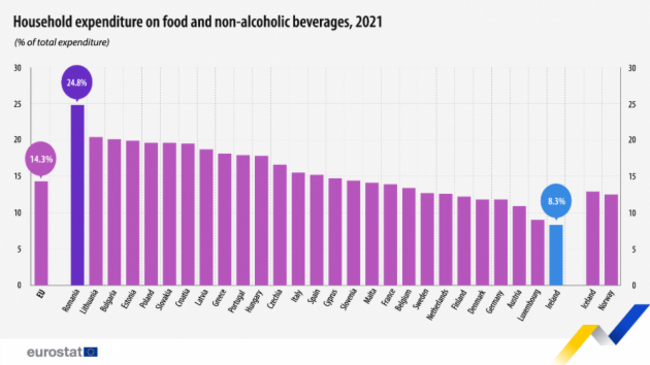
In reality, Ireland is in fact the lowest of the EU member states in spending as a percentage of income on food. While it’s the norm for poorer countries to spend a higher percentage, underspending on food compared to the famously frugal Dutch is quite an achievement.
While I wouldn’t be a member of his fan club, former US President Joe Biden summed it up well when he said: “Don’t tell me what you value, show me your budget, and I’ll tell you what you value.”
‘Food systems’ was a term devised to encapsulate more than simply the production but also the environmental impact, the human cost and labour, and the culture around its consumption. In short, Ireland’s food culture is one of quick convenience, high price pressure on primary producers and, apart from pride in butter and beef, a fairly shallow cuisine.
I doubt any Irish person needs reminding of the historic factors preventing us from developing the food culture found in continental Europe. It does speak to a culture of convenience and mass production, though, when most Irish think first of chicken fillet rolls and spice bags when pushed to give examples of ‘Irish foods’. Nor am I exempt from falling into that same category.
Most Irish consumers may believe it is simply a fact of climate that so much of their weekly vegetable shop is from Spain or Morocco, but this summer’s coverage of the brutal heatwaves and scorching fires across southern Europe and North Africa should give pause.
Consider Almeria, a region of Andalusia in southern Spain, with such a density of greenhouses it is visible from space. An incredible 40,000 hectares (98,800 acres old money or 56,000 soccer pitches) is covered in white plastic.
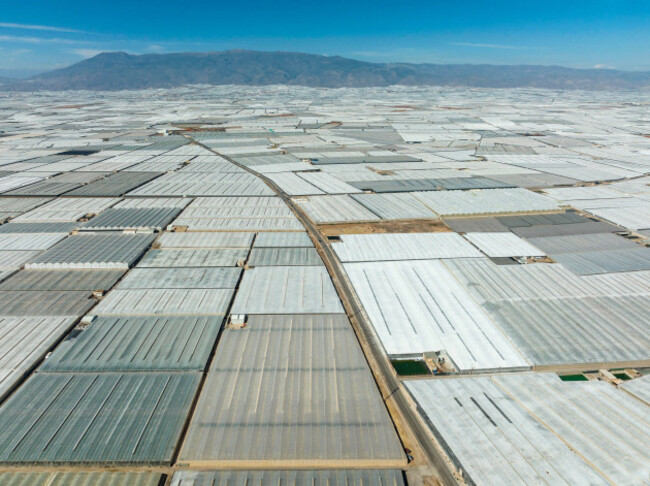
Almeria suffers extended and extreme droughts, with many parts of the region getting as little as 250mm of rain annually, approximately 1/3 of Dublin’s and 1/4 of Wexford’s – our two highest producing horticultural areas. This leaves the region heavily reliant on irrigation and severely over-exploited groundwater. Your berries from Morocco were likely similarly watered with the scarce resources. Only early this year did Moroccan authorities declare an end to their seven-year-long drought before suffering four severe heatwaves again in 2026 with the mercury hitting 50ºC.
Climate change is making this region unliveable, yet still the greenhouses expand. There is another secret that contributes to its success. Beneath that white plastic, human rights abuses are rampant. Estimates suggest as many as 30,000 undocumented migrants work in Almeria. Across all of Spain, 250,000 migrants work legally but as many again are estimated to be working illegally, in brutal conditions. They live in shanty towns, routinely working illegally long shifts below minimum wage, doing backbreaking labour of picking, processing and packaging fruits and vegetables that ultimately land on Irish tables. A thriving economy of exploitation, human trafficking and organised crime ensures more human labour is always available.
Abuses are not unheard of, sadly, in our own agricultural sector, especially in aquaculture and processing, but this scale of human exploitation is hard for Irish farmers to get their heads around. The journey of our food system from Irish children suffering chilblains to this is as shameful as it is underreported.
In a former life, I remember the confusion amongst farm representatives at the last-minute inclusion by the Parliament of conditions on EU subsidies to workers’ protections. Department officials here saw it as unnecessary complications; many MEPs however, saw it as a way to finally address one of European food’s darkest elements, the human sweat and suffering on every grocery shelf.
Blaming an Irish farmer for ploughing up unprofitable rows of onions to replant with grass in the hopes of seeing a next generation on their farm misses this point in the most convenient way. A way that avoids us asking ourselves a simpler but far harder question of whether we ultimately get the food system we pay for.
Thomas Duffy farms in partnership with his parents and sister in Co. Cavan. He is the former President of Macra na Feirme and former Vice President of CEJA, the Council of European Young Farmers.
To embed this post, copy the code below on your site















have your say